
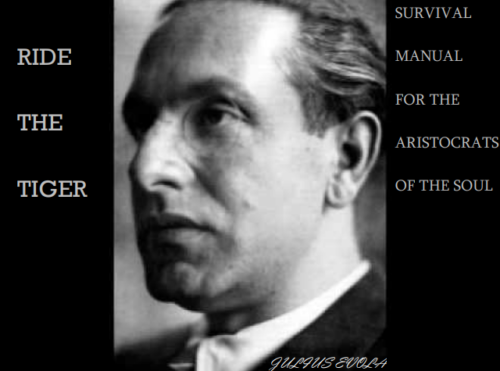
VJMP Reads: Julius Evola’s Ride the Tiger I

Having chosen a left-wing work (The Interregnum) for our previous reading, we now go to the right again and have a look at Julius Evola’s Ride the Tiger. Subtitled “A Survival Manual for the Aristocrats of the Soul”, it’s based on the premise that the fight against modernity has been lost and the only thing a thinking man can do is ride the tiger of modernity until it’s time to rebuild on the other side.

Part I of the eight parts of this book is called “Orientations” and divides into two essays.

The first of these is called ‘The Modern World and Traditional Man’. This opens outright with a declaration that this text isn’t for everyone. Like The Satanic Bible, Evola is explicit in that his book is only for a particular kind of person. Ride the Tiger is written for the outsider.

Evola’s style seems timeless in the sense that his complaints about the nature of society apply just as well to 2018 as they did to his time, and probably apply well to many times in the past. Things are collapsing, certainly in social terms if not yet physical ones, and so Evola advocates a return to traditional values.

These traditional values are not bourgeoisie ones, Evola is at pains to point out, but in fact “the very antithesis of them.” Indeed, he hints at evoking the perennial philosophy, such as when he writes “It is good to sever every link with all that which is destined sooner or later to collapse. The problem will then be to maintain one’s essential direction without leaning οn any given or transmitted form.”

Psychonauts such as the readership of VJM Publishing will commiserate with this feeling, as it’s a handy description of the ego death experience that comes with the peak of a psychedelic trip. One loses all touch with and memory of the fleeting forms of energy that make up the material world, and resides solely in pure consciousness, and thereby reunites with God.

Fittingly, then, Evola states that the Tradition that inspires him has “the character of an esoteric doctrine.”

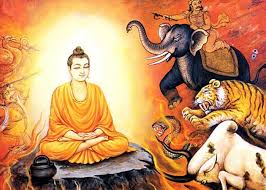
The second essay, ‘The End of a Cycle – “Ride the Tiger”‘, continues in the same vein. Evola explains that the expression “to ride the tiger” is from the Far East and refers to the idea that it’s safer to ride on the tiger’s back than to try and flee and get pounced on, for the tiger will eventually tire out and then one can make an escape.

Essentially, the idea expressed here is this: great and terrible changes are sweeping the world, and will continue to do so. They will destroy much, if not all, of the existing order, regardless of whether this order is good or bad. There is no hope of resisting this process.

All of this sounds terribly pessimistic and nihilistic on the surface, but it’s clear that, like Nietzsche before him, Evola has anticipated the nihilism that follows the destruction of the incumbent value system, and is speaking of what must come beyond that. He writes of the “Four Ages” system famililar to readers of Plato’s Republic as well as to Hindus.

The warning of this chapter is that the forces of destruction and degeneracy are too powerful to be overcome; resisting them is as futile as resisting the tide. But in this there is still a message of hope: those destructive forces are too mindless, stupid and disorderly to hold sway for very long and so, like the storm, they will pass, and leave an opportunity to rebuild order in their wake.

And so, Evola mocks the “progressive” and “advanced” thinking of the West as little more than symptoms of a disease of the soul. This is apparently the context in which the book ought to be read.

The object of the book is summed up in the final paragraph of this essay: “defining the attitude to be taken toward certain experiences and processes of today”. In other words, how do we deal with the fact that everything’s falling to bits?

*

If you enjoyed reading this essay, you can get a compilation of the Best VJMP Essays and Articles of 2017 from Amazon for Kindle or Amazon for CreateSpace (for international readers), or TradeMe (for Kiwis).

The Political Paradox at the Heart of Cyberpunk

Science fiction has generally been considered a left-wing preoccupation. Not only is the readership of science fiction stories younger than average, but the nature of science fiction lends itself towards progressivism. Female characters such as Lieutenant Ripley of Alien had great appeal among the generation that had cast off the moral strictures of the 1950s, but a right-wing yang has always existed within the dark yin of the milieu.

The political atmosphere of science fiction reflects an old-school leftism that’s almost entirely different to the identity politics of the social justice warriors who dominate the media of today. The leftism of science fiction was always more libertarian than today’s culture would prefer, and was written without the need to shoehorn a moral lecture into the story.

Philip K Dick wrote his science fiction works, to a large extent, out of inspiration drawn from his hatred of authoritarianism and authoritarian systems. This is why his protagonists, like Bob Childan in Man in The High Castle, were usually everymen who lacked any aristocratic pretenses. Joe Haldeman’s The Forever War depicted a future world in which hedonistic homosexuality was standard practice and a kind of communism had taken over the resource distribution of the planet.

Realistically, it’s hard to imagine a high-tech society that hadn’t also managed to solve the vast majority of its social problems, for the simple reason that if a society has the resources to be high-tech it also has the resources to feed, clothe and house everyone. The essence of cyberpunk, however, is “high tech, low life”; Brave New World is not cyberpunk, and neither is 1984, for the reasons that these works deal with heroic and upstanding characters.

This essence lends itself to a conservative orientation for two reasons.

The first is that it suggests that “the more things change, the more they stay the same,” which is a deeply conservative sentiment. It’s a break with the easy utopias envisioned in atomic era works like Alfred Bester’s The Demolished Man or Aldous Huxley’s The Island. These works portray future societies which, although they have their problems, have generally solved all the major survival challenges (although The Demolished Man has a cyberpunk vibe in that the protagonist is also the antagonist).

In cyberpunk, by contrast, it’s common that society has either collapsed or become dystopic. The America of Neal Stephenson’s Snow Crash has disintegrated into a patchwork of city states, fiefdoms, armed enclaves and chaos zones, which goes against the common narrative of an easy ascent into becoming a space-faring civilisation common to most earlier science fiction.

Likewise in William Gibson’s Bridge trilogy, where society has rotted out from the inside, meaning that people have been forced to take on a hard edge to their personality and behaviour in order to survive. In Gibson’s stories, crime exists for the same reasons it exists in our own world; greed, fear, stupidity and cruelty cast their shadows on every chapter.

This is a conservative sentiment because it directly opposes the common leftist belief that it’s possible to build a utopia. Cyberpunk works warn us of the terrible possibilities that are likely to result from attempts to build a perfect world – Akira could be considered the modern Frankenstein.

The second reason is that “high tech, low life” reflects a cynical interpretation of human nature. The protagonist of the Altered Carbon series, Lieutenant Kovacs, never gets fooled or manipulated on account of automatically assuming the worst of everyone he encounters. He is particularly cynical, verging on paranoid, and this quality serves him well as it keeps him one step ahead of the criminals trying to kill him. Cyberpunk heroes are often like this – more antihero than good old boy.

Much like the first reason, this low-life element of cyberpunk reminds us that ideas of utopias are just dreams. Life finds a way, and so does crime. This is essentially conservative because it asserts that human nature cannot fundamentally be changed.

Humans have not been intrinsically good at any point in the past, and so there’s no reason to think they should be in the future. Therefore, we can assume that humans (especially young men) will aggressively push the boundaries just as much in times to come. As is the case today, these people will often go too far in asserting their wills, and this can lead to reprisals, and thereby the whole dark side of the human drama that cyberpunk is known for.

It is not the contention of this essay that this paradox detracts from the power of cyberpunk media. To the contrary, cyberpunk draws its power from the tension inherent in the juxtaposition between the desire for order and the desire for freedom.

Many of the protagonists in cyberpunk stories just want to be left alone to enjoy their lives, but violence and trouble finds them anyway, and they have to learn to become hard in order to cope. The protagonist of Metrophage is an everyman who could have been a protagonist in a Philip K Dick story, but instead of the mind-bending confusion of a PKD story he gets dragged into the noir of a cyberpunk one.

This sentiment of escaping an oppressive, totalitarian force is also a common sentiment for many intelligent, free-thinking people nowadays, who just want to be left alone to experiment with consciousness in the form of psychoactive substances without being attacked by law enforcement officers.

In this balance, cyberpunk appeals to a more intelligent kind of reader. The resolution of the cyberpunk paradox might be found in that punk is an expression of rebellion against those same human forces that create political dystopias and faceless corporate juggernauts. In this rebellion it is an affirmation of the human spirit, more libertarian than either left of right, and this is perhaps where cyberpunk gets most of its appeal.

*

Vince McLeod is the author of ANZAC cyberpunk work The Verity Key. If you enjoyed reading this essay, you can get a compilation of his and other VJMP essays in the Best VJMP Essays and Articles of 2017 from Amazon for Kindle or Amazon for CreateSpace (for international readers), or TradeMe (for Kiwis).
The Yin-Yang of History

Traditionally speaking, when men like this start appearing among your youth, it’s the beginning of the end

The postwar period was a good one for the West. The major Anglo powers had seen all the challengers and potential challengers to their world hegemony bombed flat – partially by them, mostly by each other. With Nazism and Communism both falling to their knees, the liberal democratic order ushered in some good times for the people of the world. Peace and prosperity reigned… but the yin-yang of history tells us that nothing lasts.

The 1990s might be seen, from the vantagepoint of history, as the apogee of these good times. The Soviet Union had fallen, and China and India were yet to rise. Those of us who knew the course of history, however, knew this: good times create weak men. Weak mean create hard times. Hard times create strong men. Strong men create good times.

This is the yin-yang of history.

Good times are the equivalent of summer. Here, people don’t have to think very hard about how to survive and thrive. In the same way that it’s warm and sunny in summertime and so people don’t have to think very hard about what clothing to put on before they go outside, political conditions are favourable in the sense that the ruling class doesn’t have to think very hard about security without and solidarity within.

In the summertime of history, wealth abounds from the increased energy in the atmosphere. To most, these good times seem like they’re going to last forever. The more perceptive of people, however, even if they don’t know about the yin-yang of history, can often see the signs of collapse coming in advance.

The problem with good times, as Plato observed in The Republic, is that they create weak men. When times are good, the tendency is to let minor infractions slide, and although this can lead to an atmosphere of joy it also leads to indiscipline. This indiscipline is why the weak men are weak, and it’s this indiscipline that leads to the hard times.

It might be argued that this is the stage that the West finds itself in 2018 A.D. Our Baby Boomer leaders, who were raised with all the laxness of a generation that had got its fill of violence in World War II and had decided to bring up the Boomers with as little harshness as possible, clearly do not possess the mental discipline to educate themselves properly about the matters of the world.

In our age, it’s entirely possible to find a Western minister or higher who doesn’t know the basics about history or science. There is ample opportunity to learn about such things, of course, but our leaders would rather drink alcohol and watch television. Some, like the Belgian Minister of Health, have lost control of their weight entirely.

These weak men cast a shadow on their nations: the same as the shadows of autumn, who they represent. Their enemies observe this absence of intellectual power, and they move to take advantage.

Because the leaders have no discipline to educate themselves properly, they don’t understand what’s really happening in the world. This results in decisions getting made on the basis of how things used to be a long time ago (but no longer are), or how things might be in some idealised future world (instead of how they now are).

These poor decisions lead naturally to hard times. This stage in the cycle of history corresponds to the wintertime. Leaders lead the people in the wrong direction, causing them to dissipate their energies on follies or to spill them on battlefields for no reward. Here there is poverty – in fact, there is never enough of anything, and people learn to live with want.

Hard times can lead to bitterness, but in the same way that the bitterest cold of winter leads to a hardening in the form of ice, so too do the bitterest lows of life lead to a hardening of the heart. These hard men do not, at first, bode well for the people who they live among. To the contrary – the pitiless, ruthless nature of hard men make them natural criminals and killers.

But the hardness of hard men leads to discipline in those who come after them. This discipline – true iron discipline – is a matter of Will and therefore it is ultimately generated from within. These disciplined men are the opposite of the men we have in 2018 A.D. These disciplined men impose order upon their minds by devoting themselves to the correct course of study and behaviour.

Disciplined people who study hard represent the springtime of a people. It is for these people that VJM Publishing exists. These are the people who will rise up and make good decisions. They will come to occupy positions of leadership not because their backers paid for the best advertising, but because they are asked by their peers to occupy these positions on the basis of demonstrated wisdom.

Because of this wisdom, these leaders are not afraid to shy away from the knowledge necessary to make the correct decisions. This leads to increasing wealth and prosperity. So when the men of gold are recognised as such and are placed into positions of leadership on account of this, then the people will enter another golden age, or another age of summer.

*

If you enjoyed reading this essay, you can get a compilation of the Best VJMP Essays and Articles of 2017 from Amazon for Kindle or Amazon for CreateSpace (for international readers), or TradeMe (for Kiwis).

The Left Are the New Christians – For Better or Worse

The essence of Jesus Christ, as he appears to the modern Left, can be summed up in the word ‘nice’

In the West, most of us associate Christianity with the political right. It’s the right – especially in America – that makes the most overt appeals to the Bible and to Jesus. But if one looks past these appeals to the Christian religion, it seems that the political left is more interested in virtue signalling in general. Have they become the new Christians?

People profess Christian beliefs in order to virtue signal. The idea is that Jesus Christ was the perfect man and without blame, and therefore the more Christ-like a person appears to be the more perfect they are.

The problem with this mentality is that a people’s perception of what Jesus was like – and therefore, their conception of what entails moral perfection – is an artifact of the time and place they live in. Even worse, the popular perception of what Jesus was like is usually fabricated wholesale to suit the needs of the ruling classes.

It has now become fashionable to associate Jesus with socialism. Pope Francis, when not covering up for the numerous child abusers within his institution, makes a concerted effort to link his church with progressive attitudes to refugees, homosexuals and climate change. These are all trendy, left-wing issues that promote globalist solutions – which is what Francis really wants.

The idea is to recast Jesus as the “Lord of Nice,” and since it would be really nice to open your borders to anyone who wanted to wander in and claim welfare for the next 50 years, it’s presumed to be the sort of thing Jesus would have done. Jesus wouldn’t let refugees into his actual home, of course, or even his neighbourhood, because of the imperative to keep house prices up, and he definitely wouldn’t have opened the doors of his church to them, but he surely would have at least dumped them in poor neighbourhoods and offered to pay some tax to go towards their upkeep.

When Jesus was cast as the Lord of morally upstanding and wholesome, then it was the right wing that virtue signalled about how much they were like this. Now, the Baby Boomers that comprise the right don’t care about anything other than money, and Generation X don’t even care about that, so it’s left to the Millennials to virtue signal about how much they are like Christ.

In much the same way that the Biblical Christ taught people to give up concerns for pleasure in this material life, so does 21st-Century Jesus teach that we give up concern for maintaining basic law and order in our societies and protecting our women from rape and our vulnerable youth from physical abuse.

These are mere physical, material concerns, and will naturally dissipate. So it doesn’t matter if Muslims and Africans flood into the country in their millions and rape and destroy everything in sight – the fools simply don’t understand that the real pleasures are in the afterlife!

Of course, this is the reason why the Romans threw Christians to the lions in the Colosseum – the presence of any Abrahamic cult will inevitably cause the society that hosts it to rot from within unless action is taken. The left do not realise that they are controlled by whoever controls their perception of what Jesus Christ was like – and these people tend to be the major moneyed interests who control the mass media.

In other words, their sworn enemies.

The purity spiral of the neo-Christian Left has led to them breathlessly supporting the importation of rapists and religious fanatics into the West, in the hope that this masochistic niceness will be seen and appreciated as Christ-like and rewarded. In this sense, they are much like the original Christians who were too concerned with moral posturing to do anything about the hordes of Germanic invaders that ended up destroying the Roman Empire.

*

If you enjoyed reading this essay, you can get a compilation of the Best VJMP Essays and Articles of 2017 from Amazon for Kindle or Amazon for CreateSpace (for international readers), or TradeMe (for Kiwis).