The Real Media War is the Mainstream Media vs. You

noamchomsky

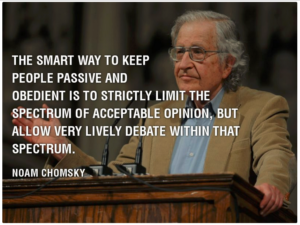
Noam Chomsky said something very intelligent once, quoted in the above image. It’s an extremely perceptive insight because it lays bare at a stroke one of the most powerful tools of deception that the Hate Machine has to levy against you.

The corporate media is very skilled at creating the impression that the war between truth-tellers is a war between TV1 and TV3, or between Stuff and Newshub.

In reality, it is a war between those who seek to force you into that claustrophobic little paradigm of thought that Chomsky referenced, and the rest of us.

An insight into how this works can be gleaned from observation of the incestuous nature of the mainstream media. On Stuff, for example, many of the articles are simply puff pieces that reference other mainstream sources of media, in particular television, the pleb’s choice of medium.

This probably isn’t surprising once you consider that the majority of the New Zealand media is owned by a small number of foreign billionaires. If you own both a television station and a newspaper, then why not direct your newspaper to write about the shows on your television station?

This collaboration is in principle little different to how the major bookstores work in concert to act as gatekeepers for any book or publisher whose message does not serve corporate interests (which is why you don’t find David Icke and VJM Publishing books in Whitcoulls or Paper Plus).

They will say it’s a matter of economy of scale but this dodges the point, because there will always be more money in pandering to the lowest common denominator, which has been true for a long time.

This newspaper warned at the time that the flag referendum was a deliberate waste of time and energy intended to distract us from making progress on real social issues. Predictably, this warning was not heeded by the masses, who indeed wasted many months of time and energy deciding which flag would ultimately be rejected in favour of the status quo.

The accuracy of Chomsky’s headline quote is very evident if one studies the message of the New Zealand media during that period. They presented a meaningless choice between a range of already doomed options, and then simply refused to discuss anything else.

And then, a few months later, they simply did it all again: excluding all political debate of any national significance so that John Key’s hubristic charade could be front and centre.

The end price of $26,000,000 was a win-win-win for the National party: they successfully hamstrung any meaningful debate about the state of society for months, and they made us pay for it, while at the same time cutting access and funding to social services.

The real media war is between those who want to inform you (out of solidarity) and who want to confuse, frighten, mislead and befuddle you (usually out of a profit motive). So if you have a piece of information that is of more value than the average mainstream media puff piece about Max Key or Kate Middleton, then share it.

If You Want to Think of the Children, Then Legalise Cannabis

When I was working a cannabis law reform booth at a hippie festival in Nelson about eight years ago, I had an unpleasant encounter with a local hysteric. She approached us like she would have approached two fellows who were advocating to legalise child molestation and launched into a rant about the “twelves” who would inevitably get hold of cannabis if it was legal.

Before either of us could respond, she was dragged off by her embarrassed husband. If we had had the chance, we would have responded with an argument out of the Cannabis Activist’s Handbook: that a repeal of cannabis prohibition would actually make it harder for teenagers to get hold of cannabis.

Now there is evidence that this counterargument was correct. The stupid thing is that, if one puts the hysteria aside for ten seconds, it’s quite obvious that legal cannabis is safer for teenagers than New Zealand’s current black market model.

It was found that in Colorado, where cannabis was legalised in 2012, legal cannabis stores generally don’t sell weed to minors. In a study similar to the Liquor Board stings in New Zealand, 19 out of 20 Colorado cannabis retailers refused to sell cannabis to a person who looked under 21 and who could not produce ID.

As can be imagined, a 19 out of 20 rejection rate is much better than what it would have been had the 20 stooges gone to tinnie houses instead.

Even though American teenagers are consuming less alcohol and tobacco than previously, rates of cannabis use among teenagers remains constant. Why?

It’s probably because, as centuries of relentless cultural brainwashing has ever less of an effect thanks to the Internet spreading truth about forbidden subjects, people naturally come to realise that they enjoy smoking cannabis more than getting drunk and smoking cancer sticks.

A short history lesson: the Greatest and Silent Generations survived the Great Depression and World War Two and incurred severe psychological trauma in doing so. This trauma was passed down to the Baby Boomers, many of who were fed into the meat grinder of Vietnam. Generation X, who followed, mostly escaped direct trauma but there are many who suffered secondary trauma as a consequence of being raised by mentally damaged Boomers. Now there are the Millennials, who are mostly okay.

It is not a coincidence that, as the generations get younger, they seem to naturally prefer smoking cannabis over using alcohol and tobacco.

This is probably because the less traumatised a person is, the less they desire the brutal sledgehammer effect on consciousness that alcohol has, and the less they desire the serenity-at-all-costs mentality that accompanies a tobacco habit. Alcohol is a brutal drug for a brutal age, and legal tobacco might prove to be an anachronism from a time when considerations like human life weighed far lighter than profit.

The desire to alter consciousness, however, also occurs frequently in people who have not been severely traumatised – and these people appear to prefer cannabis.

Cannabis tends to have the effect of making the user more, not less, sensitive. This means that people tend to avoid using it unless they are around people they like in a setting they find comfortable or in a mindstate where some cognitive enhancement, not destruction, is desired.

There is no good reason to limit the freedom of young people to alter consciousness to using alcohol and tobacco.

It may have made sense in an era when the life expectancy of humans was so low that few had the fortune to live long enough to die of alcohol or tobacco-related illnesses, but in the current age denying young people the use of recreational cannabis has the cruel effect of pushing them towards an early death from cancer or heart disease.

Understanding New Zealand: Cannabis Law Reform Voters

With the news that the Greens have more or less adopted the ALCP policy from the 2014 Election, there is a sudden interest in the sort of person who might be attracted to vote Green on the basis of this policy. In this specific instance, there’s one obvious and decent-sized demographic: actual ALCP voters from 2014, who were 10,961 in number.

So who are they? Well, they’re very clearly not the same sort of person who would vote National. The correlation betwen voting ALCP in 2014 and voting National in 2014 is -0.70. This is not at all surprising as the entire point of the war on drugs was to destroy the enemies of the conservative establishment.

Neither are they likely to vote ACT (-0.45) or Conservative (-0.54). These three correlations are fairly hefty, which tells us that the average cannabis law reform voter has a considerable level of apathy for conservatism and for right-wing politics in general.

Naturally, these correlations are the opposite on the left. Voting for the ALCP in 2014 and voting Labour in 2014 had a correlation of 0.38. For Internet MANA it was 0.76 and for the Maori Party it was 0.85.

Two correlations stand out against this easy narrative of ALCP voters primarily being leftists. They are the correlation between voting ALCP in 2014 and voting Green in 2014 (0.02) and with voting New Zealand First in 2014 (0.57).

The lack of a significant correlation with the Green Party vote might surprise many. It seems to be a natural assumption that, because the ALCP policy in 2014 was always more likely to be picked up in the future by the Greens than any other party, that a strong correlation ought to exist. The reality, however, is that the Greens and the ALCP have hitherto appealed to very different demographics.

The Greens have, since at least a decade ago, deprioritised their cannabis policy in favour of all kinds of trendy issues that appeal mostly to middle-class urban elites. This explains why the correlation between voting Green and Net Personal Income is 0.31, so much more positive than the correlation between voting ALCP and Net Personal Income, which is -0.40.

Not only do ALCP voters come from the other side of the socioeconomic spectrum to Green voters, but they are also much browner. The correlation between voting Green in 2014 and being Maori is (an insignificant) -0.09; for voting ALCP in 2014 and being Maori it is a whopping 0.89, one of the strongest correlations in this entire dataset.

This also explains much of the high correlation betwen voting ALCP and voting New Zealand First. The correlation between voting New Zealand First and being Maori is 0.66. Everyone who has ever met more than a few Maoris will have caught on to the popularity of cannabis within Maori culture, and it’s not surprising given the differential in how hard the law hits them that Maori are much more likely to cast a vote for cannabis law reform.

Few will be suprised that voting ALCP has a very strong negative correlation with turnout rate in 2014: -0.68. This is, however, only slightly worse than Labour’s correlation with voting of -0.67. So it’s less to do with lazy stoners and more to do with the general disenfranchisement of those who the system does not represent.

Cannabis voters have a moderate tendency to not be religious: correlations with voting ALCP in 2014 and being Christian, Buddhist or Hindu were -0.41, -0.52 and -0.40 respectively. Mirroring this was a correlation of 0.34 with having no religion. The odd statistic here was the sizable correlation between voting ALCP and having Spiritualism for a religion: this was 0.36.

If cannabis voters are poor, Maori and non-religious, it’s probably not surprising that they’re also young. Voting ALCP in 2014 had a hefty correlation of -0.55 with Median Age, which suggests that most of the people voting on the basis of this policy are young.

Perhaps the most interesting idea from all of these statistics is that the Greens might be winning votes with their new cannabis policy at the expense of New Zealand First voters. It’s apparent that many young Maori vote ALCP out of levity in their first election and then, as they age and become less radical, come to see the merit in voting New Zealand First. The Greens would be chiefly targeting these voters with their new cannabis policy.

If the Greens are making a serious push for cannabis voters again they may find that the demographics have changed since the last time they tried it, in 1999.

*

This article is an excerpt from Understanding New Zealand, by Dan McGlashan, published by VJM Publishing in the winter of 2017.

Estimating the Electoral Impact of the Greens’ New Cannabis Policy

The Greens have taken their sweet time in updating their cannabis policy to something reasonable, and this newspaper has not shied from criticising them for dragging their heels. But today they did update it – and this update has electoral ramifications worth considering.

The updated drug law policy seems to be the responsibility of Julie Anne Genter (whose sponsored FaceBook posts you may have seen recently if you were in enough cannabis-related groups). This is her first major effort since assuming the role of Greens Health Spokesperson from Kevin Hague.

Most encouragingly, in an interview about the new policy Genter made a reference to Canada and the USA, in particular the Western seaboard closest to New Zealand. It’s in Colorado, Washington, Oregon and California that cannabis prohibition was repealed by referendum and in Canada that it is in the process of being repealed by a party that ran explicitly on the issue in a General Election.

She also used a couple of arguments straight out of the Cannabis Activist’s Handbook: that cannabis law reform was a similar sort of deal to gay marriage in that the herd was against until until it had had a few decades to think about it and that legalisation would make it harder – not easier, as it is considered by some – for young people to get hold of it because of the current lack of ID checks on the black market.

The Aotearoa Legalise Cannabis Party has made a point of using the example of Colorado to suggest what a sane cannabis policy ought to look like. So if the Greens are signalling that this is also their long-term vision, then they ought to count on collecting votes from people who think along similar lines.

The ALCP scored 0.46% of the vote in the 2014 General Election. This isn’t much but it’s a lower limit on what the Greens might expect to gain from this policy.

All of these people were willing to drag themselves to the polls to vote for a party who had no realistic chance of making a difference but who did intend to make noise about the cannabis law, so it’s likely that the vast majority of people willing to vote for the non-Parliamentary ALCP would be willing to vote Green now that the Greens have a similar cannabis policy.

This newspaper estimated last year that the true amount of support for the ALCP was probably closer to 1%, based on the increase in support for reform to New Zealand’s drug laws since 2014 (change has been very rapid on this front). The Greens can count on most of those.

On top of that, one has to factor in all the people who would have voted for such a policy in 2014 had a major party supported it, as one now does.

These people are probably as least three times as numerous as those who voted ALCP in 2014 or were intending to do in 2017.

It’s interesting to note that voting Green in 2014 and voting ALCP in 2014 has a correlation of only 0.02. This is because Green voters tend to be white and wealthy whereas ALCP voters tend to be poor and Maori.

Voting ALCP in 2014 had a correlation of -0.40 with Net Personal Income, which suggests that cannabis voters are poorer than all but Labour, Maori Party and New Zealand First voters. Voting Green in 2014 had a correlation of 0.31 with Net Personal Income, which means Green voters are almost wealthier than average by as much as the average cannabis voter is poorer than average.

Implicit in these statistics is the potential for the Greens to attract a large number of new voters, especially those who didn’t vote in 2014, as the anti-cannabis brainwashing has been least effective on those who are already disenfranchised, such as Maori, young people and the mentally ill, and these traditionally low-voting groups now have a reason to reconsider.

These statistics suggest that there are many New Zealanders who have only just now started to hear the Green Party tune as the party seeks to expand outside of their traditional wealthy, white urban strongholds.

It’s easily possible that this new policy will result in 2% extra votes for the Greens on Election night 2017, because of the immense degree of disenfranchisement suffered by cannabis users before today. This alone would result in two extra seats once they were all dealt out.

After all, there are 400,000 cannabis users in New Zealand and our options, until today, were terrible.