Category: bullshit artistry
How Low Does Turnout Have to Get Before Voting Loses Legitimacy?

The obvious smartarse answer is “It never had legitimacy”, but this merely ducks the question. The question of when a democracy can lose enough of the perception of legitimacy that it stops working, not by being usurped by authoritarians but from the populace simply not caring about it enough, is worth exploring.
The logic goes something like this. It’s reasonable to assume that if no-one voted at all, not even the politicians themselves, then no-one would care about democracy. So there is a clear limit case as votes approach zero.
If everyone votes (or at least everyone eligible), then it stands to reason that democracy has the biggest possible buy-in. Probably in a culture where 100% of the population votes there would have to be an exceptionally unusual degree of philodemos – a degree never seen in practice.
If a hypothetical democracy starts with 100% participation and this falls over time towards 0%, at some point along the line representing that descent the democracy will fail.
But where exactly?
The most recent American presidential election does not have an official turnout rate yet, but BetFair appears to be sure that it will be somewhere around 58%. This is low by the standards of Western democracies – but there appears to be no way to tell how much of this is due to disenfranchisement and how much is due to people seeing through the system and protesting by not voting.
This already highlights a problem with democracy – bombs dropped by American forces do not do 58% damage, and sentences for non-violent drug offences are not 58% as long as they would otherwise be. No matter how much the population wants democracy, they will get it good and hard.
Not even 58% buy-in is necessary in any case. Adolf Hitler’s NSDAP won the 1933 German Federal Election with under 44% of the vote, and this was enough to get rid of the Communists and pass the Enabling Act which paved the way to total fascism.
You could even argue that – if you take the example of the United States in its infancy, where only white male landowners could vote – even with support for democracy in single digits, it can still function as long as all other possible organisational approaches are prevented from taking form.
The tricky thing is that this line of reasoning exposes the truth at the bottom of the political system: the plebs were never in charge and any impression given to that end is simply a useful illusion.
Ultimately it’s whoever controls the loyalty of the Police that is in charge, because then anyone who disagrees that they’re in charge can be taken by the Police and put in a cage (replace Police with Army in many non-Western countries). This was all that Hitler needed to ensure to take power in Germany.
One has to then ask, if the ruling classes just took all the ballots and dumped them in the ocean, invented some election results that both sounded plausible and ensured the interests of said classes were protected, and then divvied up the remaining jobs among themselves, how much wiser would we all be?
Because the ruling classes doing so wouldn’t even be much different from the way the con is already played.
We can take heart that not all New Zealanders have fallen for the ruse – 63% of the electorate did not vote for a politician in last week’s Mt. Roskill by-election, which means that 63% of potential suckers did not give their power away to a shyster by consenting to the democratic charade.
Indeed, Dr. Richard Goode of Not A Party successfully claimed victory in attracting the non-vote, declaring himself Not A Member of Parliament for Mt. Roskill. This obligates him to not attend Parliament, which means that he is not responsible for levying taxes to spend on flag referendums, and nor is he responsible for putting non-violent drug users in cages by setting the Police on them.
I think we can all agree that this is a better deal than what we are getting from our current crop of MPs.
Faith in democracy will, however, have to get much lower before philosopher-kings such as Dr. Goode can be returned to their true position in society.
Does the End of Key Mean the Chance of Sanity for NZ’s Drug Laws?
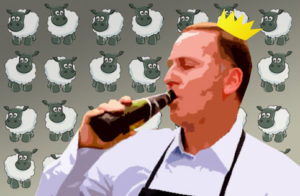
Million of lines will be written about John Key’s shock resignation today, and most of them will be about the impact of this event on business and politics. For New Zealand’s 400,000 cannabis users, most of whom are already disadvantaged, the concern is more whether Key’s resignation will herald a shift to a sane and humane drug policy in New Zealand.
The National Party neglected its duty of care to the youth of New Zealand. Although the Baby Boomers generally cashed in royally on the booming house prices, the youth of New Zealand found themselves paying for those same increases in their rent and bigger debts.
For those young and poor, the Key era was more like an inquisition. Funding for rape crisis centres was slashed, cannabis prohibition was enforced as aggressively as ever, and access to financial help was restricted, mostly to pay for tax cuts for wealthy old people.
In fact, it could be argued – if somewhat cynically – that the purpose of National Party policy, especially on the drug front, is to destroy the young for the sake of the profits of the rich.
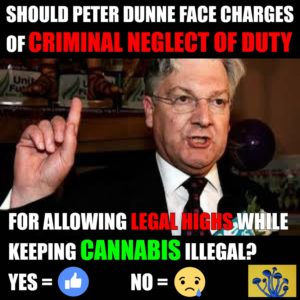
Not only was John Key strongly against even having a discussion about drug law reform, he even appointed the most aggressively anti-drug MP in Parliament, Peter Dunne, to the position of Associate Minister of Health, from where he was able to block all efforts for drug law reform.
John Key didn’t seem to have a problem with Dunne’s hamfisted efforts to ‘fix’ New Zealand’s archaic drug laws. He stood to one side when Dunne opened up the borders to Chinese legal highs of completely unknown origin. Even when reports of mental health casualties poured in from all corners, Key refused to criticise the blundering Dunne.
When Dunne brought in the disastrously flawed Psychoactive Substances Act, John Key voted to make it law, all the while ignoring the cries of thousands of Kiwis who have discovered medicinal benefit in cannabis. New Zealand was 12 years behind California on medicinal cannabis law reform when Key came to power – now we are 20 years behind, and still not a hint of progress.
No doubt the mainstream media will, in coming weeks, join in a chorus of “Rockstar, rockstar!” as they prepare New Zealanders to support globalist forces in the 2017 General Election.
Outside of the mainstream, and away from the arse-licking sycophants who have a corporate platform, Key will be remembered with bitterness for a long time.
Bill English, Key’s anointed replacement as Prime Minister, is also an old dinosaur, but he is known for being something of a pragmatist. In any case, chances of any meaningful change before the 2017 Election is extremely unlikely.
The best one can realistically hope for is that, with the resignation of a man who was like Torquemada to medicinal cannabis users, the country can finally have the long-suppressed rational conversation about drug law reform.
Once that happens, it’s simply a matter of time until the collective realisation dawns that cannabis prohibition must be repealed.
Criminal Neglect of Duty