Estimating the Electoral Impact of the Greens’ New Cannabis Policy

The Greens have taken their sweet time in updating their cannabis policy to something reasonable, and this newspaper has not shied from criticising them for dragging their heels. But today they did update it – and this update has electoral ramifications worth considering.

The updated drug law policy seems to be the responsibility of Julie Anne Genter (whose sponsored FaceBook posts you may have seen recently if you were in enough cannabis-related groups). This is her first major effort since assuming the role of Greens Health Spokesperson from Kevin Hague.

Most encouragingly, in an interview about the new policy Genter made a reference to Canada and the USA, in particular the Western seaboard closest to New Zealand. It’s in Colorado, Washington, Oregon and California that cannabis prohibition was repealed by referendum and in Canada that it is in the process of being repealed by a party that ran explicitly on the issue in a General Election.

She also used a couple of arguments straight out of the Cannabis Activist’s Handbook: that cannabis law reform was a similar sort of deal to gay marriage in that the herd was against until until it had had a few decades to think about it and that legalisation would make it harder – not easier, as it is considered by some – for young people to get hold of it because of the current lack of ID checks on the black market.

The Aotearoa Legalise Cannabis Party has made a point of using the example of Colorado to suggest what a sane cannabis policy ought to look like. So if the Greens are signalling that this is also their long-term vision, then they ought to count on collecting votes from people who think along similar lines.

The ALCP scored 0.46% of the vote in the 2014 General Election. This isn’t much but it’s a lower limit on what the Greens might expect to gain from this policy.

All of these people were willing to drag themselves to the polls to vote for a party who had no realistic chance of making a difference but who did intend to make noise about the cannabis law, so it’s likely that the vast majority of people willing to vote for the non-Parliamentary ALCP would be willing to vote Green now that the Greens have a similar cannabis policy.

This newspaper estimated last year that the true amount of support for the ALCP was probably closer to 1%, based on the increase in support for reform to New Zealand’s drug laws since 2014 (change has been very rapid on this front). The Greens can count on most of those.

On top of that, one has to factor in all the people who would have voted for such a policy in 2014 had a major party supported it, as one now does.

These people are probably as least three times as numerous as those who voted ALCP in 2014 or were intending to do in 2017.

It’s interesting to note that voting Green in 2014 and voting ALCP in 2014 has a correlation of only 0.02. This is because Green voters tend to be white and wealthy whereas ALCP voters tend to be poor and Maori.

Voting ALCP in 2014 had a correlation of -0.40 with Net Personal Income, which suggests that cannabis voters are poorer than all but Labour, Maori Party and New Zealand First voters. Voting Green in 2014 had a correlation of 0.31 with Net Personal Income, which means Green voters are almost wealthier than average by as much as the average cannabis voter is poorer than average.

Implicit in these statistics is the potential for the Greens to attract a large number of new voters, especially those who didn’t vote in 2014, as the anti-cannabis brainwashing has been least effective on those who are already disenfranchised, such as Maori, young people and the mentally ill, and these traditionally low-voting groups now have a reason to reconsider.

These statistics suggest that there are many New Zealanders who have only just now started to hear the Green Party tune as the party seeks to expand outside of their traditional wealthy, white urban strongholds.

It’s easily possible that this new policy will result in 2% extra votes for the Greens on Election night 2017, because of the immense degree of disenfranchisement suffered by cannabis users before today. This alone would result in two extra seats once they were all dealt out.

After all, there are 400,000 cannabis users in New Zealand and our options, until today, were terrible.

Does the End of Key Mean the Chance of Sanity for NZ’s Drug Laws?

jkgallery

Million of lines will be written about John Key’s shock resignation today, and most of them will be about the impact of this event on business and politics. For New Zealand’s 400,000 cannabis users, most of whom are already disadvantaged, the concern is more whether Key’s resignation will herald a shift to a sane and humane drug policy in New Zealand.

The National Party neglected its duty of care to the youth of New Zealand. Although the Baby Boomers generally cashed in royally on the booming house prices, the youth of New Zealand found themselves paying for those same increases in their rent and bigger debts.

For those young and poor, the Key era was more like an inquisition. Funding for rape crisis centres was slashed, cannabis prohibition was enforced as aggressively as ever, and access to financial help was restricted, mostly to pay for tax cuts for wealthy old people.

In fact, it could be argued – if somewhat cynically – that the purpose of National Party policy, especially on the drug front, is to destroy the young for the sake of the profits of the rich.

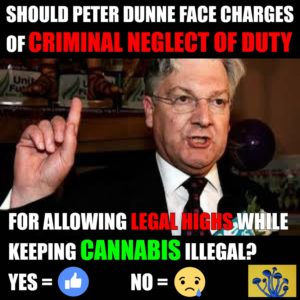
Not only was John Key strongly against even having a discussion about drug law reform, he even appointed the most aggressively anti-drug MP in Parliament, Peter Dunne, to the position of Associate Minister of Health, from where he was able to block all efforts for drug law reform.

John Key didn’t seem to have a problem with Dunne’s hamfisted efforts to ‘fix’ New Zealand’s archaic drug laws. He stood to one side when Dunne opened up the borders to Chinese legal highs of completely unknown origin. Even when reports of mental health casualties poured in from all corners, Key refused to criticise the blundering Dunne.

When Dunne brought in the disastrously flawed Psychoactive Substances Act, John Key voted to make it law, all the while ignoring the cries of thousands of Kiwis who have discovered medicinal benefit in cannabis. New Zealand was 12 years behind California on medicinal cannabis law reform when Key came to power – now we are 20 years behind, and still not a hint of progress.

No doubt the mainstream media will, in coming weeks, join in a chorus of “Rockstar, rockstar!” as they prepare New Zealanders to support globalist forces in the 2017 General Election.

Outside of the mainstream, and away from the arse-licking sycophants who have a corporate platform, Key will be remembered with bitterness for a long time.

Bill English, Key’s anointed replacement as Prime Minister, is also an old dinosaur, but he is known for being something of a pragmatist. In any case, chances of any meaningful change before the 2017 Election is extremely unlikely.

The best one can realistically hope for is that, with the resignation of a man who was like Torquemada to medicinal cannabis users, the country can finally have the long-suppressed rational conversation about drug law reform.

Once that happens, it’s simply a matter of time until the collective realisation dawns that cannabis prohibition must be repealed.

Gutless Government Washing Its Hands of the Victims of Its Drug Policy

syntheticcannabis

Damage from legal highs use is booming in Christchurch, and the Government has washed its hands of the human casualties.

Peter Dunne has said that nothing will happen until a review of the Psychoactive Substances Act in 2018, meaning that the door is closed to further drug law reform until after the next election (when Dunne might well be gone).

This newspaper pointed out at the time that the purpose of the Psychoactive Substances Bill was to delay drug law reform as long as possible. This warning went unheeded by the moronic sheep in Parliament, who rolled over on their backs and passed it with their full support.

So it looks as though Peter Dunne, the whore of the tobacco and alcohol industries, has successfully stymied all drug law reform for the nine years of National’s three terms.

Remember when the mainstream media was heralding this criminal as a drug law reformer on the basis of a few words in a speech in Vienna? They’re still puking out Government propaganda, this time calling the drugs “synthetic cannabis.”

Has anyone, in the history of New Zealand, done more damage to the youth of this country than Peter Dunne, who not only brought the plague of legal highs upon Kiwis but propped up a Government that slashed mental health care funding?

With Dunne’s support, the National Party withdrew funding to assist the same mental health casualties they themselves had created through allowing legal highs over cannabis. Dunne is symbolic of a conservative Government that has washed its hands of the very same human suffering that it has created.

The linked Stuff article cites District Court Judge Jane McMeeken, who, typical of the Baby Boomer generation and their complete lack of imagination, says “No easy answers existed on how to stop people using synthetic cannabis. Prohibition did not appear to have worked.”

Any idiot knows that legalising cannabis would remove, at one stroke, most of the demand for legal highs. In Colorado there is no market for legal highs, and nor is there one in the seven other American states that have now legalised cannabis.

Why do we continue to let our youth suffer from the plague of legal highs when, on the other side of the Pacific Ocean, the entire American West Coast has now legalised cannabis?