Should Kiwis With Historical Cannabis Convictions Be Compensated?

Now that the New Zealand Parliament has officially apologised to Kiwis convicted of historic homosexuality offences, the day when they apologise to medicinal cannabis users draws ever closer. So in much the same way that there are calls for gay men convicted for homosexuality offences to be compensated, there will also be calls for people convicted of medicinal cannabis offences to be compensated.

This isn’t necessarily a brand new idea – Article D of the twenty-six point plan in the Cannabis Activist’s Handbook calls for compensation on the grounds that a criminal record for a medicinal cannabis offence severely impacts the sufferer’s social and financial standing.

It’s easy for most to agree that a person’s rights to cultivate a herbal medicine are in the same category as their rights to have sex with another man. There is no good reason to sic the Police on people who do either, because neither action causes harm to anyone else.

And so it’s straightforward to accept that there is a genuine case for compensation for harm done to the victims of the Police and Justice systems. After all, putting someone in a cage for an action that harms no-one is itself a crime.

There are life-long consequences to getting a criminal conviction, such as extreme difficulty in finding a job, getting a loan or being accepted to an academic course. The financial losses to these three consequences alone might add up to half a million dollars or more over the course of a lifetime.

So most of us can accept that it’s fair that the Government pays money to put right the damage that it caused to its own people by effectively conducting a war on them without their consent.

If a person wants to make the argument that compensation should be denied because the offences were technically crimes at the time they were committed, they ought to ask themselves if they would be happy with a criminal conviction for reading this VJM Publishing article in a dystopic future where websites without state approval were considered pirate media.

Because it’s very easy to dismiss the psychological damage caused by arbitrary misapplications of judicial power when it doesn’t happen to oneself.

What ought to happen is, first, that it be written into the New Zealand Bill of Rights that actions that do not have victims cannot be crimes. This will not only entrench the legality of both homosexual activity and medicinal cannabis use, but it will also make it impossible for any future offence in this category (i.e. victimless ones) to be pushed into law.

What needs to happen, second, is that a commission is put together to calculate – using the same evidence-based methodology that is being pushed by some with regards to cannabis law reform – an accurate dollar figure corresponding to the amount of suffering caused by being persecuted by this law.

Possibly the fairest way would be to declare a set sum of compensation per conviction and per day in jail if there was a custodial sentence.

For example, we might say that the amount of personal damage inflicted on a person by giving them a criminal conviction was equal to $25,000, with a further $250 for each day spent in prison.

And third we need to decide if we’re actually going to pay this compensation or if we’re going to just say “Fuck ’em”.
You Can Never Win Freedoms Back; You Can Only Trade Them

Although the accepted narrative is that we are moving into a time of greater freedom, in many ways we are in fact becoming less free – and these losses are not necessarily easy to notice

Many young Kiwis have felt a sense of relief after Julie Anne Genter and The Opportunities Party decided to champion cannabis law reform. Finally it seemed like the political class were going to grant the New Zealand people some of their rights back. But, as this essay will examine, dealing with politicians is never that simple.

Both Genter and TOP broke with the New Zealand political convention of treating cannabis law reform as a taboo subject earlier this year as the foreshadow of the General Election loomed, incentivising new policy directions that attracted media attention.

Both of them also broke with convention by bringing logic and evidence to this discussion, instead of the usual fear-mongering and hysteria. As has long been argued by this company (most notably in the Cannabis Activist’s Handbook), once the narrative on cannabis shifted from lies to truth, the days of prohibition were numbered.

Once the sheeple of New Zealand came to realise that cannabis was a medicine and not really the devil’s lettuce, it didn’t seem right to put people in cages for it anymore, and that led directly to the need for law reform being taken seriously by everyone today.

So does this mean that New Zealand is moving out of the Puritanical mindset when it comes to psychoactive substances and will now be discussing the issue sensibly?

Of course not! Morgan wants to put the drinking age back up to 20.

Even though his entire message is that prohibition of cannabis isn’t working, and even though it’s widely understood that prohibition of alcohol didn’t work, voting for cannabis law reform through TOP is also going to be a vote for some Kiwis to lose the freedom to consume alcohol.

Some people might not think too much of this, but Morgan’s actions here reveal the strategy that politicians have used to seize control of the plebs throughout all times and places.

Politicians do this by offering you some of your freedoms back at the cost of others. Their trick is to always take away more freedoms than they offer, but to present it in a way that tricks the plebs into thinking that it’s the other way around.

Another example of it also pertains to cannabis: the fact that almost every cannabis user in the country who has a driver’s licence is also a criminal, because it is a crime to drive with any amount of THC in the system, and anyone who has smoked cannabis within the last six weeks will have THC in their system – even if they are not at all impaired.

If the politicians decided to legalise cannabis tomorrow they could simply bring in more punitive consequences for driving a motor vehicle, such as regular checkpoints with saliva swabs to detect for THC in the system.

Enough checkpoints and saliva swabs and it simply wouldn’t matter that cannabis was technically fully legal – the degree of damage done to the population by the state would remain the same. It could potentially even be increased.

And then we’d end up like the states of Australia and America that have “decriminalised cannabis” but made it criminal to drive with THC in the system, impaired or otherwise.

Either that, or we’ll lose our rights to speak freely on the Internet. It’s possible that the wholesale criminalisation of the young that came about as a consequence of the cannabis laws will be replicated with criminal trials for “hate speech” and “harmful digital communication”.

In any case, we can guarantee that the freedom of politicians to lie to the nation – and to cause them great suffering as a consequence of the despair and confusion – will not be impeded by anything.

Apologising For Anti-Gay Oppression Means Nothing If The Government Still Oppresses

Thirty years after the New Zealand Government stopped violating the rights of Kiwi homosexuals, New Zealand politicians have finally worked up the courage to crawl out of their holes and apologise – but are they sincere?

The House of Representatives today took the extraordinary measure of apologising to Kiwis with historical criminal convictions for engaging in homosexual activity. The move was broadly welcomed, the general attitude suggesting that putting someone in a cage for an act that harmed no-one was, in hindsight, wrong.

Let’s be honest. What the New Zealand Government did to gay people wasn’t just wrong – it was a human rights abuse.

The reason why it qualifies as a human rights abuse is that humans have the inherent, inviolable right to do whatever they like as long as it doesn’t harm anyone else.

Engaging in consensual homosexual activity did not harm anyone else, therefore it wasn’t a crime. Therefore, putting gay people in cages for doing it was a human rights abuse.

After some decades of pressure from reasonable people, the New Zealand Parliament appears to have finally accepted this logic and apologised.

But the truly obscene thing about this whole affair isn’t men sticking their cocks up each other’s arses.

The truly obscene thing is how our current crop of gutless politicians, safely separated by thirty years of history, happily stick the boot into their forebears of a previous generation, while paying no mind to the fact that they are still oppressing cannabis users with the same total absence of justification as they once oppressed homosexuals.

So how can we take the Government’s apology for violating the human rights of homosexuals seriously when it continues to do exactly the same thing to cannabis users?

Marama Davidson, who never misses an opportunity to shamelessly grandstand, spoke in Parliament today about the deaths caused by the anti-homosexual prejudice engendered by the law criminalising homosexual activity.

But regarding the fact that prejudice and discrimination against medicinal cannabis users is still taking lives today, she (like everyone in Parliament apart from Julie Anne Genter) remains completely silent.

The cowards in Parliament won’t be making apologetic speeches about the damage caused by cannabis prohibition for another thirty years, not until most of the current lot are dead.

Grant Robertson stood up in Parliament today and said, on the subject of homosexuality being illegal, that “the arrests, the imprisonments and the fear of that happening did not just ruin lives and destroy potential – it killed people. Hundreds, possibly thousands of lives have been lost because men could not bear the shame, the stigma, and the hurt caused by this Parliament.”

Exactly the same words could be said about cannabis prohibition – but our politicians lack the courage to say them.

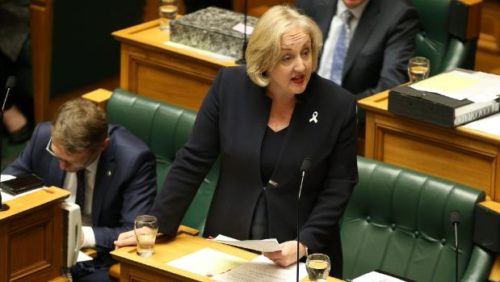
Justice Minister Amy Adams said “this apology is a symbolic but important act that we hope will help address the harm and right this historic wrong.”

If the New Zealand House of Representatives is serious about being apologetic for violating the human rights of Kiwi homosexuals, why are they continuing to violate the human rights of Kiwi medicinal cannabis users?

The prejudice against cannabis users – one that is enforced by the New Zealand Parliament to this very day – has taken ten times as many lives as the law against homosexuality and continues to take them.

Until the current Parliament takes the general issue of human rights seriously – not just rights for favoured, fashionable minorities – this apology can be dismissed as an exhibition of crocodile tears.