

Jordan B Peterson is the Timothy Leary of Our Generation

Helping the next generation to see beyond – or corrupting the youth?

Jordan B Peterson has struck a dull and ossified mediascape like a meteor. Where there used to be only talking heads reading from teleprompters and a variety of family-rated corporate whores, the Canadian professor has burst onto the scene spraying the truth like machinegun rounds. Being so used to lies as we are, this has astonished us, and as of right now Peterson is the man of the moment. The reaction he has generated is an echo of another psychologist who clashed with the Establishment of his time – Timothy Leary.

Once described by U.S. President Richard Nixon as “the most dangerous man in America,” Leary was a pioneer of psychedelic therapy. Also like Peterson, Leary was once a psychology lecturer at Harvard University. Leary devoted his life to understanding the human mind and behaviour and communicating this knowledge to other people, and in doing so helped set them free.

And in setting people free, he became the enemy of the Establishment.

Peterson and Leary are hated by the Establishment because they deprogrammed the young people of their time from the brainwashing that the elites had forced onto them. In Leary’s time, during the early 60s, the young had been brainwashed to be right-wing: they had been programmed to be judgmental, harsh, even hateful. Leary’s task was to teach them to love, and he found that psychedelics were useful for accelerating this deconditioning process.

The only difference with Peterson in this regard is that the young people being deprogrammed by Peterson have been brainwashed with left-wing logic. Instead of being programmed to be discriminating and hard, they have been programmed to be unquestioning, passive, yielding and soft. In other words, where Leary was confronted with a youth that was too masculine as a response to World War II, Peterson has been confronted with a youth that is too feminine as a response to the great decades of peace.

Timothy Leary showed in the Concord Prison Experiment that violent felons could be induced to repudiate their criminal ways if given a guided psychedelic therapy session under the supervision of a qualified therapist. Recidivist criminals learned some empathy for the victims of their aggression and swore off it. In other words, he showed that an excess of masculinity can be countered by the restorative effects of psychedelics.

Those restorative effects can also counter an excess of feminity. They can help a Western world that has lost itself in materialist sensations. We are so obsessed with our own bodies and with sensory pleasures that we have lost touch with the spiritual and with the transcendental. Peterson correctly understands that psychedelics can help here but he is also canny enough not to fall into the Leary trap of propounding something that the populace isn’t mentally ready to handle.

Both men also had a message of “turn on, tune in, drop out”, only they are different. Leary’s message was to drop out of society entirely. His belief was that people who turn on to their true nature will realise that it isn’t served by the way society is structured, and that if they completely rejected it they could form a new society that suffered from none of those problems. A new society could be built by a switched-on movement of hippies, and it would prevail.

Peterson has a similar message, only without the anarchism. For both Peterson and Leary, turning on and tuning in involved learning to know one’s own mind, one’s one thoughts and consciousness. Where Peterson is different is that his emphasis is on restoring order within oneself before attempting to impose order upon the external world. His catchphrase is “Clean your room before you worry about fixing the world,” echoing Gandhi’s “Be the change you want to see.”

Where both men are exactly the same is in that they teach people to look within for answers, instead of without. Teaching young people to rely on their own judgment and their own experiences instead of taking direction from aggressively self-imposed moral authorities absolutely terrifies the Establishment – because the Establishment consists of nothing more but self-imposed moral authorities.

The Government, the Church and the media all gain their power from the attention that they are given by those who look to them for guidance. Power flows where attention goes. When Peterson exhorts young people to impose order upon their own inner lives so that they can more easily impose order upon the outer world, these Establishment elites correctly see this as a massive risk to their own influence and control – and that’s why the Establishment and its lackeys are attacking him more and more.

The true counterculture is neither left-wing nor right-wing, but simply a reaction to the excesses of the previous culture. In the same way that Leary was the voice of the left-wing counterculture of the 60s that opposed right-wing thought control, Peterson is the voice of the right-wing counterculture of this decade that opposes left-wing thought control. In this way, he is another iteration of the philosopher-king archetype who gets attacked by the liars in the Establishment – a pattern going back at least to Socrates.

*

If you enjoyed reading this essay, you can get a compilation of the Best VJMP Essays and Articles of 2017 from Amazon for Kindle or Amazon for CreateSpace (for international readers), or TradeMe (for Kiwis).
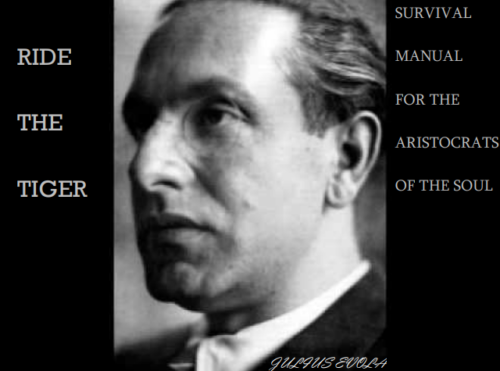

VJMP Reads: Julius Evola’s Ride the Tiger VIII

This reading continues on from here.

The 22nd essay in Ride The Tiger is called ‘Dissolution of Modern Art’. Much like everything else, Evola contends that art has also degenerated. In the case of art, it has degenerated into a feminine subjectivity that is too afraid to say anything. Now we can no longer even speak of traditional art because no-one has any idea what that even is.

In this essay Evola echoes Plato’s description of the degeneration of political forms, only applied to the world of art. Modern art would be best served by achieving maximum craptitude, because that would provide the clean spiritual slate upon which something authentic could be written. Literature is also criticised as “fetishising” human relationships and merely documenting them with full banality.

As in many previous essays, Evola concludes that art has been given too great an importance, to the detrimental of the spiritual. What gives meaning to life can exist “even in the virtual absence of art”. Art has, in reality, undermined idealism, especially in the modern world. Positive realism lies in the assertion of values such as truth and spiritual courage. That which truly has value needs no consensus to agree.

The 23rd essay is ‘Modern Music and Jazz’. Evola has a keen interest in music and understands its development over the course of recent centuries. Perhaps weirdly, Evola writes here about the “preponderance of dance music over vocal and emotional music” – a sentiment shared by many today. He considers that the drift towards nihilism in philosophy and art has been echoed by one in music.

Music has, according to Evola, developed in ways that mirror the development of all other social movements. Therefore, the advent of jazz is no surprise – it is merely the democratisation of music, something “primitively ecstatic”. This doesn’t mean that jazz is crude, though, or that jazz players are unskilled musicians. It simply heralds the return to the world of fundamental, elemental forces.

This “Negro music” is associated with “dark forms of ecstasy” in Evola’s reckoning. He compares the feelings that arise from dancing to rhythmic music to the frenzies of the dervishes: “possessions of savage ritual”. Despite frequently being paired with drugs, these occasions cannot be compared to the ancient rites of Dionysus etc. because there is nothing sacred about them – they are mere escapism.

On the subject of drugs, the 24th essay is ‘Excursus on Drugs’. Evola considers drugs to “most visibly have the goal of an ecstatic escape”. Some of the people who choose such an escape are those who have perceived the meaninglessness of human existence. Others are “neurotics and psychopaths”. Part of the danger of drugs is, like rhythmic music, they can be used to open up awareness to a suprasensible world, such as in initiatory ritual.

Despite this caution, Evola gives due credit to the use of various drugs in sacred ritual. The Taoists considered even the use of alcohol to have a kind of magical effect, and he mentions the Central American shamanic traditions that made much use of mescaline, peyote and psilocybin mushrooms. However, he also points out that no-one really understands how to use these sacraments anymore, because no-one is capable of the necessary spiritual preparation. This leads to the risk of “possession by dark powers”.

If used correctly, nonprofanely, drugs offer the possibility of coming into contract with a superior dimension of reality. Stimulants and depressants can more or less be ignored for these purposes. Hallucinogens are excellent but have many drawbacks; their ancient use involved guiding the trip with symbols and a preliminary catharsis of emotion, two things that are seldom done today. Narcotics can be useful for the sake of dissociating from the mundane but the experience is hard to control.

*

If you enjoyed reading this essay, you can get a compilation of the Best VJMP Essays and Articles of 2017 from Amazon for Kindle or Amazon for CreateSpace (for international readers), or TradeMe (for Kiwis).

VJMP Reads: Julius Evola’s Ride the Tiger VII

This reading continues on from here.

Part Five of Ride The Tiger is called ‘Dissolution of Consciousness and Relativism’ and is comprised of two essays.

The first of these is called ‘The Procedures of Modern Science’. Here Evola begins by describing how the Western idea of Western supremacy upholds itself by appeal to its achievements in materialist science. Evola thinks that this is a gross error, and goes as far as to say that “None οf modern science has the slightest value as knowledge.” It is concerned with statistics and probability rather than truth.

The cult of scientific objectivity that Evola decries is all too willing to discard currently-held theories in favour of ones that, if adopted, provide temporary gains in terms of political power. This supposed objectivity, instead of leading to ever-refining truth, has merely caused science to lose itself chasing shadows. Einstein’s theory of relativity comes in for special criticism, being notable only for producing the bomb.

Scientism has only led to a kind of cult of quantity, which has made people obsessed with numbers and formulas and abstractions, so that we have forgotten what reality actually is and what it’s about. It’s a false logic, and it’s grossly unsuitable for anyone with spiritual pretensions.

The twentieth essay is called ‘Covering Up Nature – Phenomenology’ and continues the theme of the inadequacy of the scientific culture. Science hasn’t really got us any closer to the nature of reality, and each new “advance” merely takes us further away. After all, the world of our actual experience is still made up of fire, air, earth and water, and mathematical abstractions tell us nothing about how to deal with these.

Modern man is destructive because scientism has conditioned him to see everything as soulless. Our compulsory education system brainwashes children with this perspective from when they are very small. Even worse is the popular delusion that science can replace religion in the sense that it might give humanity a promised path to future happiness. This delusion has caused much misery.

Alchemically, this essay continues the theme of decrying the men of silver, whose preoccupations have not and can not lead to spiritual absolution. Evola gives credit to the concerns of the men of silver in so far as the discipline of mathematics cultivates clarity of thought, but all of these intellectualisms ignore the spiritual. Once one has seen the “great illusion” it’s apparent that science cannot be sufficient to solve human needs.

The twenty-first essay is called ‘Sickness and the European Culture’ and comes back to the subject of European decadence. This essay is very short, at only three pages.

Here Evola reinforces the contention that European culture has become sick because it has lost its spiritual centre. With no shared sense of spiritual tradition, the forces holding society together have weakened, and some parts of it have broken away. The tragedy of World War II is considered a natural consequence of this process of technical and scientific advancement at the expense of spiritual knowledge.

Part of the problem, Evola holds, is that politics has become separated from an intellectual and cultural class that, in its conceit, has decided it’s above the political. This is not the fault of that class so much as it is a symptom of the collapse of the unifying, transcendent and spiritual ideas that lie underneath cultural expressions such as politics and the arts.

*

If you enjoyed reading this essay, you can get a compilation of the Best VJMP Essays and Articles of 2017 from Amazon for Kindle or Amazon for CreateSpace (for international readers), or TradeMe (for Kiwis).

The Masculine Approach, the Feminine Approach, and the Four Elementary Perceptions

If one wishes to divide the world into two halves, a problem immediately arises: on what basis does one make the division? There seem to be an infinite number of dimensions that a division can be made along. This essay argues that there are two orthogonal, fundamentally different ways to divide the world in two, and this leads to four elementary perceptions.

In its initial state, perception is untrammelled. When consciousness is united with God, one is aware of everything. From this state, the only way that change is possible is for this perfect perception to become occluded somewhere. Somewhere, consciousness must turn to unconsciousness, light to dark, warm to cold.

There are two ways to look at this inevitable fall from union with God. The first way is to simply perceive the change; the second way is to judge the change. This dichotomy is true of all distinctions between feminine and masculine, as the feminine is associated with the perception end of the perceiving-judging spectrum, and the masculine with the judging end.

This first way, making the choice to perceive, is the feminine way. This way divides the world into light and dark or hot and cold, where no judgment is made about one of the two being better than the other. The feminine way of dividing the world does so horizontally, in that the halves are seen as interdependent and as feminine and masculine.

The second way, making the choice to judge, is the masculine way. This way divides the world into good and bad, where good and bad are different to (but overlapping with) the feminine division of yin and yang. This way of dividing the world does so vertically, in that one half is judged to be worth more than the other half. Good is set above bad.

These two perceptions are just perceptions. Neither of them is right or wrong, and that isn’t important in any case. What is important is when these perceptions are useful, because either is useful in some situations and not in others.

Masculine is good when you have just come inside from the rain. Then, masculine is a warm cup of coffee. Feminine is good when you have just come inside from a hot day of playing sport in the Sun. Then, feminine is a cool beer. So either masculine or feminine can be good or bad in the moment, without a moral judgment needing to be made.

Likewise, judging is good when deciding whether to let a person into your house. It’s important to make sure that a person is not bad before opening your doors to them. Perceiving is good when trying to enjoy a piece of music, because it’s enough to just experience the sound and to let oneself by raised and lowered by it. Judging might take the fun out of it.

So the decision whether to perceive or to judge in any given moment depends on the environment a person is in and the situation around them. Generally speaking, if things are relaxed then people are inclined to perceive and if they are stressful people are inclined to judge. It also depends on inherent personality characteristics: women are more likely to break towards perceiving if in doubt, while men are more likely to break towards judging.

In all, this means that there are four different perspectives that one can take to anything in the world. Any other thing can be treated as either good, evil, yang or yin, depending on whether one chooses to primarily judge it or to primarily perceive it. Whichever of the four is chosen only makes sense in reference to the other three not chosen: bad is non-perceptive, non-good; good is non-perceptive, non-bad; feminine is non-judgmental, non-masculine, and masculine is non-judgmental, non-masculine.

This way of thinking (of dividing four elementary perceptions into two groups of two, based on approach) represents a middle point between the vertical, masculine logic of clay-iron-silver-gold and the horizontal, feminine logic of earth-water-air-fire. It might therefore claim to be a way of thinking that represented a higher degree of balance than the other two.

It also leads to them both after a small amount of extrapolation, because the distinction between good and evil is essentially identical to the distinction between precious (gold and silver) and base (iron and clay). Here gold distinguishes itself from silver by being double good, because silver is relatively bad as far as precious elements go. Likewise, iron is good in comparison to clay, because it is hard and can be used in tools, and is therefore relatively good as far as base elements go.

Likewise, the distinction between masculine and feminine is essentially identical to the distinction between warm (fire and air) and cold (water and earth). Here, fire distinguishes itself from air by being double masculine (i.e. it is hot and dry, not just hot), and earth distinguishes itself from water by being double feminine (i.e. it is cold and unyielding, not just cold).

*

If you enjoyed reading this essay, you can get a compilation of the Best VJMP Essays and Articles of 2017 from Amazon for Kindle or Amazon for CreateSpace (for international readers), or TradeMe (for Kiwis).