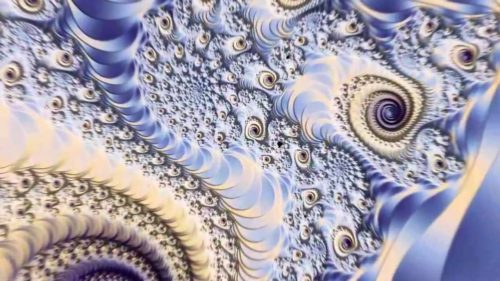
The Great Fractal

In the beginning was consciousness. This is the same as God, and it is the same as yourself. God is consciousness, and God is you, and you are consciousness. This didn’t really happen in the beginning, because there’s no such thing as time, but it’s the start of the story.

All religions and spiritual movements are inspired by gnosis about the real nature of God. It’s very simple – God is consciousness because consciousness is sufficient to create the entire physical world (and all possible worlds), and consciousness is outside of time and space and is complete even in division.

Nothing over and above consciousness is necessary to create the appearance of the entire material world and everything in it, and the appearance of every possible material world and everything in that. In fact, all of these possible material worlds can be derived through repeated iteration of a simple fractal equation – the Great Fractal.

So when people say that God is omniscient and omnipotent and everywhere and eternal they are entirely correct, because all of these things are true of consciousness.

The only disagreement arises when people try to describe the precise nature of God. These efforts are doomed to failure because consciousness is more fundamental than language, and therefore cannot be defined in language. And so all efforts to describe God or to interpret the will of God are errors, usually made through a person conflating their ego with God and therefore confusing their personal desires for the will of God.

That’s all there is to life. You, being conscious, are conscious of things. This never changes, not even on the other side of the death of your material body.

The Great Fractal is the sum total of all of the possible phenomena that God can be conscious of. It is called the Great Fractal because all possible lives are similar to all other possible lives in ways that, if represented graphically, form a fractal of infinite complexity and depth.

Every possible life is being lived by God, right now, with full consciousness – and always has been and always will be. There is a being exactly the same as you who is right now living the life you lived up until ten minutes ago – and there are an infinite number of lives being lived inbetween now and ten minutes ago.

The Great Fractal is alive. It is bursting with consciousness. Every possible life that God can imagine – from the simplest flatworm to seventh-dimensional wizards, is consciously being lived right now, and always will be, forever.

How? God just dreamed them up, and God continues to dream as an act of will. That’s all that this – what we call life – is: just a dream. You know this because it’s not any more real than the dreamworlds that you experience at night. Nothing is different at such a time – you are consciousness, and you are conscious of phenomena, and that’s all there is to it, awake or asleep.

What you consider to be your life is just one infinitely small and infinitely limited perspective of the Great Fractal, at the human-on-Earth-in-the-21st-century level. Just like a computer program that can give you the impression of an entire journey merely through zooming in on particular co-ordinates of a fractal, so is your life just a pathway through the Great Fractal and what you see along the way.

You do have free will, only you are limited by certain laws whose purpose is to make this illusion more immersive. What you consider to be free will is nothing more than navigating through the Great Fractal to the degree that you are able – you decide on a part of the Great Fractal that you would like to experience and then – if it’s possible to get there from where you are now while obeying the laws of immersion – you go there.

Why did this happen, instead of something else happening?

Being pure consciousness, God is perfection. God resides in a state of perfect bliss, complete and without desire.

Although this is perfect on one level, it’s grossly imperfect on another: it’s not very interesting.

Simply put, the most enjoyable game that God can play is to look into a limited section of the Great Fractal for long enough so that God can actually come to convince Godself that this limited section is really the whole thing – and then God can feel a sense of awe and grandeur by once again awakening to an appreciation of the whole, an appreciation of itself, an awakening from the delusion that God was ever something else.

And then to do it again, and again and again, forever – an unceasing pattern of forgetting and remembering, of mistaking the illusion of the material world for transcendental reality and then realising the trick and laughing about the fact that one could ever fall for something so obvious.

What we call enlightenment is what naturally arrives as a consequence of turning the common, understandable, materialist perspective around; from looking backwards at the uncreated consciousness instead of looking forwards into the created Great Fractal.

The Great Fractal is the sum total of all the contents of consciousness and all the possible contents of consciousness. It is what the ancient Vedic culture called Maya. We mistake it for reality to the extent that we are making a game of this life.

Te Reo With Mnemonics: Sports Words

Rugby – whutupōro

(loan) A group of kids playing rugby ask another kid, who is wearing rags, if he’d like to play. The kid says “Fuu, too poor, yo.”

League – rīki

(loan) A rugby league team walks past an old woman. She looks horrified and holds her nose, as if they reek.

Cricket – kirikiti

(loan) A man walks through a field wearing cricket gear and carrying a cat.

Netball – poitarawhiti

A woman in netball uniform walks onto a court eating a pie. The umpire says to her “If you want to play netball you’ll have to pay the pie tariff.”

Ball – poi

A boy plays cricket, but instead of bowling a ball he bowls a pie.

bounce – tāwhana

Inside a tavern, a crowd of drunken revellers bounce balls of all descriptions.

The Maori word for bounce – tāwhana – sounds like the English word tavern

catch – hopu(-kia)

A man hops along some grass and then dives to catch a ball.

coach – kaitohutohu

A man holding a kite talks to some skeptical schoolchildren. He says “I am the best in the world at coaching you on how to use this kite. Or who? Or who?”

Court/Field – papa tākaro

A middle-aged man meets some children on a sports field after a game and gives them some takeaway food. He is the papa takeaways.

tackle – rutu

Some trees are playing rugby. One of them tackles another by wrapping its roots around them.

kick – whana

A man tries to kick an electric fan into a goal.

pass – kuru

A doctor has a coughing patient on the other side of the room. The doctor says “This will cure him!” and passes a rugby ball into the patient’s chest.

*

The above is an excerpt from the upcoming Learn Maori Vocabulary With Mnemonics, by Jeff Ngatai, due to be published by VJM Publishing in the summer of 2017/18.

For Those Ignored By The Political Class, The Only Real Protest Is Not Voting

Several opinion pieces have appeared in the mainstream media in recent days exhorting Kiwis to vote in next month’s election. With choice phrases like “not voting won’t solve anything”, “the 2014 result was determined by the people who turned up” and “Voting builds our political power”, all mainstream propaganda organs are doing their best to get you to consent to the status quo.

Because that is all that voting is – you giving your consent for things to carry on pretty much exactly as they already are. The political class will interpret the fact that you voted as a sign that you are content with the overall system – and therefore as a sign that nothing need be changed.

And so, your vote has a zero percent chance of changing anything. You might as well dance naked in a thunderstorm praying for the lightning gods to strike down the enemies of the nation.

How the country will be run for the next three years has already been decided by the mutual agreement of the sort of person who politicians really do listen to – rich old people, who have got together long ago with those politicians and hashed out the precise details of how things are going to be, whether the masses like it or not.

If you’re not a wealthy Baby Boomer, the politicians couldn’t give a fuck what you think. But they do want your consent for what they’re going to do to you.

If they don’t have that then they run the risk of provoking the rise of some kind of revolutionary movement that might actually make a difference to how society is run. Such as: a movement that campaigned on an expensive universal basic income, or on an equally expensive capital gains tax, or on an immigration policy that reflected the will of all Kiwis instead of just multiple property owners and those looking for cheap labour.

And this is the reason why there is all the propaganda right now to get people to vote. Voting in a democratic system is the same as you giving your consent to how the country is governed – and to the people who own both sides of the political system, the consent of the population they’re exploiting is the only thing left that they don’t already have.

If you do vote, then politicians of both the left and right wings of the ruling party tend to naturally assume that you’re more or less happy with the direction of things.

Knowing in advance that the winner of the election is going to ignore your will in favour of those who have money, your only means of protest is to not vote at all. Past a certain level of disenfranchisement, the only action one can take to affect the system is to not vote. A refusal to vote is the only way your voice can really be heard.

If the turnout rate in next month’s General Election was less than 50%, the measured degree of public discontent would be too great to just shrug off, it would then become possible for some hard questions to be asked about the direction the country was going. The mainstream media would be forced to ask whether or not the political system was really a democracy or just an oligarchy masquerading as one.

The higher it is, the more likely it becomes that political discourse is replaced with photos of spaghetti on pizzas, videos of dropping in to London for a sister’s wedding, and witch-hunts against outsider candidates.

You can help force New Zealand politicians to take the will of New Zealanders seriously by withholding your vote this September 23rd.

VJMP Reads: Anders Breivik’s Manifesto V

This reading carries on from here.

This section (pages c. 286-415) is entitled “Europe Burning” and details a deliberate strategy, on the part of Breivik’s enemies, to destablise the European continent. This is achieved through a variety of political and sociological means.

Breivik appears to be an ardent believer in the Eurabia theory. This theory has it that the elites of the European and Muslim spheres have secretly agreed to come together in order to act as a counterweight to the influence of America and Israel.

The Eurabia theory sounds plausible on the face of it. But much of the rhetoric around it is misleading. A cynic might argue that the Eurabia rhetoric was deliberately dishonest.

Mass Muslim immigration to France happened not because of a conspiracy but because of economic reasons. We can surmise this because other Western nations also saw an influx of poorly educated third-worlders to work the jobs that the natives had become too highly educated to want to do.

Likewise, European prejudice against Jews and Israel did not arise as a consequence of Muslim and Arab leverage on European politicians. Anyone with so much as a passing knowledge of European history will be aware that native Europeans were more than capable of hating Jews without outside encouragement.

This document exhaustively references antisocial actions taken on behalf of certain Muslims and explains them in terms of collective Islamic anti-Western action. It’s certainly true that if a person would read a several hundred page list of crimes committed by Muslims they could come away thinking that such an agenda existed, but the document does not make an effort to determine whether such a list of crimes is unusual.

Another place in which the document makes implausible assertions is with regards to the sentiment that Judaism and Christianity are traditional European religions and Islam is not. Why Christianity and Judaism should be considered any more European than Islam, when all three Abrahamic sects come from the same place and exhibit similar characteristics, is not discussed by Breivik.

Neither does Breivik explain why he can so ardently attack Communism, Marxism, liberalism, globalism and feminism, but defend the very same Judaism that is most commonly associated with those ideologies.

This unusually benevolent stance towards Judaism is underlined by the multiple references to the work of Bat Ye’or, – who is the most energetic proponent of the Eurabia conspiracy theory – and the claim that Israel is a “cultural cousin” to Europe.

It is, true, however, that Breivik’s grasp of history is much deeper than those of the mainstream commentators whose political opinions inform the masses. He points out that the advent of the nation state, this enemy of the globalist, was itself a reaction to the religious wars that plagued Europe until the mid 17th century, and that wars predated the nation state by thousands of years.

Therefore, there is no reason to agree with the lazy consensus pushed by mainstream leftists that the end of the nation state will bring about a greater level of peace.

Ironically, Breivik “the neo-Nazi” comes across as decidedly less totalitarian than some of his enemies in certain regards. His dislike of the European Union is based in part on the phenomenon of unelected Eurocrats having more power than elected representatives of national governments.

He is correct to point out that critics of the unelected Eurocrats are often dismissed as “anti-democratic” elements – an absurdity on its face.

Although Europe has many enemies in Breivik’s analysis of the world, from the European Union to the mainstream media to mainstream academia to right-wing libertarians who deny the pull of culture, the major enemy is undoubtedly Islam: “The Islamic world always has been our enemy and always will be.”

Throughout this section, Breivik demonstrates an acute historical knowledge on the one hand, and a tendency to rapidly jump over several logic steps on the other. This leads to a number of uneasy conclusions.