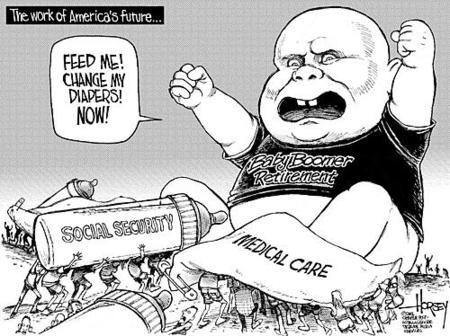
Generation X’s Most Bitter Realisation

Instead of seeing the next generations as inheritors of a world that they were duty-bound to steward, The Baby Boomers see the young as resources to be exploited

Some things have been part of life for so long that we’ve taken them for granted. We take for granted that parents pass wealth onto their children in the form of knowledge and silver; we take for granted that technological and social improvements mean that the quality of life increases for every generation that passes; we take for granted that each generation has an obligation to the leave the world in order for the one that comes after it. Generation X has come to bitterly realise that some of these assumptions are no longer true.

The most bitter realisation of Generation X is that we will be the first generation in history to inherit a lower standard of living than the previous generation enjoyed. The Baby Boomers ticked up so much debt on the intergenerational credit card that they can never pay it back themselves, even if they intended to. We will pay it back through the sweat of our own labour so that our parents can enjoy a lengthy retirement, the vast majority of them still fit to work.

What is currently taking place is the greatest theft in history: the Baby Boomer’s theft of the production of the Generation Xs and Millennials, who will lose a large proportion of their wages to pay back the debts their parents accumulated, and for rents on houses that they can never own, merely so that those parents could experience an unprecedented level of comfort.

They did this by giving themselves tax cuts without cutting spending, so that our nations had to borrow to pay for basic social services, many of which the Baby Boomers themselves used more frequently on account of being elderly. All over the world this was done, not just New Zealand; everywhere an excuse was found for the increase in borrowing.

At the same time, the wages of the next generation were squeezed between having to pay back massive student loans that the Baby Boomers were not themselves subjected to, competing with foreign labour to a degree that the Baby Boomers were not themselves subjected to, and forking out for ever-scarcer affordable housing to a degree that the Baby Boomers were not themselves subjected to.

So not only did the Baby Boomers ensure that they enjoyed the highest standard of living ever recorded by one generation in human history, they did so explicitly at the expense of the generations who would follow, saddling them with a debt so heavy that even war reparations would be less burdensome.

They ticked up this unique standard of living for themselves on the national credit card, and simply left us to pay the debt off, which will take half a century. For most Western nations, cleaning up this mess will involve trying to integrate millions of individuals from very strange and often barbaric cultures, people that the Baby Boomers let into our countries because they didn’t want to pay us proper wages like they themselves had been paid.

The question that will define the soul of Generation X is whether we do the same thing to the generations after us out of bitterness and resentment for what our parents put us through, or if we treat the generation after us fairly out of a belief that we learned something from the greed of our parents.

FaceBook Contains The Seeds For Its Own Destruction In Its “Community Standards”

As the yang contains the seeds of the yin that will eventually grow to overwhelm it, so does FaceBook contain the seeds for its own destruction in its totalitarian “Community Standards”

Social media is becoming an ever more difficult place to express oneself, with the list of things that you’re not allowed to say growing by the week. FaceBook (otherwise known as FaecesBook) is arguably the worst offender, and is getting worse all the time. Unfortunately for them, the seeds of their own destruction are sown by their aggression against free expression.

More and more people are finding themselves “zucked”. This means they are banned from FaceBook for a set length of time because of transgressions against the mysterious “Community Standards”: an ephemeral set of ever-shifting laws against saying certain things, on the grounds (presumably) that some might find the speech offensive.

In doing so, FaceBook has forgotten who made it popular in the first place. It wasn’t people who were worried about community standards – to the contrary, it was the sort of person who flocked to the Internet as a place to speak freely. It was the cool people who made FaceBook a fun place to talk about things that were hard to talk about in real life, for whatever reason.

These people are not going to tolerate being banned for 30 days for using words like ‘faggot’ or ‘nigger’: two things which ought to be punished by no more than mild social disapproval, without need for recourse to a higher authority. Cool people don’t put up with that sort of crap; cool people will simply find another platform (such as www.minds.com), upon which they can still express themselves freely, and without being encumbered by arbitrary restrictions imposed by some moralising, prudish control freaks.

The author was recently banned from FaecesBook for three days for writing the word ‘fags’. It wasn’t written as a slur, but as the opposite. It was part of the phrase “God Hates Fags”, in the context of mocking religious fundamentalists who hate homosexuals and who are boneheaded enough to protest homosexuality by holding up signs that presume to speak for God.

So it doesn’t even matter if you make a comment in support of homosexuals by mocking those who only are homophobic because they think God told them to be. Use of the word ‘fag’ or ‘fags’ is verboten, so utterly verboten that it is a crime for which there is no defence.

On another occasion I was zucked when a troll in a group I was in accused the group of being full of people who believed that Hitler did nothing wrong. I responded with “But Hitler didn’t do anything wrong” – a comment so clearly a joke that no-one except for the most socially retarded idiot sperglord could have thought otherwise. That’s no defence in the eyes of FaceBook, though, for who all thoughtcrime must be ruthlessly punished.

Perhaps I should have been banned for making such an obvious joke? It would have been much fairer.

It makes one wonder – has Zuckerberg ever been to a pub? Has he ever been out in public, and heard how people speak in real life when they’re trying to relax and make some light humour? ‘Fags’ is hardly a problem. What is a problem is the ever-increasing creep of intrusive advertisements on FaceBook, a platform where the vast majority of the content is created by users who could go anywhere else.

Or is the plan to make FaceBook a gigantic safe space, much in the same way that television currently is? Because the obvious problem with this approach is that FaceBook got its initial momentum from being the precise opposite to a safe space, and if it tries to be the United Nations of Internet forums it will end up just as despised and derided as the UN is.

FaceBook is already dying, but it might take several years for the obvious signs of its irreversible decline to become undeniable. It is, in effect, going through the inevitable life cycle of Internet forums, in which the fourth stage – Destruction – is marked by the controllers of the forum bringing in more and more and more rules in an attempt to recapture the glory days, without them being aware that it is the very application of all these rules which has driven the glory away.

The application of ridiculous Community Standards that not even the average grandmother can abide by without getting banned will be the death of FaceBook.

VJMP Reads: The Interregnum: Rethinking New Zealand V

This reading carries on from here.

The fifth essay in The Interregnum is ‘Welfare and Precarious Work’ by Chloe King.

Unlike the other offerings so far, this essay actually resonates with people who are working class. Instead of waffling on about climate change and other shibboleths of the global elite classes, King focuses on real issues that affect real Kiwis: poor wages, poor security of work and a pitiful excuse for a social safety net.

This essay uses anecdotal examples of young Kiwis trying to make it in a workplace that is forcing them into ever worse conditions. The nature of work in New Zealand is becoming ever more stressful as things like the 90-day firing law undermine employment security, and the essay does a good job of showing how this leads to increased rates of mental illness.

It also correctly draws attention to the cruelty of the Fifth National Government. Paula Bennett’s welfare reforms now force people seeking a benefit to fill out a 48-page form of questions – obviously a considerable challenge to the kind of person whose literacy levels place them in precarious economic positions.

King also speaks to a very real sense of outrage when she writes about how mentally ill people are often bullied back into the workforce well before they are ready – a short-sighted approach whose shortcomings become obvious when the inevitable next mental breakdown occurs.

Describing something she calls “constricted choice”, King details a very real problem in the modern workforce: our choice of jobs has increased, but the average quality of those jobs has plummeted, meaning that Kiwis are essentially forced into taking poorly paid work out of duress. The fact that we have a wide choice of crap jobs doesn’t actually make it any better.

Ultimately, King hits the bulls-eye when she states simply that “Workers deserve to be paid fairly and treated with dignity and respect.” She is right when she points out that the nature of workplace relations in New Zealand have deteriorated to the point where the emphasis is on coercing workers into obedience rather than encouraging them.

The “politics of selfishness” is a very real thing, especially in New Zealand, and King rightly points out that she’s not asking for much when she posits that “no-one should work and be poor at the same time.” It’s not much to ask for, but we’re still not getting it, and the essay concludes with a call to collective action.

In summary, Chloe King’s piece strikes much harder and more accurately at the heart of the issue than the previous efforts in this book: poor living and working conditions right here, right now, not vague threats of what might happen in 50 years’ time. It is easy to get the impression that the left is going to do much better by proposing a universal basic income than it is by going on about climate change, and so for their sake they’d do better promoting voices like King’s.

If You Want the Young to Avoid Smoking, Properly Fund a Mental Health System

The way to lower rates of tobacco use is not by raising taxes on the substance but by curing the mental illnesses that lead to people finding solace in smoking

Decades of government propaganda has convinced most people that tobacco smoking is a harmful addiction with absolutely no benefits whatsoever. Unfortunately, this brutalist approach to what is really a complicated issue neglects the very real psychiatric benefits of smoking tobacco. This essay proposes that the only realistic way to get young people to avoid smoking is to properly fund a mental health system.

Because our culture is going backwards in many ways, we are losing a lot of wisdom that used to be common. A lot of old folk remedies have been forgotten because a large pharmaceutical company was able to make profits selling an alternative. Cannabis is the most obvious of these, but tobacco risks becoming another.

Tobacco has been used in the West for its anti-anxiolytic and antidepressant qualities for hundreds of years, beginning with its discovery by Europeans in South America. The substance has a long history of shamanic use in South America, where some traditions seemed to believe that the exhaled smoke carried one’s wishes up to God.

Unfortunately, knowledge about how to use this substance wisely has been lost, and most people have drifted to either the extreme of smoking a pack a day or the extreme of thinking that tobacco has no benefits at all. Subtlety has been forgotten.

The first public government campaign against tobacco smoking was carried out by Nazi Germany. The authoritarian nature of the National Socialists made them well suited for ignoring the mental health benefits of the substance. Despite that, the Nazis were unwilling to go quite as far as the New Zealand Government and try to have the substance banned.

The truth is that people smoke tobacco because it feels good, and that tobacco feels good not because it gives an instant rush of pleasure that makes you addicted but because it alleviates suffering that already existed in the smoker’s mind.

If it was true that it gave people a rush of instant pleasure then everyone should become addicted, but this is not at all the case. People who are suffering psychologically are far more likely to become addicted, for the simple reason that smoking tobacco temporarily takes the suffering away. This appears to be especially true of people suffering from schizophrenia, depression or anxiety.

Some will say that these people have “addictive personalities”, but that is rubbish. The simple fact is that people who are suffering are more likely to take a substance that alleviates that suffering than people who are not suffering – this is obvious if one considers the balance of incentives.

And so they smoke tobacco because it helps them deal with stress, anxiety, rage, depression, and a range of neurotic and psychotic disorders.

The correct approach here is not to brutally force the citizenry into abstinence by taxing the mentally ill into poverty like a 20th century authoritarian hellhole would, but to cure the mental illnesses that cause people to smoke tobacco before they start smoking it.

Fundamentally, this means two interrelated things have to change. The first is for the Government to acknowledge that mental illness are legitimate health problems in the same way that physical illnesses are, and to properly fund a mental health system. With a properly funded mental health system psychiatrists will be able to keep up to date in their field instead of parroting 30-year old drug war propaganda because they have no time to research.

For this to be possible depends on the second thing, which is that New Zealand makes a cultural change in which it acknowledges that mental illnesses are legitimate problems in the same way that physical illnesses are, and that “hardening up” when you are suffering from depression makes as much sense as hardening up when you have a broken leg, and is equally as likely to kill you if you try to go on with your life without getting help.