
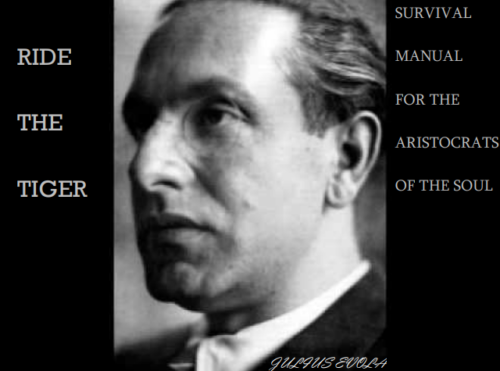
VJMP Reads: Julius Evola’s Ride the Tiger IX

This reading continues on from here.

Part Seven of Ride the Tiger is called ‘Dissolution in the Social Realm’. This consists of four essays. The first of these is called ‘States and Societies – Apoliteia’. In this essay, Evola contends that the sociopolitical environment has essentially collapsed, and that the right sort of person must learn to govern themselves in the absence of social guidance. This is because there are no longer any legitimate nation-states.

True leaders, Evola states, do not exist today. Neither does any movement exist that offers itself as a defender of higher ideas. The petty politicians of today are just figureheads “at the service of financial, industrial,
or corporate interests” – essentially prostitutes. Even if a party that reflected a higher truth appeared, the people are simply too base to voted for one. The only realms left for political action are the irrational and the subintellectual.

Apoliteia means detachment from the political. Evola notes that the great conflict between Western democratic capitalism and Eastern socialism requires no appeal to any higher ideal. The West is equally as destructive and nihilistic as the Marxists. However, the West does at least offer the freedom from where an assault can be mounted. The really difficult thing is to defend one’s dignity when one feels that one belongs to a different humanity.

Essay 26 is called ‘Society – the Crisis of Patriotic Feeling’. Evola immediately lays out the problem – “eνery organic unity has been dissolνed or is dissolν­ing: caste, stock, nation, homeland, and eνen the family”. The associations of today are not built on blood or ideals or anything meaningful – people only come together temporarily for economic advantage. Spiritual superiority counts for nothing. The problem can be summed up by Nietzsche: a great struggle just to win nothing. Modern states are so bloated and overreaching that they have destroyed all remaining organic bonds.

Curiously, even for writing in the 1960s, Evola can already criticise an “economy of excess” that no longer serves to meet necessities. Evola is able to deduce that overproduction has become normalised – people’s wants simply increased to meet the increase in production. Moreover, the desperate need to employ everyone has people working to produce things that no-one needs.

The modern world is absurd. Our massively increasing population is an insanity, and serves as proof that man, for all of the impulses he has overcome in his conquest of the Earth, cannot control his sexual urges. This population growth has led to the need to condition people more and more in order to force them into the workplace. The overall effect is much like a cancer. No really aristocratic soul could possibly identify with a modern world so base.

Men of our age respond even less to the old appeals for action. Appeals to religion died with World War I; appeals to the nation died with World War II. The traditional state won its power through appeals to order. It was a matter of unification from above, not below. The void can be filled if the ancient principles returned. What is needed is an invisible unity of individuals associated by their nature.

The 27th essay is called ‘Marriage and the Family’. Here Evola contends that we have to face up to the fact that the family no longer has the same meaning and importance as it once did. The essential thing is the transmission of spiritual truth from generation to generation, not merely passing on the bloodline. This loss of meaning in the idea of family combines with the trend of materialism to create misery.

Marriage is now “little more than a puritanical veneer for a regime of high prostitution”. The marriage rites that supposedly made the profane into something sacred have merely served to do the opposite. Part of the problem is that sex is seen as something sinful, which means that marriage itself is something that one only chooses to participate in because one does not want to be an ascetic.

As it is, there is no longer anything worth defending or preserving. Therefore the differentiated man cannot ready form social bonds such as marriage. He must have his own self. Part of the reason for this is, again, that if a true leader arose in today’s time, he would be the last of men to be followed. More important than ensuring a succession of blood is ensuring a succession of spiritual knowledge.

*

If you enjoyed reading this essay, you can get a compilation of the Best VJMP Essays and Articles of 2017 from Amazon for Kindle or Amazon for CreateSpace (for international readers), or TradeMe (for Kiwis).
Jordan B Peterson is the Timothy Leary of Our Generation

Helping the next generation to see beyond – or corrupting the youth?

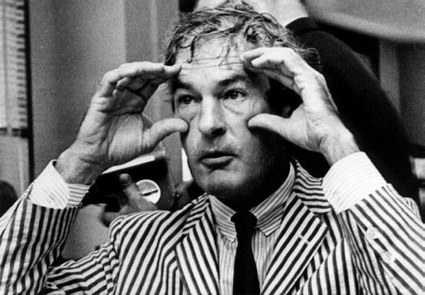
Jordan B Peterson has struck a dull and ossified mediascape like a meteor. Where there used to be only talking heads reading from teleprompters and a variety of family-rated corporate whores, the Canadian professor has burst onto the scene spraying the truth like machinegun rounds. Being so used to lies as we are, this has astonished us, and as of right now Peterson is the man of the moment. The reaction he has generated is an echo of another psychologist who clashed with the Establishment of his time – Timothy Leary.

Once described by U.S. President Richard Nixon as “the most dangerous man in America,” Leary was a pioneer of psychedelic therapy. Also like Peterson, Leary was once a psychology lecturer at Harvard University. Leary devoted his life to understanding the human mind and behaviour and communicating this knowledge to other people, and in doing so helped set them free.

And in setting people free, he became the enemy of the Establishment.

Peterson and Leary are hated by the Establishment because they deprogrammed the young people of their time from the brainwashing that the elites had forced onto them. In Leary’s time, during the early 60s, the young had been brainwashed to be right-wing: they had been programmed to be judgmental, harsh, even hateful. Leary’s task was to teach them to love, and he found that psychedelics were useful for accelerating this deconditioning process.

The only difference with Peterson in this regard is that the young people being deprogrammed by Peterson have been brainwashed with left-wing logic. Instead of being programmed to be discriminating and hard, they have been programmed to be unquestioning, passive, yielding and soft. In other words, where Leary was confronted with a youth that was too masculine as a response to World War II, Peterson has been confronted with a youth that is too feminine as a response to the great decades of peace.

Timothy Leary showed in the Concord Prison Experiment that violent felons could be induced to repudiate their criminal ways if given a guided psychedelic therapy session under the supervision of a qualified therapist. Recidivist criminals learned some empathy for the victims of their aggression and swore off it. In other words, he showed that an excess of masculinity can be countered by the restorative effects of psychedelics.

Those restorative effects can also counter an excess of feminity. They can help a Western world that has lost itself in materialist sensations. We are so obsessed with our own bodies and with sensory pleasures that we have lost touch with the spiritual and with the transcendental. Peterson correctly understands that psychedelics can help here but he is also canny enough not to fall into the Leary trap of propounding something that the populace isn’t mentally ready to handle.

Both men also had a message of “turn on, tune in, drop out”, only they are different. Leary’s message was to drop out of society entirely. His belief was that people who turn on to their true nature will realise that it isn’t served by the way society is structured, and that if they completely rejected it they could form a new society that suffered from none of those problems. A new society could be built by a switched-on movement of hippies, and it would prevail.

Peterson has a similar message, only without the anarchism. For both Peterson and Leary, turning on and tuning in involved learning to know one’s own mind, one’s one thoughts and consciousness. Where Peterson is different is that his emphasis is on restoring order within oneself before attempting to impose order upon the external world. His catchphrase is “Clean your room before you worry about fixing the world,” echoing Gandhi’s “Be the change you want to see.”

Where both men are exactly the same is in that they teach people to look within for answers, instead of without. Teaching young people to rely on their own judgment and their own experiences instead of taking direction from aggressively self-imposed moral authorities absolutely terrifies the Establishment – because the Establishment consists of nothing more but self-imposed moral authorities.

The Government, the Church and the media all gain their power from the attention that they are given by those who look to them for guidance. Power flows where attention goes. When Peterson exhorts young people to impose order upon their own inner lives so that they can more easily impose order upon the outer world, these Establishment elites correctly see this as a massive risk to their own influence and control – and that’s why the Establishment and its lackeys are attacking him more and more.

The true counterculture is neither left-wing nor right-wing, but simply a reaction to the excesses of the previous culture. In the same way that Leary was the voice of the left-wing counterculture of the 60s that opposed right-wing thought control, Peterson is the voice of the right-wing counterculture of this decade that opposes left-wing thought control. In this way, he is another iteration of the philosopher-king archetype who gets attacked by the liars in the Establishment – a pattern going back at least to Socrates.

*

If you enjoyed reading this essay, you can get a compilation of the Best VJMP Essays and Articles of 2017 from Amazon for Kindle or Amazon for CreateSpace (for international readers), or TradeMe (for Kiwis).
Writing Phobias

Most people are familiar with the idea of phobias – the term refers to intense and persistent fears of things, to the point that a person with a phobia will take extraordinary measures to avoid triggering it. Although most people have mild, subclinical phobias of some things and manage okay, for others a phobia can cause immense disruption to everyday life. This article looks at how to believably write characters who suffer from phobias.

The degree of fear caused by a phobia is enough to cause chaos in a person’s life. Instead of merely feeling alarm, a person presented with the object of their fear (or even the threat of it), will often break out in sweats, heart palpitations, dizziness and shaking. They will go to great lengths to avoid being exposed to the triggering stimulus, even if doing so has a heavy impact on their day-to-day social functioning.

Generally speaking, there are three major kinds of phobia.

The first kind of phobia is called a specific phobia – it’s a phobia of something specific, such as spiders, heights or dogs. This sort of phobia is usually a reaction to situations that occurred frequently in the biological past. For this reason, there’s nothing really unnatural about them – it’s just that the fear has been exaggerated to a point where it causes more harm through disrupting a person’s life than it helps avoid harm from danger.

Many phobias begin with an incident in which the object of the phobia caused intense fear in a person. For instance, a person walking through a field and being stopped in their path by an angry dog might develop a phobia of dogs. A phobia of spiders might develop from a childhood in an unclean house that was full of spiderwebs.

Readers who have never experienced living with a phobia could well be interested in reading about the sort of thoughts that go through the head of a character with one, or how they behave (or feel themselves forced to behave) on account of having the phobia. Few who have never had a phobia can imagine how intrusive the fear can be, and how greatly it can impact the ability of a person to live a normal life.

Social phobia is different to a specific phobia in the sense that the phobia reflects a general fear that follows the person with it. Social phobia relates to an intense fear of being judged. In particular, it tends to revolve around a fear of being humiliated in public by means of some judgment being levelled. People with it tend to feel very uncomfortable around authority figures, and would never raise their hand in class to answer a question from the professor.

Most people have a degree of self-consciousness that modifies their actions, but for a person with social phobia this will be exaggerated well beyond mere shyness. For instance, someone with social phobia may be unable to get a driver’s licence on account of being unwilling to sit with the traffic control officer and risk being judged as unfit to drive a motor vehicle.

A character with social phobia might be more interesting if their phobia was ultimately grounded in narcissism. It might be that they were only afraid of being judged on account of having an enormous ego that could not handle even the faintest criticism. This might lead them to becoming vicious in defence of that ego, or to adopting an exaggerated ‘cool’ affectation intended to mask their extreme fragility in the face of judgment.

The third major kind of phobia is agoraphobia. This relates particularly to a fear of finding oneself in an environment that offers no easy means for escape. These environments are common ones such as trains, elevators or open spaces, which naturally leads to a significant impact on ordinary life function. Being caught in such a space with no easy avenue of escape can easily cause a panic attack in an agoraphobic.

Much like social phobia, a character that has agoraphobia might live a particularly lonely and unhappy life. Having agoraphobia makes it much harder for a person to get out of their house, because their house becomes a kind of safe zone from the horrors of society. Stressful and traumatic events can trigger agoraphobia, and central to it is the fear of loss of control. Going outside comes to feel like stepping into the maelstrom.

Generally speaking, it’s easy to include a character with a phobia in your story because almost all of your readers will understand fear, and so they will be able to relate to that character. Having a character with a phobia might be an easy way to create a strong sense of fear and dread in your reader, especially if the phobia is a common one.

Phobias are not generally believed to arise as a result of a moral failing or of any personal weakness. It will therefore be easy to write a character with a phobia who comes across sympathetically to the reader. Portraying a character who struggles valiantly to live a normal life despite a crippling phobia might read as heroic, but if emphasis is put in the wrong places the character might come across as a milksop.

*

This article is an excerpt from Writing With The DSM (Writing With Psychology Book 5), edited by Vince McLeod and due for release by VJM Publishing in the summer of 2018/19.

VJMP Reads: Julius Evola’s Ride the Tiger VIII

This reading continues on from here.

The 22nd essay in Ride The Tiger is called ‘Dissolution of Modern Art’. Much like everything else, Evola contends that art has also degenerated. In the case of art, it has degenerated into a feminine subjectivity that is too afraid to say anything. Now we can no longer even speak of traditional art because no-one has any idea what that even is.

In this essay Evola echoes Plato’s description of the degeneration of political forms, only applied to the world of art. Modern art would be best served by achieving maximum craptitude, because that would provide the clean spiritual slate upon which something authentic could be written. Literature is also criticised as “fetishising” human relationships and merely documenting them with full banality.

As in many previous essays, Evola concludes that art has been given too great an importance, to the detrimental of the spiritual. What gives meaning to life can exist “even in the virtual absence of art”. Art has, in reality, undermined idealism, especially in the modern world. Positive realism lies in the assertion of values such as truth and spiritual courage. That which truly has value needs no consensus to agree.

The 23rd essay is ‘Modern Music and Jazz’. Evola has a keen interest in music and understands its development over the course of recent centuries. Perhaps weirdly, Evola writes here about the “preponderance of dance music over vocal and emotional music” – a sentiment shared by many today. He considers that the drift towards nihilism in philosophy and art has been echoed by one in music.

Music has, according to Evola, developed in ways that mirror the development of all other social movements. Therefore, the advent of jazz is no surprise – it is merely the democratisation of music, something “primitively ecstatic”. This doesn’t mean that jazz is crude, though, or that jazz players are unskilled musicians. It simply heralds the return to the world of fundamental, elemental forces.

This “Negro music” is associated with “dark forms of ecstasy” in Evola’s reckoning. He compares the feelings that arise from dancing to rhythmic music to the frenzies of the dervishes: “possessions of savage ritual”. Despite frequently being paired with drugs, these occasions cannot be compared to the ancient rites of Dionysus etc. because there is nothing sacred about them – they are mere escapism.

On the subject of drugs, the 24th essay is ‘Excursus on Drugs’. Evola considers drugs to “most visibly have the goal of an ecstatic escape”. Some of the people who choose such an escape are those who have perceived the meaninglessness of human existence. Others are “neurotics and psychopaths”. Part of the danger of drugs is, like rhythmic music, they can be used to open up awareness to a suprasensible world, such as in initiatory ritual.

Despite this caution, Evola gives due credit to the use of various drugs in sacred ritual. The Taoists considered even the use of alcohol to have a kind of magical effect, and he mentions the Central American shamanic traditions that made much use of mescaline, peyote and psilocybin mushrooms. However, he also points out that no-one really understands how to use these sacraments anymore, because no-one is capable of the necessary spiritual preparation. This leads to the risk of “possession by dark powers”.

If used correctly, nonprofanely, drugs offer the possibility of coming into contract with a superior dimension of reality. Stimulants and depressants can more or less be ignored for these purposes. Hallucinogens are excellent but have many drawbacks; their ancient use involved guiding the trip with symbols and a preliminary catharsis of emotion, two things that are seldom done today. Narcotics can be useful for the sake of dissociating from the mundane but the experience is hard to control.

*

If you enjoyed reading this essay, you can get a compilation of the Best VJMP Essays and Articles of 2017 from Amazon for Kindle or Amazon for CreateSpace (for international readers), or TradeMe (for Kiwis).