
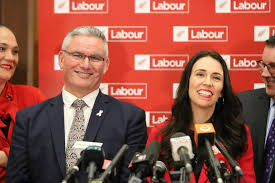
Where Labour Won Their Extra Ten Percent

The Labour Party won about 10% more of the electorate in 2017 than they did in 2014 – but where did these new voters come from?

The Labour Party under Jacinda Ardern won an extra ten percent of voters compared to the previous election. In 2014, under David Cunliffe, they won a paltry 25.1% of the total vote, but in yesterday’s election they won 35.8% (specials are yet to be counted but shouldn’t affect Labour’s vote percentage much). This article, by Understanding New Zealand author Dan McGlashan, looks at where they won these new voters from.

In the broadest and crudest sense, the Labour Party won a lot of support back from middle-class, middle-aged to elderly white people who had previously voted National, and from Maoris who had previously voted New Zealand First.

The correlation between voting Labour in 2014 and being a Kiwi of European descent was -0.76, but by 2017 this correlation had weakened to -0.56. This shift from negative to positive was replicated by the correlation between being Maori and voting Labour, which was 0.42 in 2014 and which had strengthened to 0.57 by 2017.

Taken together, these statistics suggest that Labour strengthened their position among the New Zealand-born. Indeed, we can see that the correlation between being born in New Zealand and voting Labour in 2014 was not significant at 0.01, but it had grown sharply to a mildly significant 0.30 by 2017.

This was met by corresponding drops in support from demographics who have a high proportion of immigrants. The correlation between being born in the Pacific Islands and voting Labour was 0.68 in 2014, and this fell to 0.43 in 2017, and also the correlation between born in North East Asia became more strongly negative, from -0.17 in 2014 to -0.35 in 2017.

These can be explained by the fact that some Pacific Islanders have been here long enough now to become part of the middle class. Conservative religious sentiments might have pushed some to National as well. Likewise, many of the Asian immigrants who have arrived recently are the moneyed classes looking to shift capital from Asia, and are different to the younger, educated Asian immigrant that Labour tended to let in.

There was already a notable gender gap when it came to supporting one of the two major parties. The correlation between being female and voting Labour in 2014 was already 0.31, but by 2017 this had strengthened to 0.40. There was also a very large reduction in the strength of the correlation between working part time and voting Labour. This was -0.65 in 2014 and -0.40 in 2017.

The Labour vote was also a fair bit older in 2017.

The correlation between being in the 20-29 age bracket and voting Labour in 2014 was 0.32, and this had fallen to 0.13 by 2017. Many of these people would have been young students who were persuaded to vote for The Opportunities Party.

The correlations for older age groups, on the other hand, became less strongly negative. The 50-64 age bracket had a correlation of -0.68 with voting Labour in 2014, but this had fallen to -0.59 by 2017. Likewise, the 65+ age bracket had a correlation of -0.58 with voting Labour in 2014, and this fell to -0.51 by 2017.

An interesting point here is that the correlation with being born in Britain in 2014 (-0.73) remained equally as strongly negative in 2017. So this tells us that a much greater proportion of this middle-aged to elderly group that switched from National to Labour were people with family in New Zealand, probably therefore grandchildren.

It might be that these people, having observed the sharper effects of neoliberalism on their wider family, no longer felt motivated to support it in the same way they did in 2014. After all, it was mostly this same group of people who made the most cash out of National’s immigration policies.

Further clues come from the patterns of voters based on their industry. Some industries shifted sharply towards Labour in 2017. Most notable were healthcare and social assistance (which had a correlation of -0.00 with voting Labour in 2014 compared to 0.20 in 2017) and education and training (which had a correlation of -0.01 with voting Labour in 2014 compared to 0.17 in 2017). Also notable is that the occupation of community and personal services workers had a correlation of 0.20 with voting Labour in 2014, increasing to one of 0.36 in 2017.

What this might suggest is that Kiwis whose jobs put them into contact with other people were the most likely to switch from National to Labour.

It could be that the type of Kiwi who is an everyday grandparent, and who has taken on a social conscience in their semi-retirement, has switched some of their sentiments away from National because of a lack of confidence in the belief that they would leave a good New Zealand to their grandchildren.

Looking at the statistics of the income bands, we can see that Labour’s surge won it back much of the middle ground. Although Kiwis with an annual income of less than $15K continued to overwhelmingly favour Labour, there was a swing towards them in the income bands of those groups in the centre.

The correlation between having a personal income of $15-20K and voting Labour rose to 0.13 in 2017 from -0.05 in 2014, and the correlation between having a personal income of $20-25K and voting Labour rose to 0.10 in 2017 from -0.09 in 2014. Even though these income bands are the common student ones, it was not there that the gains were made – the correlation between being on the student allowance and voting Labour in 2017 was, at 0.32, weaker than it had been in 2014 (0.34).

Taking into account the big Labour gains among part-time workers, what all this suggests is that a middle-class, elderly group of voters, probably with wider community ties and a stronger historical sense of what the country used to be like, have come to feel that Kiwi values are no longer represented by the direction the country is taking.

It’s important not to overplay this – the bulk of wealthy, older, white voters still went with National – but there is a clear trend evident. The electorate is simply not as convinced that the country is going in the right direction anymore, and the centre is starting to shift towards Labour.

*

This article is an excerpt from the 2nd Edition of Understanding New Zealand, which Dan McGlashan and VJM Publishing will have ready for sale at the end of October 2017. This will contain statistics calculated according to the official final vote counts and will be freshly updated with data from the 2017 General Election.

Who Voted for The Opportunities Party?

The Opportunities Party found the best reception among the young professional class that had previously supported the Greens

Gareth Morgan’s project The Opportunities Party (TOP) ultimately fell short of the Parliamentary threshold, but there is already enough data for us to know who voted for them in last night’s election. Dan McGlashan, author of Understanding New Zealand, has a look at the demographics of TOP voters in this article.

The most striking statistics are that TOP took a small number of votes off both the Aotearoa Legalise Cannabis Party and the Maori Party, and a huge number of votes off the Greens.

The correlation between voting TOP in 2017 and voting Greens in 2014 was an extremely strong 0.81, which tells us that the vast bulk of TOP voters came from there. Most correlations between voting TOP in 2017 and voting for other parties in 2014 were not significant: 0.16 for the ALCP, 0.15 for the Maori Party, -0.13 for Labour, -0.14 for National and -0.17 for New Zealand First.

Only two significantly negative correlations existed here. These were -0.28 between voting TOP in 2017 and voting ACT in 2014, and -0.36 between voting TOP in 2017 and voting Conservative in 2014. The reason for this is probably because these are the two parties who most conspicuously lack the social conscience that TOP campaigned on.

Crudely speaking, that suggests that TOP voters came from two main groups of roughly equal size. The first were disaffected Green voters, and the second were disaffected voters from all over the rest of the political spectrum.

In what is perhaps a function of the degree of social media saturation they achieved, TOP did the best among the technophilic segment of society. The correlation between voting TOP in 2017 and working as a professional was 0.64. The correlation between working as a professional and voting Greens in 2014 was 0.73, and this had collapsed to -0.10 by 2017, so it seems that the professional class almost wholesale shifted their loyalties from the Greens to TOP.

This is further underlined by the fact that there were moderately strong positive correlations between voting TOP in 2017 and having any university degree: 0.40 for having a Bachelor’s, 0.63 for having an Honours, 0.45 for having a Master’s and 0.58 for having a doctorate. These were all much more positive for TOP than for the Greens.

It was mostly white people who supported TOP. The correlation between voting TOP in 2017 and being of European descent was 0.37, compared to 0.05 for being Maori, -0.25 for being Asian and -0.40 for being a Pacific Islander. Although Asians usually have better educations than Kiwis of European descent, professional Asians tend towards ACT and, increasingly, National.

Perhaps the most striking correlation was the 0.60 between having no religion and voting TOP in 2014. This may the natural result of appealing to people on the basis of evidence, which is another way of saying that they want people who can think for themselves, and people like this are the group that rejects religious dogma the most strenuously.

It follows from these numbers that the average TOP voter would be fairly young, and indeed they are. The correlation between median age and voting TOP in 2017 was -0.14, compared to 0.11 with voting Greens in 2017. Considering that the correlation between median age and voting Greens in 2014 was -0.17, this suggests that TOP took much of the student/university vote from the Greens.

Indeed, we can see that the correlation between voting TOP in 2017 and being on the student allowance was a moderately strong 0.45. Considering that the correlations between being on the student allowance and voting Green collapsed from 0.55 in 2014 to -0.10 in 2017, we can guess that this shift was largely due to the influence of TOP.

Related to this is the fact that the strongest correlation between voting TOP and being in any age bracket is 0.36 with being aged between 20 and 29. The next strongest were the two neighbouring brackets of 15-19 and 30-49, all of which reflects that young people tend to have more active online social lives, where TOP did most of its advertising.

There were also very strong positive correlations between voting TOP in 2017 and working in arts and recreation (0.70), public administration and safety (0.66), education and training (0.52) and professional, scientific and technical services (0.50). These are the same industries that are most likely to employ the forward-thinking, educated young professional that used to call the Greens home.

The negative correlations with voting TOP in 2017 and working in a specific industry came with those whose workers do not tend to spend a lot of time online: manufacturing (-0.38), wholesale trade (-0.35), transport, postal and warehousing (-0.19) and agriculture, forestry and fishing (-0.11).

TOP voters were also significantly more likely to be born in New Zealand. The correlation between voting TOP in 2017 and being born in New Zealand was 0.26. Following naturally from the absence of sharp gender-based roles among the young professional class, the correlation between voting TOP and being male was only -0.02.

Going against the easy trend of a young elite is the correlation between voting TOP in 2014 and being a regular smoker, which was -0.05. One would expect it to be much more strongly negative considering the educational achievements of the average TOP voter (educated people smoke significantly less), but this weak correlation can be explained by the sizable number of cannabis law reform supporters who voted TOP, something also suggested by the collapse of the ALCP vote in the presence of another party who offered full legalisation.

Voting for TOP in 2017 had the same correlation with family income as voting National in 2017 did – 0.39 – which tells us that the average TOP voter is doing quite well. A picture starts to emerge of the average TOP voter as a person of either gender in their mid 20s to late 30s, university educated, probably with foreign experience and ambition, who is very rejecting of dogma and hierarchical thought and wants to make a clean break with the past, but who is also well-to-do in measures of social and mental health.

Some might say that this was the best sort of person that New Zealand has to offer, which is something for Gareth Morgan to consider if he wants to run again in 2020.

*

This article is an excerpt from the 2nd Edition of Understanding New Zealand, which Dan McGlashan and VJM Publishing will have ready for sale at the end of October 2017. This will contain statistics calculated according to the official final vote counts and will be freshly updated with data from the 2017 General Election.
Where Did the National Party Lose Their Majority?

Elections are won and lost by slim margins nowadays and subtle shifts have weakened National’s position compared to 2014

The drama may not be over, but we can eliminate one outcome even before negotiations begin: it is now clear that the National Party failed to get enough seats to govern alone or with support partners as suppliant as ACT, United Future and the Maori Party (the last two of whom were eliminated last night). If they are to govern, it must be with New Zealand First, which is a significant weakening of their position compared to the previous election. This article looks at where National lost support from 2014.

First of all, it’s apparent that the people who voted National last night were basically the same sort of person who always votes National. The correlation between voting National in 2017 and voting National in 2014 was 0.989. So the differences between the people who voted for them last night and who voted for them in 2014 are subtle.

The National Party did worse with white people this time around, although white people were still the overwhelming bulk of National voters. The correlation between being of European descent and voting National in 2017 was 0.51, down from 0.60 in 2014, balanced by an increase in the correlation between being Asian and voting National in 2017 (up to 0.17 from 0.09 in 2014) and between being a Pacific Islander and voting National in 2017 (up to -0.38 from -0.46 in 2014).

This is suggestive of a fairly large segment of both Asian and Pacific Islander people who have managed to rise above their previous economic situation. It also reflects the increase in correlation between working in wholesale trade and voting National in 2014 (0.19) compared to voting National in 2017 (0.26), because wholesale trade is itself an industry with a large proportion of Asian workers.

Because Asians and Pacific Islanders are more likely to be born overseas than Maoris and white people, this has led to a strengthening of the correlation between being born overseas and voting National, which was already moderately significant at 0.33 in 2014 but has since then increased to 0.39 in 2017.

South Islanders still support the National Party more than North Islanders, but the correlation between living on the South Island and voting National went down from 0.13 in 2014 to 0.07 in 2017. This is probably a reflection of the fact that National increased their support among recent immigrants at the expense of Kiwi-born voters, because a relatively higher proportion of recent immigrants live on the North Island.

The correlation between working in a particular industry and voting National in 2017 increased from 2014 in the case of manufacturing (up to -0.19 from -0.23), wholesale trade (up to 0.26 from 0.19) and transport, postal and warehousing (up to -0.47 from -0.51), and decreased from 2014 in the case of mining (down to -0.05 from 0.00), hospitality (down to -0.23 from -0.18), professional, scientific and technical services (down to 0.15 from 0.18), public administration and safety (down to -0.30 from -0.26), education and training (down to -0.31 from -0.27), healthcare and social assistance (down to -0.23 from -0.18) and recreation and arts services (down to -0.22 from -0.17).

This is perhaps interesting because it suggests that people are more likely to go from voting National to voting Labour if they have a social job, compared to being even more likely to vote National if they have a relatively unsocial job.

Related to this is that social occupations tended to leak support for National compared to unsocial ones. Although managers continued to strongly support National in 2017, as the correlation between working as a manager and voting National in 2017 was 0.52, this was weaker than with voting National in 2014, which was 0.56. A similar drop was seen in community and personal services workers, whose correlation with voting National in 2017 dropped to -0.58 from -0.53 in 2014.

Taken together, these correlations show that people whose jobs bring them into contact with the most people are the most likely to feel that the country needs a change in direction, perhaps suggesting that they have observed an increase in human misery to intolerable levels.

Some won’t be surprised to note that the correlation between living in a mortgaged house and voting National in 2017 increased to 0.05 from 0.01 in 2014 – perhaps an indication that people in this group are afraid of the market crashing and leaving them with negative equity. Tellingly, this group became much less willing to vote New Zealand First – the correlation between living in a mortgaged house and voting New Zealand First in 2017 dropped to 0.06 from 0.12 in 2014.

Taken together, those numbers suggest that a lot of people want the game of hot potato being played with house prices and immigrants to continue for a while yet.

Where the election seemed to be lost for National, at least in terms of their hopes of governing alone or with ACT only, is when the real elite class, despite still mostly supporting National, did so less overwhelmingly than in 2014.

The correlations between being in any of the four highest income brackets and voting National all weakened from 2014 to 2017. These were those earning $60-70K (down to 0.21 from 0.24), those earning $70-100K (down to 0.32 from 0.36), those earning $100-150K (down to 0.31 from 0.34) and those earning $150K+ (down to 0.31 from 0.35).

They also weakened noticeably among holders of postgraduate degrees. Voters with an Honours degree had a correlation of 0.22 with voting National in 2014 but only one of 0.17 with voting National in 2017. Holders of Master’s degrees (down from 0.20 in 2014 to 0.17 in 2017) and doctorates (down from 0.20 to 2014 to 0.14 in 2017) followed the same pattern.

The cohort of National voters is also younger this year compared to 2014. The correlation between median age and voting National decreased to 0.77 in 2017 from 0.81 in 2014.

What all this tells us is that there were three major trends in play last night.

The first one is that Labour won votes off the Greens, New Zealand First and National. Labour won a huge number of Maori voters from New Zealand First and the Greens – the correlation between being Maori and voting Labour in 2014 was only 0.42, but in 2017 it was 0.58.

The second is that National won a lot of votes from people who were educated and young and Green-voting in 2014, but who grew up to be wealthy, middle-class and incentivised to vote with their wealth interests in 2017. The Greens dominated this segment of the population in 2014 and lost most of them by 2017, chiefly to TOP and to National.

The third is that National lost a lot of votes from the sort of person who is the real power elite of the country. Although the rich, the employers, the owners of freehold land, Anglicans and educated people all still preferred National to Labour, they were markedly less keen in 2017 than 2014. Many of these people switched to TOP, which is ironic because they now won’t be represented at all (at least not directly).

*

This article is an excerpt from the 2nd Edition of Understanding New Zealand, which Dan McGlashan and VJM Publishing will have ready for sale at the end of October 2017. This will contain statistics calculated according to the official final vote counts and will be freshly updated with data from the 2017 General Election.

The Three Main Forms of Virtue Signalling

The difference between virtue signalling and a genuine desire to help is that virtue signalling doesn’t demand any kind of sacrifice

Virtue signalling is when a person (usually male) makes an effort to signal to any prospective mating partners within earshot the quality of their reproductive virtue. Like a stag bellowing as loudly as it can during the roar, much of the communication made by the human male is intended specifically to let nearby females know about his reproductive capacity. This essay looks at the specific forms of it.

The female of every sexually reproducing species attracts the male through signalling her fertility, which is perceived by the male as beauty. The male counterpart is virtue signalling, in which he signals that any offspring produced by him would successfully be able to compete with those of other males. There are three basic virtues that a male can signal to attract a female: strength, intelligence and moral rectitude.

Strength relates alchemically to iron, and is mostly a function of height and weight. This is why men with a poor posture habitually straighten their backs up when they see an attractive woman walking in their direction. After all, a man is not very strong if he doesn’t even have the muscles to hold his body up straight.

What any given woman finds attractive along these lines is mostly a function of what physical qualities the men in her ancestry needed in order to survive. And so European women are attracted to strong arms, Asian women to a steady nerve, and African women to fast-twitch muscle fibers. All women, however, are attracted to a physical body that looks as if it can survive the rigours of life on Earth – one that metaphysically represents iron.

But strength is only part of the equation. It may be the most important factor for the majority of sexually reproducing species, because most of these species assert a right to exist primarily on the basis of their physical strength, but sheer physical strength is less frequently the prime determinant of success in humans (unless they are savages).

Intelligence relates alchemically to silver, and this could be considered the next level of virtue signalling. Many intelligent men have realised that, for the human animal, intelligence is a better predictor of future success than mere physical strength, and this has led many men to make displays of their mental health and strength instead of displays of physical health and strength.

Silver is softer than iron, and consequently the men who virtue signal their intelligence tend to be more subtle than those who virtue signal their physical strength. The usual way to go about it is to show off who knows the most about any given subject, or who has the greatest range and depth of general knowledge.

Another way to do it is by wearing glasses.

This form of virtue signalling often leads to petty arguments, in which the participants are unwilling to concede that their opponents have made any valid points because of a fear that this will be taken as a concession that those opponents are more intelligent or knowledgeable. Since the point of virtue signalling is to demonstrate to any observing females the reproductive quality of the signalling male, there is very rarely an incentive to concede a point to an opponent, because this will merely make them appear more attractive at your expense.

Humans are ultimately a social species, and no single individual is capable of dominating the collective. This means that an ability to get along with other humans and to behave correctly is the virtue that most strongly predicts reproductive success in our modern societies. The result of this is the importance of moral rectitude.

Moral rectitude relates alchemically to gold, because of its rarity, value and malleability. In this context, virtue signalling refers to when men act as if they are much kinder than they really are. Here a man might claim to have a will to perform a certain act in a certain situation, or to have a certain belief about the correct ordering of society, when the reality is very different.

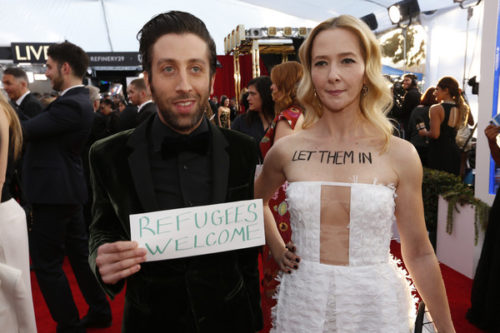
One of the most common examples of this moral virtue signalling in 2017 is the expression of a desire to let refugees into the country, to be taken care of by general taxation. Inevitably the intent of this is to signal to all observing females that the male is kind and decent and morally upstanding. In other words, that he is in possession of the gold of being able to understand the Will of God as expressed through morality.

The reason why this is virtue signalling is that the males in question almost never have a genuine desire to look after these people. Those who virtue signal the most about refugees almost never live in the kind of neighbourhood that refugees are dumped in, and they almost never work the sort of jobs that are impacted by a sudden increase in the supply of unskilled labour.

Other common examples are going on about having a black friend to signal that one is not racist, or pretending to support women’s sport to signal that one is not sexist.

The whole point of all of this virtue signalling is to demonstrate reproductive fitness, which is why men will often end up fighting and arguing over who is the strongest, the smartest or the most good. Essentially there’s no real difference between a couple of rams butting heads in rutting season and two men trying to demonstrate that each is the most virtuous by claiming to support various political causes.