Why Christianity Will Destroy The West (Again)

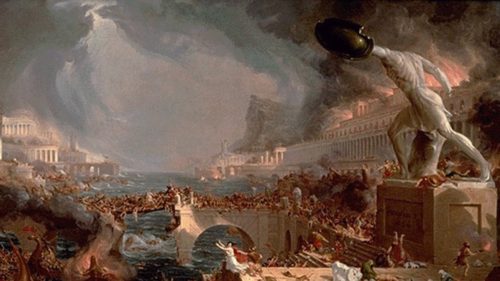
Christianity caused the 4th century Roman Empire to rot from within, until they were unable to secure their borders against invaders and collapsed. A similar fate is befalling 21st century Europe

Christian culture is defined by many things; virtue signalling, slave morality, resentment, passive aggression and self hatred are the foremost of these. This Abrahamic disease of the collective consciousness was fatal for the Roman Empire before us, and, unfortunately, the Western world hasn’t been able to shake it off for nearly 2,000 years. It’s going to be fatal for us too.

Mass immigration destroyed the Roman Empire – this is a matter of historical record. Fat, lazy and decadent, the Romans no longer had the will to defend their own Northern borders against Germanic barbarians, and that led to those barbarians having their will with the place. Free plunder resulted.

The Gothic War started in 376 when a huge number of Goths turned up on the border of the Roman Empire seeking refuge from the Huns. At first, Emperor Valens was pleased at the prospect of cheap labour for his workforce and willing soldiers (heard this story before?), but the unwillingness of the local population to support this foreign multitude of hungry mouths (what about now?) led to insurrection, and aided by traitors within the local Roman population (what about now?) the Goths were able to sack the place, leading to the eventual collapse of the Roman Empire.

All of this was made possible by the conversion of the Empire to Christianity, which turned the minds of the Romans away from reality and replaced their natural morality with the slave morality that we see expressed today in the legions of social justice warriors and cultural Marxists.

Angela Merkel is the daughter of a Lutheran minister, and her Christian morality was instrumental in her decision to open the borders of Germany to the hordes of Syrian migrants seeking refuge from people exactly like themselves.

Thinking like a Christian and striving to make a show of piety, and supported by wealthy, fashionable virtue signallers, Merkel decided to allow a million Syrians to have their way with the country she ruled, on the basis that they were claiming to need help and that submitting to this invasion would be charitable.

The same catastrophe is going to happen to us, for the same reasons, and the same people will be cheerleading for it.

The immensely privileged Alison Mau used her platform in the mainstream media to let us know yesterday that we were all racists for not wanting to take hundreds of refugees, despite acknowledging that these refugees were severely mentally ill, which would require that the mentally ill New Zealanders already present go to the back of the healthcare queue to accommodate them.

Her logic is that, if you are one of the tens of thousands of Kiwis who are desperate for mental health care from a system that you have paid taxes into and which your grandparents built, you’re going to have to get to the back of the queue behind a horde of people who have not inherited a birthright to the wealth of the nation.

As Dan McGlashan points out at several points in Understanding New Zealand, this is the major division on the left, between the privileged, usually Green supporters and the unprivileged, usually Labour and New Zealand First supporters. The privileged, like Alison Mau, having enough money to protect her from the cruel vagaries of life, are happy to support whatever cause is trendy this week without care for the consequences, because the consequences of mass “refugee” resettlement will fall upon the unprivileged. The unprivileged, like the working class of New Zealand, will see the community bonds of the neighbourhoods destroyed, and the queues in front of them for getting mental health care become longer, and the security of their women and elderly start to become jeopardised.

The self-righteous Christian sentiment that expresses itself as a desire to be seen to be virtuous and compassionate will destroy the West, and it isn’t the Muslims that necessarily do all the damage. They just do enough damage to make people lose their minds, as the Jews once did in Germany. And then, all Hell breaks loose.

The real danger is not Muslims, because they are a century from being a real threat to the West. The real danger is what we ourselves might get tempted to do when the hordes of Muslim “refugees” fail to integrate, and start to achieve territorial dominance in certain areas.

A Holocaust of Muslims in Europe this century is entirely plausible – not because such a genocide is itself plausible but because all the stupid shit that leads up to one is apparently in the process of being repeated. Like the yin and the yang, the excesses of one ideology lead to the excesses of its counter, and the excess of a narcissistic desire to virtue signal one’s likeness to the ideal of tolerance and compassion as embodied in Jesus Christ will be violence.

The Boringest T20I Is Worse Than The Boringest ODI

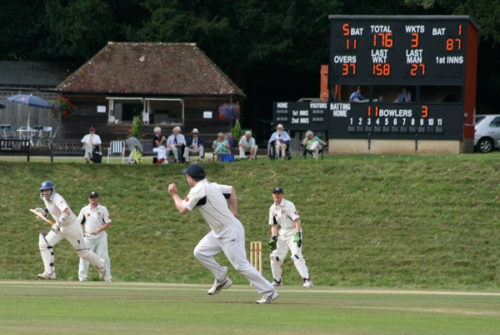
Scoreboard pressure in often so intense in T20s, especially at international level, that one misstep puts the chasing side in a hopeless position

In much the same way that cricket analysts were slow to catch on to the importance of strike rate in ODIs, so too have they been slow to catch on to the importance of strike rate in T20s. Everyone knows strike rate is important in limited overs; what few understand is how this can lead to extremely boring matches. This article looks at why efforts to contrive a more interesting game of cricket have only somewhat succeeded.

The advent of T20 came about when someone realised that, all other things being equal, fans liked seeing boundaries and wickets, and didn’t much care for dot balls or for contests that were over long before they technically finished because the chasing side lost early wickets. And so a form of the game was contrived to have as few dot balls as possible, and as many boundaries and wickets as possible.

But what this new fashion risks losing sight of is the fact that cricket is only interesting in the first place because it is a contest of skill, and sometimes the nature of the match situation in T20 is not conducive to playing the game skillfully.

For instance, it almost never occurs in ODIs that the chasing team, in the first five overs, falls so far behind the required strike rate that the match is effectively lost without resorting to slogging. The chasing team might lose early wickets, which makes the chase much harder, but as long as they can keep their wickets intact there are still plenty of overs in which to win through playing proper cricket and building an innings.

In T20s it’s common for the chasing team to build up enough scoreboard pressure in the first five overs that they effectively cannot win. In other words, it’s possible to lose the game with the bat in the first five overs because of scoreboard pressure – something that is near to impossible in ODIs.

This can happen if the team setting a total bats well enough that they’re close to the optimal possible run rate over the 20 overs (which is usually somewhere just above 10 an over, a rate that cannot realistically be maintained for an ODI). When the required run rate for the batting team climbs above this, it cannot be achieved without taking risks (i.e. slogging) and when this happens one is no longer playing cricket. It’s no longer a contest of skill but merely hit and hope.

This is an incredibly boring outcome from the spectator’s point of view, because the beauty of cricket is that it is a contest of skill where the batsman must find a balance between aggression and keeping his wicket intact. Removing the “keeping the wicket intact” part of the equation often reduces the game to slogging.

It has happened twice in the two matches of the T20I series between New Zealand and India so far.

In the first T20I in Delhi this week, Shikhar Dhawan and Rohit Sharma both scored 80 at strike rates of 145+ opening the India innings, which allowed them to finish on 202, more than 10 runs an over. This asking rate was so high that the slightest stumble in the chase would see the match over as a contest.

And it duly was effectively over, 22 balls into the chase after Munro and Guptill had both been dismissed. At this point the equation was 185 runs off 98 balls and Kane Williamson and Tom Latham, for all their undoubted skill as batsmen, couldn’t do much about it because neither could slog at the required rate.

Once a T20 match gets to this stage it gets ugly, because batsmen have no time to get used to the conditions so as to play big innings where they strike the ball skillfully and with timing into gaps in the field. So after Williamson and Latham were dismissed, Colin de Grandhomme had to come in and slog his first ball, which got him out.

In last night’s T20I at Rajkot, the contest was effectively over in the second over of the chase after Trent Boult had taken two wickets. Colin Munro clubbed his way to 109* (58) in the first innings, which meant that the slightest stumble would put the total out of reach.

And it duly was effectively over after Boult’s second, which meant they needed 10.5 an over for the remaining 18, or an individual strike rate of 175, with their two best hitters out. None of their batsman managed this, as few do.

The remaining batsmen were unable to score at the required strike rate without throwing their wickets away, and so limped to a loss, effectively throwing in the towel long before the innings concluded.

In ODIs strike rate is a major factor, but strike rate seldom destroys the chasing team’s hopes as quickly, as ruthlessly and as completely as in T20Is. Scoreboard pressure can destroy a chasing team’s chances so quickly that players can be forced into mindless slogging, and this is much less interesting to watch than a balanced contest between bat and ball.

The Black Caps T20 side already can’t find room for batsmen of the quality of Ross Taylor and Tom Latham, because they can’t (or don’t) slog enough. This means that the viewer is watching batting of a lower level of skill just because the way the T20 format is contrived promotes such. This is also not interesting from a viewer’s perspective.

The real horror scenario is this – what if it is decided that strike rate is so important in T20Is that there’s no room in the side for Kane Williamson? Because if this day ever comes, T20Is might start to be considered a joke format by cricket fans in the same way most rugby union fans consider sevens, or at least one only suited for levels below international.

If the joy of sport comes from watching skill on display then it can be argued that T20Is are objectively more boring than ODIs because they objectively give less opportunity for the batsman to display skill. The overwhelming importance of strike rate means that skillful cricketers are often pushed out of the side by sloggers, which are only fun in small amounts.

VJMP Reads: Anders Breivik’s Manifesto XV

This reading carries on from here.

In this section (pages 1235-1290), Breivik turns to the question of how to consolidate and organise European conservative groups. This is mostly to be achieved through the promulgation of what Breivik calls the “Vienna School” of ideology, so named because it was in Vienna where the last great expression of a European will to not be ruled by Islam took place.

For Anglo readers, some of Breivik’s philosophy will appear very curious. Some of this originality is a consequence of being European, such as his desire to resist “excessive US cultural influence”. He also believes in the idea of partitioning South Africa in two countries, with one for the Europeans. These sentiments he shares with many other European thinkers, not all of whom are right-wing.

Fundamentally, as is repeatedly emphasised, Breivik is looking for space away from what he considers hate ideologies. These hate ideologies are all as bad as each other in Breivik’s mind, and he claims to oppose any such ideology based on hate: “A multiculturalist is just as bad as a Nazi, which again is just as bad as a true Muslim, a communist or a fascist.”

The four most prevalent hate ideologies in the modern world, against which all nationalists and patriots much stand, are according to Breivik:

1. National Socialism (anti-Jewish hate ideology, racist in nature).
2. Islam (anti-Kafr hate ideology, Christians, Jews, Buddhists, Hindus, Atheists etc).
3. Communism (anti-individualism, anti-freedom).
4. Multiculturalism (anti-European hate ideology, anti-white racism).

Sometimes Breivik’s argumentation is so reasonable that one is forced to consider whether or not he may have become demented after composing this document. For instance, he correctly points out that it isn’t a good or honourable idea to fight the hate of multiculturalism with the hate of Nazism, and one ought to strive to find an ideology without hate. He also points out that young people should not be considered “lost causes” just because the media labels them racists, a level of tolerance severely at odds with his infamous actions.

Much of this section is taken up with talk about the “seven fronts” of peaceful activism, which involve ways of promoting a cultural conservative message and resisting the hate ideologies of Communism and Multiculturalism while acting within the law at all times, and how people in these fronts must officially deny support for the “eighth front” of armed resistance.

Breivik gives a sense of having left no stone unturned when he writes at length about the reality of time in prison for anyone really interested in being a member of the eighth front. How to conduct oneself in prison in order to undermine Islam is discussed at length.

The most interesting thing to take away from this section is the question Breivik raises when he talks about the need for reasonable cultural conservative movements. He makes the claim that multiculturalists have sown the seeds for their own downfall by making moderate cultural conservatism impossible, because this has driven a large number of impressionable young people into the embrace of hate ideologies like Nazism.

This might be the aspect of Breivik’s philosophy that people will have the most difficulty understanding. He has the historical understanding to foresee a counter-reaction to leftism, and he knows that the greater the excesses of one age, the greater the excesses of the counter-reaction. So he is a voice of moderation in a very real way, somehow managing to be a centrist on the paranoid and aggressive axis.

Interestingly, however, Breivik puts the responsibility of creating this reasonable cultural conservative movement on his readers. He argues that any unwillingness to do so will inevitably result in impressionable youth having their social needs met by more insidious movements.

New Zealand Should Start Accepting White South Africans As Refugees

White South Africans may have become to the blacks what Jews once became to the Germans. Should New Zealand act now in the interests of preventing a genocide?

The race rhetoric in South Africa appears to have reached an unprecedented level of nastiness, and farm murders are increasing. Ever more prominent black South African voices are calling for the removal of white people. With a mind to possibly preventing a genocide, New Zealand ought to consider whether we should start accepting white South Africans as refugees.

There are several major advantages to the idea from a New Zealand perspective.

South Africans regularly find themselves at or near the top of the income tables for the various immigrant groups to New Zealand – in stark contrast to the sort of person who usually comes to the West as a refugee. This suggests that they broadly fall into the categories of immigrant that we’re trying to attract anyway.

The common Marxist argument that Third World refugees are generally beneficial to the nations that let them in has been proven to be a lie, but white South Africans have a similar level of academic achievement to white people in other Western cultures, and this has had a positive effect on employment rates and economic productivity. In this sense they could be considered a First World culture.

This also means that they’re much less likely to do the kind of welfare bludging and petty crime that people from other large refugee sources tend to do, which means that the New Zealand population is less likely to regret the decision to let them in. Many Europeans bitterly regret letting in so many immigrants whose net contributions are negative, and New Zealand has the right and duty to act to avoid the same fate.

Culturally speaking, white South Africans are more like us Kiwis than anyone else in the world is, with the exception of Australians. The first major wave of British colonisation was to the Americas, which is why the Americans and Canadians are similar, and the second major wave was to South Africa, Australia and New Zealand, which is why these cultures are similar.

White South Africans speak English, they play cricket and rugby, they have a much better idea of how to conduct themselves in a Parliamentary democracy than most other immigrants, they value education, they have extensive experience (however cynical) of other ethnicities, they have a Northern European Protestant work ethic like most other successful colonial cultures, and, at least for now, they are mostly free of the massive psychological trauma that makes the long-term integration of a foreign person into society truly difficult.

In other words, they’re every bit our cousins as much as the Aussies are.

If white South Africans are not much different to us than Aussies are, their integration will be straight-forward, which is something that cannot be said of most potential refugees. This means that we can accommodate more of them for a given amount of social upheaval.

After all, a given number of immigrants will cause a level of social disruption that is a function of how different those immigrants are to the host population, so if one of the limits to taking refugees is how willing the host population is to accept them, then taking refugees that are more like us will allow us to help more people.

This means that if we are to take refugees at all, and many are arguing that we should, then we should take white South Africans first.

One negative that people might argue is that South Africa, as a developing country, needs the brainpower of its most highly-educated demographic much more than New Zealand does, as we already have a large class of highly-educated professionals whereas South Africa is still fairly poor and educational standards are very low.

But against that it could be argued that these white South Africans are going to end up moving out of the country one way or the other, and in short order in either case. Because they are educated, white and English-speaking it’s also fairly easy for Australia, Canada, Britain or America to take them in, so we might as well grab them now.

Another potential negative to consider is that offering blanket asylum to white South Africans might jeopardise a potentially more orderly withdrawal process. Measured emigration might turn into a panic.

But against this it would be argued that if a Zimbabwe-style ethnic cleansing in South Africa appears probable – and it’s looking ever more likely – then moving as quickly as possible is the best move to minimise human suffering in the long term.

New Zealand should take measures to accommodate considerable numbers of white South African refugees because the safety of those cultures in the African continent can no longer be guaranteed, and letting them into New Zealand is both easier than them going anywhere else and better for New Zealand than letting any other group of refugees in.

*

If you enjoyed reading this essay, you can get a compilation of the Best VJMP Essays and Articles of 2017 from Amazon for Kindle or Amazon for CreateSpace (for international readers), or TradeMe (for Kiwis).