
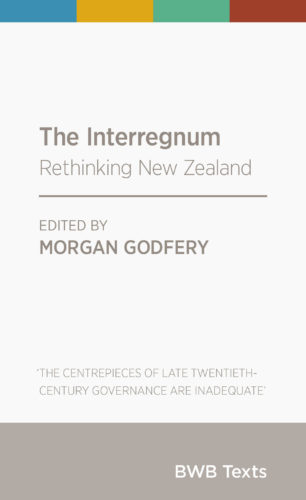
VJMP Reads: The Interregnum: Rethinking New Zealand III

This reading carries on from here.

The third essay in The Interregnum is “Reimagining the Economy” by Wilbur Townsend. I must admit that reading a book that opens with several Marx and Gramsci quotes which then goes into radical economic intervention makes me think of the millions of people who starved to death in the 20th century. Despite that, I continue in the belief that the left must have learned to moderate its radicalism by now.

Promisingly, this essay opens by sticking to sober facts. Townsend points out that the economy has grown by 48% since 1990, but the average wage is only 22% higher, on account of that the dividends of this greater economic growth is not being distributed. Moreover, wages in finance and insurance have grown 62% while wages in hospitality have grown 3%.

“There is money being earned in this country but, increasingly, it isn’t being earned by us.” This is the central lament of this essay, and it’s a fair one. After all, neoliberalism and free trade are sold to the people as innovations that will increase the logistical efficiency of getting cheap goods and services to market. But it’s not worth saving $500 on a television if you also lose $15,000 in wages.

In an odd coincidence, the essay contains a reference to Luddites, in the context of people who opposed technological advancement on the basis that it destroyed labour opportunity, and who question the liberating potential of these advancements. Jonty Gillespie and the machine cultists in The Verity Key refer to people as Luddites if they’re not interested in going deep enough into a virtual environment to forget the outside world.

Despite representing working-class sentiments more faithfully than Morgan Godfery managed in his opening effort, the middle-class social justice warrior influence does shine through at some points in Townsend’s essay, such as when he laments that “Misogynistic workplaces” and “sexist bosses” are responsible for the dearth of female truckies and wharfies. One suspects that some of Townsend’s acquaintances would happily have a proportion of men castrated if such was considered necessary to “solve the gender gap”.

Like many in the left of today, biological explanations for gender differences are avoided with superstitious fervour.

The youthful idealism also shines through when he argues for a universal basic income.

No matter how good the arguments for a universal basic income are, we have never had one before and there are good reasons for this. Townsend possesses an eerie certitude about the idea that a universal basic income would lead to a sharp increase in the quality of life, and, although there’s good reason to agree with him, raising the spectre of people dropping out of society to move to Takaka and smoke bongs might not sell it to a Middle New Zealand that just put the National Party in power for nine years.

Townsend takes this idealism so far as to insist that the factories, machines and raw materials should be returned to the collective. He pre-empts the obvious criticism by acknowledging that historians don’t have much time for Communism, but he waves it away by saying “I suspect they just haven’t noticed it done well.”

Despite this, he makes a good point when he mentions that sovereign wealth funds could serve as the capital owners of a range of national assets or robot workfleets, and from there a universal basic income might become possible.

In summary, this essay mixes some good points with a terrifyingly nonchalant self-righteous belief in the primacy of Marxist ideas. It’s probably fair to consider this a piece inspired by youthful idealism, despite the intelligent points occasionally raised.

VJMP Reads: The Interregnum: Rethinking New Zealand II

This reading carries on from here.

The second essay in The Interregnum is called ‘Speech and Silence in the Public Sphere’ by Andrew Dean. It recounts the story of the abuse copped by Eleanor Catton in the wake of her criticism of the direction the county was taking in 2015, and how this is indicative of deteriorating levels of public discourse.

Although most of the essay is devoted to quoting Philip Catton, which makes one wonder why Professor Catton didn’t write the essay himself, it aptly summarises the state of the cultural wars in New Zealand and in the West. The narrative of neoliberalism is triumphant; its victims are marginalised because their suffering goes against this narrative.

I was in Philip Catton’s History of Science class at the University of Canterbury in the year 2000. It’s curious to think about what the professor teaching that class 100 years from now will say about our time, and about the quality of our public discourse. Dean is right: our public discourse has degenerated to a shameful level, even as the Internet has theoretically made it easier than ever to share science, knowledge and truth.

Catton and Dean both have a point when they say that inequality has made the level of discourse more degenerate. The greater the inequality in a society, the more criticism of it is dismissed as “whinging” by those at the top and their lackeys in the mainstream media. Furthermore, the greater the inequality the more society becomes stratified into subgroups that speak their own dialect, so that it becomes difficult to communicate between different positions on the hierarchy.

The worse any one group of people is doing, the less their voices fit the neoliberal narrative that “Everything is better than ever, so spend spend spend!” And so, the more their voices are silenced by a mainstream media that is beholden to the same capitalist interests who support neoliberalism.

Dean refers to the same pattern that Dan McGlashan calls the “general disenfranchisement rule” in the demographic analysis Understanding New Zealand. It’s a feedback loop in which increasing inequality causes the people in the lower socioeconomic demographics to lose faith in the belief that the system represents them at all, which leads to a decreased turnout rate in elections, which leads to a system that represents them even less, leading to a further decreased rate and so on.

He also mentions the effect that neoliberalism had has on the discourse at our universities. Instead of acting as the conscience of the nation, our universities have to compete for students in order to get funding, which means that they have to present a certain image. In the case of New Zealand universities, which get a lot of international students from Asia, it is almost impossible to have a public discussion about the need for cannabis law reform.

All in all, this essay is pleasingly accurate and concise, and ends by pointing out that not only it is necessary to point out the failings of neoliberalism it is also getting harder to do because of the silencing of dissenting voices to the mainstream narrative.

The Future of Empathy

Empathy has probably evolved to facilitate social interaction in the human species, which is why an absence of it tends to have antisocial consequences

By most measures, the world seems to have become a more empathetic place since the Stone Age. The average person’s chances of meeting a violent end are far lower today than back then, and one’s exposure to grossly traumatic events are also far lower. This has had some interesting effects for a species that may have adapted to a certain level of environmental violence.

In many ways, this increasing empathy is becoming standardised and expected. We are more empathetic than ever before by a number of measures: we share more of our wealth than ever, we commit fewer crimes against each other than ever, we have a much better understanding of mental illness than ever. We debate social issues – like bringing refugees into the country to be supported out of general taxation – that would have been unthinkable even a century ago.

The question arises: where does this process end? In my upcoming cyberpunk novel, The Man With A Thousand Fathers, I explore this point in some detail. It is set in the 2080s, when the science of psychology is much more advanced than what it is today and when the confluence of virtual reality and psychoactive research chemicals has meant that the world on the flipside is often realer than this one.

In the Thailand of the story world, children who are discovered to have defective levels of empathy are put into a virtual reality environment instead of being allowed to go into real life, and then raised with exposure to a set of stimuli specifically calculated to condition them to be more civil. One of the story’s characters, an orphan named Suwat, spends over a decade in such a virtual environment before being released.

It’s entirely possible that such a thing may eventuate, for utilitarian reasons. It’s not difficult to predict the kinds of children who are going to grow up to be criminals. They’re simply the kids that lack empathy for other kids. Any schoolteacher could tell you with high accuracy which children in their class are likely to grow up to cause problems and which children are not.

It’s also not difficult to predict why these kids lack empathy. The vast majority of the time it’s because they themselves aren’t shown empathy at home. Children are not born knowing what’s what; they learn to base their behaviour and moral values on what is demonstrated to them as normal. If a child’s parents don’t show empathy to each other or to that child, that child might well grow up to learn that not showing empathy is normal.

A child who has been exposed to really bad things might even come to learn that empathy is weakness that makes a person vulnerable. They might learn that showing empathy is a signal that one is soft, and that one dare not show it in case it invites aggression and exploitation.

With advancing virtual reality technology, we’re almost at the point where using a virtual environment for therapeutic purposes becomes mainstream. Virtual reality therapy has already shown promise in treating soldiers suffering from PTSD.

Extrapolating from this, it might become possible, if a virtual environment was engineered accurately enough, to use VR therapy to cure a wide range of psychiatric illnesses and disorders.

On the darker side, advancing technology might also make it possible for psychotechnicians to use machines to measure aspects of brain activity that the owner of the brain might not themselves be aware of. It has been possible to detect homosexuality in a subject for decades by exposing them to graphic homosexual images and measuring whether certain parts of the brain spark into life or not, and who knows where this sort of technology might lead.

It might happen that young children are exposed, en masse, to virtual reality examinations in which their brains are tricked into thinking that they’re in situations where empathy is required, and then their levels of empathy are measured. Anyone with too low a level is shipped off to VR therapy in the hope that they can learn to become more co-operative.

*

Vince McLeod is the author of ANZAC cyberpunk novel The Verity Key.

If Charles Manson Was a Serial Killer, What Was George W Bush?

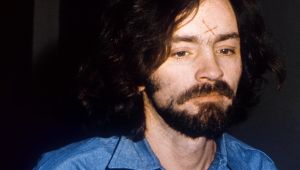
Charles Manson: responsible for 999,991 fewer deaths than George W Bush

News media are reporting that one of the world’s most “notorious serial killers”, Charles Manson, has died in prison. Described as a “mass murderer” by many, including Wikipedia, Manson was found guilty for a string of murders committed by followers of his Family cult, even though it was only ever alleged that he ordered the killings. But if Manson was a serial killer for ordering the deaths of nine people, then what is George W Bush, who ordered the deaths of a million?

It’s well known that Charles Manson never killed anyone himself (at least he was never tried of a murder that he committed himself). At his famous trial, where he faced several counts of murder, it was never even alleged that he killed anyone. From the beginning it was asserted that the Family members had killed on his authority, and so Manson was as good as guilty even if he hadn’t literally murdered.

One obvious question arises from this. If being the leader of a hippie cult that killed nine people is enough to get a man put in prison for life, how has George W Bush got away with being the leader of a statist cult that killed over a million people? Surely, according to the same logic that was used to imprison Manson, George W Bush ought to stand trial for several hundreds of thousands of counts of murder and up to a million counts of manslaughter?

All of the US soldiers that killed people in Iraq from 2003 onward justify what they did because they had vowed to follow orders. They had sworn to do whatever they were told by their superior officers (unless it was illegal), and their superior officers had done the same, all the way up to the first link in the chain of command, which is the President. It was the President’s word that got the invasion started, and the President’s authority that justified it.

So if the actions of Manson’s followers made him guilty of murder, then the actions of George W Bush’s followers have also made him guilty of murder.

Even worse, Charles Manson had very little in the way of guidance that he could have drawn on to make a better decision. He was the son of an alcoholic teenage prostitute, and so wasn’t raised to learn how to make good judgments. What’s George W Bush’s excuse for so callously ordering a military action that killed over a million people? He was the son of a president himself, so should have learned better judgment than anyone else.

Moreover, the people of the world demonstrated in no uncertain terms that they thought the invasion was a bad idea. Over a million people protested in London, and three million in Rome – still the largest protest in world history. The whole planet told George W Bush that what he proposed to do was going to be a humanitarian catastrophe – so he can’t say that he wasn’t warned by the world that he was making an error.

So if Charles Manson was worthy of all the hatred he endured because he was guilty of possessing a monstrously arrogant disregard to the value of human life, then George W Bush is worthy of a hundred thousand times more.