
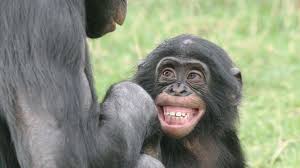
A Person’s Politics Follow From Their Conception of Human Nature

People who believe that humans are more like bonobos than chimpanzees tend to be left-wing, and vice-versa

Most people with strong political opinions like to think that their opinions are perfectly logical, and derive directly from natural principles. Although most people are correct and reasonable in that their political opinions follow logically from their perception of human nature, the problem is that people have an extremely varied range of beliefs when it comes to their perceptions of human nature. In some cases, there’s no way of knowing who’s right.

Take, for example, the question of nature versus nurture. This is another way of asking: how much of a person’s behaviour can be attributed to natural causes that they were born with, such as genes, and how much can be attributed to environmental causes, such as how they were raised?

All positions on this extremely important question fall somewhere between 100% nature and 100% nurture, the former being known as “genetic determinism” and the latter being known as the “tabula rasa” (“blank slate”) theory. This sounds objective and scientific, but it really isn’t, because one’s attitude here will reflect one’s political opinions.

Take the question of Third World immigration and refugees, for example. A person who believes in genetic determinism might be extremely reluctant to open the borders to African or Muslim refugees, because they will tend to believe that these people will never and can never learn to behave in a civilised manner.

A person who believes in the tabula rasa theory, by contrast, will tend to believe that the wealth of Western nations is because of cultural reasons, and therefore African and Muslim refugees will acclimatise to the Western way of doing things, and therefore over time their crime rates and income levels will equalise with the native population.

Another area in which this occurs is with regard to bonobos and chimpanzees. Here we can also see that a person’s belief about the scientific, biological reality of the human species has a profound effect on their political beliefs.

Bonobos and chimpanzees are the two generally accepted chimpanzee species, and some (such as Jared Diamond) have argued that humans are so similar to them that we belong in the same group as them as a third chimpanzee. But from which of the two can we draw more accurate inferences about the true nature of behaviour in the human animal?

The bonobo is a creature of peace, the chimpanzee is a creature of war. This is evident from observing the two species in their natural habitat. The chimpanzee is violent, cruel, loves fighting and tends to cure anxiety by bashing a weaker chimp. The bonobo is hypersexual, loves bonding and grooming and tends to cure anxiety by having sex.

If a person believes that humans are more like the bonobo they will tend towards pacifism and polyamory, and will be left-wing. If a person believes that humans are more like the chimp they will tend towards violence and monogamy, and will be right-wing. This is true even if the person in question knows nothing at all about the ethology of the two species.

A third is whether or not people are naturally lazy. This one is especially difficult because attitudes to industriousness are biological to a major extent.

Few appreciate this, but in a cold environment people evolve to be active because physical activity keeps you warm, and this confers a survival advantage by staving off colds and hypothermia-related conditions. In a warm environment people evolve to be inactive because physical activity gives you heatstroke.

This is why pale-skinned people tend to work hard and dark-skinned people don’t – it’s not because of any moral failure on the part of the latter.

Consider this information in the context of whether or not we should bring in a universal basic income. The fear on the conservative side is that a universal basic income would cause certain demographic groups to become lazy and shiftless, and they would all stop working immediately and live the parasitic lifestyle natural to their kind.

If a person’s conception of human nature is not that people are lazy but rather that people are industrious, they will be much more likely to support a universal basic income out of the hope that it will free people from drudgery and therefore enable them to put their energies into creative endeavours of more benefit to human happiness.

In summary, it’s usually possible to surmise a person’s political opinions from their belief in human nature. Political opinions are not formed in a vacuum – they are informed by many factors, one of which is a person’s belief in how other people naturally behave given a certain schedule of reinforcements and punishments.

*

If you enjoyed reading this essay, you can get a compilation of the Best VJMP Essays and Articles of 2017 from Amazon for Kindle or Amazon for CreateSpace (for international readers), or TradeMe (for Kiwis).
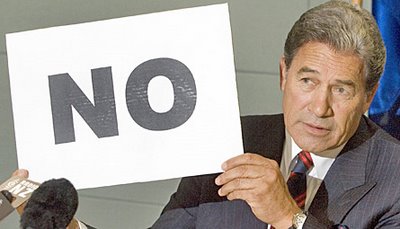

New Zealand First Risks Destruction If It Opposes Medicinal Cannabis Reform

From Jim Anderton to Peter Dunne and now to Winston Peters, New Zealand has always managed to find one piss-soaked old bastard to hold up cannabis law reform

The New Zealand First Party won 8.7% of the votes in the 2014 General Election, which entitled them to 11 Parliamentary seats. Strategic blunders saw them fall to 7.2% of the vote in 2017, still above the 5% threshold but precariously so. New Zealand First is at risk of committing another strategic blunder by opposing Chloe Swarbrick’s Medicinal Cannabis Bill, and this article will explain why.

Dan McGlashan’s Understanding New Zealand provides us with an explanation for what happened here. We can see that the correlation between being Maori and voting New Zealand First was initially very strong, at 0.66 in 2014, when they did very well in the Maori seats. By 2017 the strength of this correlation had fallen to 0.38, as a large proportion of that Maori support abandoned the party.

Between 2014 and the 2017 General Election, New Zealand First came out in opposition to those same Maori seats in which they had done so well. This was a massive error because Maori people are extremely reluctant to cede any kind of political power to the Crown, for the understandable reason that when they have done so in the past, they ended up losing heavily from it.

New Zealand First were punished at the ballot box in 2017, losing 1.5% of their vote, mostly from Maoris who switched back to to Labour.

Between 2017 and the 2020 General Election, we may see another fall in New Zealand First support, and for similar reasons, only this time it may be catastrophic. The difficulty is that Winston Peters risks betraying the wishes of many of the people who support their party by opposing Swarbrick’s Bill.

On the Bill, Peters is quoted as saying “It goes far too far. There’s no restrictions at all, it’s random, it’s haphazard, it’s free for all.” Whether this means New Zealand First will support the Bill through its first reading or not is unclear, but if they vote to dismiss the Bill they run the risk of self-destruction, because they will alienate many of their core supporters.

Invalid’s beneficiaries are heavy supporters of New Zealand First – the correlation between being on an invalid’s benefit and voting New Zealand First in 2017 was 0.47, which is moderately strong. Many of these invalids have found medicinal relief in cannabis, which is reflected in the strong correlation of 0.79 between being on an invalid’s benefit and voting Aotearoa Legalise Cannabis Party in 2017.

These stats suggest that there are a large number of cannabis-using invalids who voted New Zealand First at the last election, and further New Zealand First opposition to cannabis law reform risks alienating these people further.

Although New Zealand First does get more support from older people than younger ones, this is nowhere near as pronounced as most people think it is. The correlation between median age and voting New Zealand First in 2017 was only 0.26, in comparison to the correlation of 0.78 between median age and voting National in 2017.

Therefore, concern about the opinions of elderly Boomers with regard to cannabis ought not factor too heavily in New Zealand First’s calculus. The vast majority of young people support proper cannabis law reform, and New Zealand First risks tarnishing their image among these voters through their conservatism on this issue.

Perhaps the biggest risk that New Zealand First runs by opposing this medicinal cannabis bill is through losing the support of the New Zealand-born, who are not only the biggest New Zealand First supporters by far but also the biggest cannabis law reform supporters by far. The correlation between being New Zealand-born and voting for New Zealand First in 2017 was 0.54, which is moderately strong, but the correlation between being New Zealand-born and voting for the Aotearoa Legalise Cannabis Party in 2017 was 0.73.

Cannabis use is an intrinsic part of Kiwi culture, and it’s not going anywhere. If the New Zealand First Party really wants to make good on its pretensions to represent Kiwis and our culture, they need to accept the fact that we really enjoy using cannabis and are going to keep doing it.

New Zealand First might be tempted by conservative instincts to oppose this bill, but you can’t piss directly in the face of your own supporters in that way and expect that they will turn out to support you when you ask for it at election time. Maoris, young people and invalids are all heavily impacted by our ludicrous cannabis laws, and young Maoris doubly so. They have been crying out for relief, and a recreational alternative to alcohol, for decades.

New Zealand is already 22 years behind California on the medicinal cannabis issue, and New Zealand First is causing this country to fall further and further behind, mostly at the expense of their own long-term voters. If they don’t keep up with the state of play and research in other jurisdictions they risk destruction at the hands of the voters.

*

If you enjoyed reading this essay, you can get a compilation of the Best VJMP Essays and Articles of 2017 from Amazon for Kindle or Amazon for CreateSpace (for international readers), or TradeMe (for Kiwis).
The Four Kinds of Warfare

When a person hears the word ‘warfare’, it usually conjures up images of fire and explosions, bombs, tanks, blood, death, bayonets and bullets. This is what most people mean by ‘warfare’. As this essay will examine, there are four different elementalist perspectives that we can take towards the subject of war, depending on the realm of reality that we are in.

The element of iron corresponds to the kind of warfare that we are used to. In the natural world, iron represents the strength that came to dominate over the clay. It is the strength of muscle, claws and fangs, and later bone clubs and spears, and then swords, axes and knives and then firearms.

When we talk about warfare we’re usually talking about warfare on this level. Here the goal of the warfare is to reduce one’s opponent to chaos by destroying the coherence of (and therefore the order in) their physical body. The element of iron is especially useful here because it can be hammered into a tool that can pierce or slice through an opponent’s body of clay.

Much of modern warfare in this sense is really a logistical challenge that seeks to optimise how quickly iron can be moved from one part of the battlefield to another. Hence, bullets move as fast as possible and tanks move as fast as cars despite weighing several tons. The apogee of this process might be the aircraft carrier, many of which can carry dozens of strike fighter jets plus other armaments.

The element of silver corresponds to economic warfare. This means that it is a warfare of primarily unseen things: debt and interest rates being the foremost of them. In the same way that a man with an iron instrument can reap a field of wheat, a man with a silver instrument (such as a bank charter) can reap a field of men.

The nature of this economic warfare is silvery like the gossamer of a spider’s web. Its power does not come from crushing and slicing, like the iron, but from dazzling and entangling. It has been used ever since Babylon and bases itself on things that people with ordinary intellects have trouble understanding, like fractional reserve banking.

So people with low levels of financial literacy find themselves bedazzled by the promise of, for example, an instant loan no-questions-asked-right-now, and this leads to them becoming entangled in scams like payday loans that they take out to blow on something like a holiday, and then getting bled for a small amount every week forever to service the interest.

The element of clay corresponds to demographic and biological warfare. This does not mean biological in the sense of nerve agents and genetically engineered viruses, but in the sense that the most powerful weapons of any group of people over the long term are the wombs of their women.

Most refuse to acknowledge it, but Europe is in the process of being conquered by an r-selected, equatorial enemy that primarily wages war by reproducing at a high rate and ensuring that the children produced are brainwashed into willingly serving as soldiers for the furtherance of the meme complex. This is warfare of clay because it’s the same way that plants and insects outcompete each other: by spitting out as many offspring as possible.

It has been said that “demography is destiny”, and this is clearly true if one looks back over history and notes how high birth rates inevitably lead to the surviving offspring seeking out new territories (and usually killing the existing occupants of them). The British Empire was also founded on high birth rates and it has been the same for every previous empire in history.

The element of gold corresponds to spiritual warfare. This is the hardest perspective to understand, and it is the perspective that is the most valuable.

The reason why it is the most valuable is the battlefield in question here is the human will, absent which, no force can triumph in any of the other three areas of warfare, no matter how vigorous, strong or smart.

It isn’t a simple matter to describe how warfare is conducted on this level, but it’s enough to say that the spiritual birthright of every human being is to understand that their core essence is pure consciousness, and that this consciousness is immortal, invulnerable and eternal and is the same as God.

*

If you enjoyed reading this essay, you can get a compilation of the Best VJMP Essays and Articles of 2017 from Amazon for Kindle or Amazon for CreateSpace (for international readers), or TradeMe (for Kiwis).

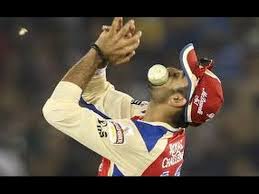
Will We Ever See Tactically Dropped Catches in T20?

Pictured: not a deliberate drop

There is a nightmare scenario lurking in the future shadows of T20 cricket. It’s unexplored territory that arguably goes against the spirit of the game, like the underarm delivery or the Mankad. The possibility of it is so unpalatable that few have thus far dared think about it. The nightmare scenario is this: Will we ever see a T20 match in which a fielder deliberately drops a catch?

The reason why this might become an issue is because of scoreboard pressure. Considering the following scenario:

It is the second innings. The team batting first scored 200, and in response, the chasing team is 141/1 after 15 overs. This means that the chasing team needs 60 runs off 30 balls, a RRR of 12 per over. This is a challenging task but not ungettable. The No. 3 batsman is in, but has struggled to get the ball out of the middle all day and is striking at less than 100. The Nos. 4, 5, 6 and 7 batsmen are all established hitters who reliably strike at 125+. The No. 3 batsman has just hit the first ball of the 16th over in the air towards mid-on, who is lining it up.

The question: Is it in the interests of the fielding team for the mid-on fielder to complete the catch, or is it better for him to deliberately palm the ball into the ground?

Consider the match situation. The chasing team needs 60 runs off 30 balls, which essentially means that they have to score boundaries. The No. 3 batsman has had trouble hitting boundaries all innings, which means that the chasing team has a fair probability of losing if he remains at the wicket, because he will use up deliveries that the Nos. 4, 5, 6 and 7 batsmen could be using to strike boundaries.

If he gets out now, on the other hand, those batsmen will be able to come in and strike at a higher rate, meaning that the chasing team would have a much higher chance of winning the match.

In simpler terms, what happens when the wicket count is meaningless on account of there being so few overs left and the current striker has a lower strike rate than the next man in (or, at least, the fielding team anticipates that he will have a lower strike rate)?

Against this, it might be argued that a set batsman will have his eye in better than the next batsman in, and so taking the catch will always benefit the fielding team. Moreover, taking the catch makes it more likely that the bowlers can get into the tail.

But that doesn’t negate the possibility, however unlikely, that a match situation may arise in which the fielding team calculates that the match is unwinnable for the chasing team while a certain batsman is at the crease on account of the intensity of the scoreboard pressure.

What may happen in the end is that batsmen are simply sent to the crease in descending order of strike rate.

*

If you enjoyed reading this essay, you can get a compilation of the Best VJMP Essays and Articles of 2017 from Amazon for Kindle or Amazon for CreateSpace (for international readers), or TradeMe (for Kiwis).