Kieran Read Quits Rugby For Cricket, Citing Head Injury Concerns

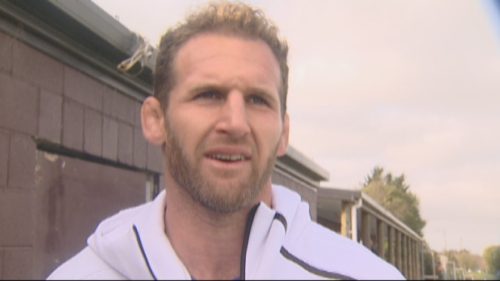
Kieran Read speaks to the media outside his Papakura home this morning

New Zealand and the rugby world have been shocked this morning by the announcement that Kieran Read is retiring from rugby union effective immediately, and has set his sights on making the Black Caps squad “within the next 18-24 months”. Read, who has 108 caps for the All Blacks, told the nation this morning that several years of minor knocks to the head have made him decide that enough is enough, and he has been forced to make decisions with his long-term wellbeing in mind.

Read, who played for the Crusaders as well as the All Blacks, is convalescing from back surgery for a slipped disc. Spending this time with his family, including his two young children, gave him an appreciation for the long-term risks of brain damage from repeated blunt force trauma to the head.

“Rugby is a great game and always will be a great game, and I have had a great career,” Read explained to a media scrum outside his home this morning. “But I have also had a very long career, and a career in an age where rugby players are heavier and faster than ever before. I’ve taken a number of blows to the head in my dozen years as a professional rugby player, and the past few weeks have made me realise the importance of being there for my own kids, in the future, in good mental health.”

Reading from a prepared statement, Read mentioned the recent news coming out of the NFL about the long-term effects of repeated head trauma, and how this, along with increased attention being given to the issue by way of Head Injury Assessment protocols, changed his previously casual attitude. Recent research appears to be suggesting that up to 40% of former NFL players suffer from brain damage – and they have helmets. Rugby players don’t tackle with the head, but rugby is still a collision sport.

“Spending time playing with my kids, and feeling headaches like I do, forced me to ask whether it was necessary to risk further brain injury. I have given my all for the All Blacks and for the various teams I have been involved with, and on balance have decided that it’s time to put my family and my head first.”

Speaking exclusively to VJM Publishing’s Dan McGlashan, Read says that he’s put out the feelers to New Zealand Cricket but isn’t expecting miracles. “I’ve spoken to Hess [Black Caps coach Mike Hesson] and he’s made clear to me that there are no guarantees about selection. I’ll be judged on my merits, primarily as a batsman and initially for my Papakura club side, and we’ll take it from there. No guarantee about any ‘X-Factor’ weighing in my favour like Jeff Wilson got.”

Read was a useful cricketer in his high school days, going as far as representing New Zealand in Under-17 cricket, but felt forced to make the decision to focus solely on rugby as a demanding professional career loomed. In an age of cricket where the importance of defence is minimised in favour of massive hits, the 6’4″, 111kg Read stands in the same category as Chris Gayle and Kevin Pietersen as a man who can swing the willow extremely hard.

It’s not yet known who will replace Read as All Blacks captain, but the front runners are believed to be Crusaders captain Sam Whitelock, who has taken more of a leadership role in recent years, and openside Sam Cane, who captained the All Blacks during their 2015 Rugby World Cup match against Namibia.

*

Dan McGlashan is a regular contributor to VJM Publishing and is the author of Understanding New Zealand.

Should There Be A Ministry of Men’s Affairs?

Life is so much harder for men in New Zealand that they kill themselves at almost three times the rate of women

Many people were shocked, and many were not, by Julie Anne Genter’s comments this week about old white men. Speaking to Cobham Intermediate School pupils, Genter made the point that some of these old white men “need to move on and allow for diversity and new talent.” These statements were made in her capacity as Minister for Women, but if you look at the statistics, it seems like there’s more need for a Minister for Men.

The reason for a Ministry of Women’s Affairs was ostensibly to close the gaps between the well-being of women and men. Since the advent of Abrahamic religion in the West, women have been forced into a subservient role, being forced to take the blame for the fall of man as well as for invoking the horror of Nature. Biblical passages such as Timothy 2:12 instructed Christendom that “I do not permit a woman to teach or exercise authority over a man; she is to remain quiet.”

Ever since these male supremacist religious cults invaded the West, our women have been forced to endure structural abuse. Divorce was banned, forcing women to endure permanent relationships with violent men. Prostitution was banned, denying women natural opportunity for economic advancement. Abortion was banned, forcing women to carry unwanted children to term or else risk a back-alley abortion from a “doctor” with no licence.

By any objective measurement, women had the worst of it for a very long time, and, when we realised this, we tried to make up for it with things like feminism and Ministries for Women’s Affairs. What we’ve been slow to realise is that, now that advantage is mostly a matter of obedience to the political, educational and commerical authorities, women have it better than men in many regards.

Most obviously, women have a much easier time of things in academic settings. Page 38 of the document linked in this paragraph demonstrates that women get better grades in literacy, and page 42 shows that they also get better grades in numeracy. This disparity is even worse for men at university level, which New Zealand women are 40% more likely to participate in.

When men had higher university participation rates than women, the media couldn’t keep quiet about how sexist and evil this state of affairs was. Indeed, this was one of the stated reasons for bringing in a Ministry of Women’s Affairs in the first place. An inequality of outcome in terms of education and gender was simply impermissible, immoral, outrageous.

In 2015, 527 New Zealanders killed themselves, of who 384 were men (72.8%). That means for every Kiwi woman who feels so rejected by society that she is compelled to take her own life, there are almost three Kiwi men who feel the same way. This is greater than the gap between Maori and non-Maori suicide rates, which is itself considered a large enough gap to be a national tragedy that demands immediate action (indeed, there is a Ministry of Maori Development).

So if society is so bad for Maori people that they need their own Ministry, as evidenced by suicide rates, and if society was so bad for women that they needed their own Ministry, as evidenced by tertiary participation rates, then surely there is sufficient cause to say that New Zealand men need someone looking out for them as well?

It’s absurd to claim that women are disadvantaged compared to men because men earn 20% more, when at the same time men are killing themselves at almost 300% the rate of women. It’s doubly absurd when it’s considered that women are benefitting immensely from the way that the pension system is set up, at the expense of predominantly male workers.

If the experience of being a man in New Zealand is so much less pleasant than the experience of being a woman that it carries triple the risk of suicide, it’s time to take steps to redress the balance by instituting a Ministry of Men’s Affairs to make up for all the privilege that women hold.

*

If you enjoyed reading this essay, you can get a compilation of the Best VJMP Essays and Articles of 2017 from Amazon for Kindle or Amazon for CreateSpace (for international readers), or TradeMe (for Kiwis).

Why Are The English So Poor At Sport?

Sometimes it hurts to be English – especially when playing against Southern Hemisphere sports teams

It could never be said of the English that they are poor sports, but they are poor at sport. Almost astonishingly so. For a nation of 50 million, their historical sporting achievements are dismal: one Soccer World Cup, one Rugby World Cup and a small hatful of Olympic medals are all they have gathered thus far. This article looks at why England is so poor at sport despite massive population and economic advantages over most of their opponents.

There may not be any sport more English than Test match cricket. Not only did England invent the predecessor – first class cricket – but they were also the first to start playing the highest level of the game internationally, with Tests against Australia and South Africa. They’ve been at it the longest, and they have more money behind it than anyone else.

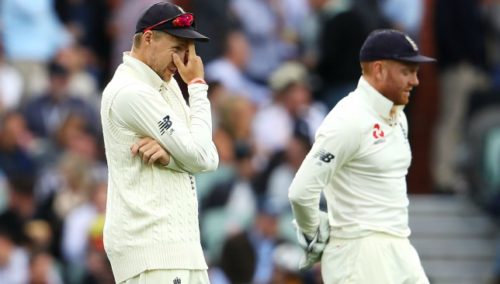
Despite that, their Test cricket record isn’t the greatest. They just got a hiding in their most recent Test – losing by an innings – to New Zealand, a nation with less than a tenth of the population and economic resources. Not only did England lose, but they were bowled out for 58 in their first innings – an outcome that can be rightly described as a humiliation.

Nor was this a fluke – New Zealand are ranked higher than England in Tests, as are Australia, South Africa and India. This outcome is as unlikely as America inventing basketball yet being ranked lower than, say, Argentina.

England doesn’t do any good at rugby union either, despite having invented that also. Although they have been hyped for months by the media as the No. 1 challengers to Steve Hansen’s All Blacks, the English side crashed to 5th place in this year’s Six Nations, a result almost as bad as their group stage exit in the 2015 Rugby World Cup. They are regularly destroyed by teams like New Zealand and Ireland, and this year copped a hiding from Scotland, despite that these nations are but one-tenth of England’s size.

At this point, an Englishman might contend that both cricket and rugby union were relatively niche sports in England and that the major sporting preoccupation was and is, by far, soccer. Australia’s favourite sport is cricket and New Zealand’s is rugby, so those sports attract their best athletes – it’s not surprising they win. England’s best athletes play soccer.

The obvious problem here is that the English don’t do any good at soccer. Despite winning the World Cup in 1966, they haven’t come close since. Nations of similar size and economic power, such as France, Germany and Italy, put English achievements on the soccer field to shame. England hasn’t won a Soccer World Cup in half a century; Germany has won three, Italy two and even Argentina has managed a couple of wins in this time.

England’s best result, in their favourite sport, at any point in the past 50 years was a 4th place finish in 1990. So given the size and power of England, their lack of sporting success demands an explanation.

In essence there are two major reasons why English sporting prowess is so feeble: one eugenic, one spiritual.

The eugenic reason is a question of history. The British Empire was the largest that the world had ever seen, at one point covering one quarter of the world’s land area. Considering that Britain itself is just a small speck off the European coast, it meant that there were enormous new frontiers of land that needed men to work them.

These frontiers needed a certain kind of man. The land was untamed; it needed muscle to clear it and to build the new settlements and roads. Roads had to be dug from hillsides, forests had to be cut down by hand. There were frequent military threats from angry natives, and these needed to met by men with the strength and will to defend a plot of land with violence. Big, strong, tough men.

Over the course of a few centuries, the English divested themselves of their most physically impressive genes, as the carriers of them, being naturally more adventurous, tended to move to the colonies, leaving the sickly, lethargic and weak behind. This means that the modern English population bears all the hallmarks of centuries of dysgenic selection in favour of physical weakness.

The spiritual reason might also be a question of history. For whatever reason, English people no longer have the will to assert themselves. It may be guilt arising from having built a gigantic colonial empire in which many native peoples were brutally oppressed, or it could be residual trauma from many years of horrific warfare over the past century.

In either case, the English people have been so brutalised by their ruling classes over the past millenium that the populace essentially lives in a state of permanent abuse-generated submission, in contrast to the free and easy Aussies and Kiwis. Muslim rape gangs prey on English girls without fear, knowing that the locals are too cowed to do anything about it.

These historical processes have led to a spiritual vacuum, crippling the English from within. It may be that this absence of spirituality has led to English sports teams lacking the will the assert themselves on the sports field.

*

If you enjoyed reading this essay, you can get a compilation of the Best VJMP Essays and Articles of 2017 from Amazon for Kindle or Amazon for CreateSpace (for international readers), or TradeMe (for Kiwis).