
The 2017 New Zealand Political Whores Index

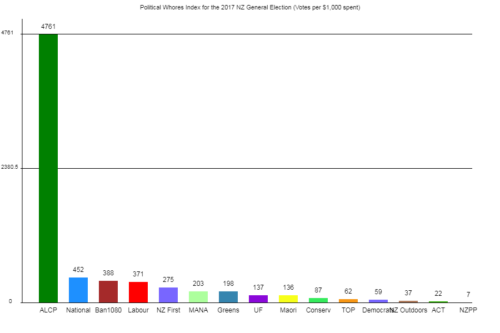
A bar chart of the Political Whores Index, calculated as votes received in the 2017 General Election per $1,000 spent

The New Zealand Electoral Commission has now returned its list of party expenses for the 2017 General Election. This enables us here at VJM Publishing to update 2014’s Political Whores Index. 2017’s Political Whores Index tells us who tried to earn a place in Parliament, and who tried to buy one.

The logic of the Political Whores Index works like this. Political parties spend money at election time to get media exposure, because the more media exposure a party gets, the more votes it gets. This is usually easier and cheaper than actually talking to people and hearing their concerns. Effectively, parties just turn on the media funding tap and votes come out.

The correlation between dollars spent on campaign expenses for the 2017 General Election and votes received is 0.95, which pretty much tells us that our democracy is for sale. The more money you can spend, the more votes, is the hard and fast rule.

So all of our political parties are whores, but it can be said that the more money a party spends and the fewer votes they get, the more of a whore they are. This can be considered whoring because the parties that do it try to buy votes by transmitting a manufactured impression through the media, rather than honestly trying to build goodwill among the people by meeting and talking to them so that they can form their own impression.

This willingness to whore oneself out instead of honestly building a positive reputation among the New Zealand people can be expressed as a ratio of dollars spent on election expenses to votes returned by the populace. As was true of our effort in 2014, which saw the ACT party crowned the whoriest party in New Zealand and the Aotearoa Legalise Cannabis Party the most honest one, we will present those ratios in an ordered list.

In the following table, PWI stands for ‘Political Whores Index’ and is calculated by dividing the number of votes each party received in the 2017 General Election by the declared party expenses for each party contesting the 2017 General Election (in dollars), multiplying the remainder by 1,000, then rounding to the nearest whole number.

In other words, it represents the number of votes won per $1,000 spent.

PARTY $ SPENT VOTES PWI
ALCP 1696 8075 4761
National 2546742 1152075 452
Ban1080 7749 3005 388
Labour 2580523 956184 371
NZ First 679095 186706 275
Internet 2322 499 215
MANA 17921 3642 203
Greens 818525 162443 198
United Future 12963 1782 137
Maori 225552 30580 136
Conservative 71764 6253 87
TOP 1013714 63261 62
Democrats 13761 806 59
NZ Outdoors Party 43508 1620 37
ACT 601487 13075 22
NZ People’s Party 274541 1890 7

For the second election running, the Aotearoa Legalise Cannabis Party was, by far, the least whoriest of all the parties that contested in 2017. They returned a staggering 4,761 votes for every $1,000 spent – unarguable evidence that cannabis law reform is an issue that the New Zealand people are demanding. As shown elsewhere, cannabis law reform is the issue that unites real Kiwis.

No other party achieved so much as 10% of this ratio. Many will be surprised to hear that the National Party was second, with 452 votes for every $1,000 spent. In short, the electorate wasn’t particularly displeased with how National was running things, despite that National lost power. Yes, there was widespread misery among the poor and we have the highest youth suicide rate in the world, but people who vote don’t care much about that.

The Ban 1010 Party was 3rd, just edging out Labour, who won 371 votes for every $1,000 spent. It’s curious, perhaps, that Labour and National are both doing quite well by this measure, as they are both mainstream parties. But this simply speaks further to how there was no real appetite for change among Kiwis. People weren’t particularly interested in upsetting the apple cart.

The New Zealand First Party did moderately well, gathering 271 votes per $1,000 spent. Unlike 2014, this was considerably poorer than the National and Labour parties, probably reflecting Winston Peters’s decline as a public speaker, as many of their votes in 2014 were gained through town hall meetings.

The Green Party were the whoriest of the four major parties. They only got 198 votes per $1,000 spent. So they spent about as third as much as National for about one-seventh of the votes. This tells us that the electorate has partially turned against the Green Party message, despite their strong support of the cannabis law reform issue. It may have been that the Green proposal to raise the refugee quota drove a lot of Maori and working class voters to Labour and New Zealand First.

The Opportunities Party was a poor return on investment, although as it was essentially a vanity project it could not be said to have failed simply on that basis. With wall-to-wall saturation coverage on FaceBook and other Internet portals, they spent over a million dollars for a little over 60,000 votes, thereby achieving a PWI of 62 votes for every $1,000 spent.

It’s illuminating to compare the PWI of The Opportunities Party with that of the ALCP. The Opportunities Party spent almost 600 times as much as the Aotearoa Legalise Cannabis Party, and won less than 8 times the number of voters. Considering that most TOP voters were voting for legal cannabis anyway, this figure shows that TOP was really a joke party that tried to buy its way into Parliament.

Speaking of joke parties that try to buy their way into Parliament, the Conservative Party scored a PWI of 87, only slightly better than TOP. This tells us that the 5% threshold is really an outstanding idea, because it prevents wealthy, narcissistic freaks from assembling a coterie of arselickers and simply spending so much money on media exposure that they can brainwash the mentally weakest twenty thousand of the population into casting a vote for them.

Worst of all, however, was the New Zealand People’s Party. Also the vanity project of a rich Baby Boomer, they pissed away over quarter of a million dollars for a paltry 1,890 votes. This left them with a PWI of 7, which means that their message was 660 times less appealing to the New Zealand people (all factors equalised) than that of the ALCP.

MANA (203), United Future (137) and the Maori Party (136) all had reasonably poor PWIs, but were still significantly higher than the “fuckwit” parties.

Ultimately, the Political Whores Index suggests that the New Zealand people are quite happy with our current arrangement of two major parties and two minor ones, because none of the more radical parties were able to gain any particularly high level of traction for their amount of electoral spending. It was mostly dollars in, votes out.

Just give us some real cannabis law reform.

*

If you enjoyed reading this essay, you can get a compilation of the Best VJMP Essays and Articles of 2017 from Amazon for Kindle or Amazon for CreateSpace (for international readers), or TradeMe (for Kiwis).


Writing Anorexia Nervosa

A person with anorexia nervosa can see themselves as hideously fat even while dangerously underweight

Anorexia nervosa (usually just called anorexia) is an eating disorder characterised by an overpowering fear of being fat or of gaining weight. This fear is so all-consuming that it can lead to illness from self-starvation. This article looks at how to write engaging and believable characters with the condition.

The basis of the psychopathology of anorexia is believed to be valuing of thinness. People with anorexia feel that being thin is extremely important, to the extent of it being an obsession. For this reason, anorexia is much more common among women compared to men, and more common among women exposed to fashion media or who have an interest in sport and fitness compared to other women.

More specifically, thinness is considered important because it’s where a person’s sense of self-worth derives from. Thinness is seen as a virtue by anorexics, which is why the condition is so hard to understand for people who don’t have it.

Some might be surprised to hear that anorexia is one of the most deadly of all psychiatric conditions, up there with schizophrenia and major depressive disorder. An unusually low body weight is linked to a wide range of physical ailments, as many elementary bodily functions cannot operate past a certain level of starvation. Even without intending to, it’s common for anorexics to become sick and die as a consequence of lengthy periods of starvation.

If you are writing about a protagonist that suffers from anorexia, their internal dialogue might have a lot of anxiety based around a need to be in control of their body weight. Sometimes such a person will have a ruthless, almost sadistic approach towards their own body. This explains why there is a high degree of comorbidity with Obsessive-Compulsive Disorder. A person with anorexia often becomes extremely particular and fussy about their food and their calorie intake.

Then again, the approach might be more feminine. Instead of a desire to control, having a meal might conjure feelings of fear, almost panic. The sight or smell of food might trigger a reaction similar to that of a person with a phobia encountering their object of fear. It might be enough to also trigger powerful feelings of self-loathing.

Much like psychosis, anorexia tends to come and go in ’bouts’. An episode of anorexia is often triggered by a traumatic life event. It may be that sudden high levels of stress and anxiety result in a desire to compensate for a perceived loss of control.

Anorexia is not a psychotic disorder. A person with it will generally know that they have something amiss about them – but therein lies the difficulty. This reasonable part of the mind struggles incessantly against the part of the mind that commands that one must be thinner no matter what. It might be that the part of the mind that desires thinness above everything is somehow stronger, or more able to assert itself.

The effect that this might have on a protagonist of your story is therefore similar, in many ways, to that of one with depression. Constant feelings of having undermined oneself lead to guilt, personal recrimination, and a loss of confidence in one’s own intelligence, one’s competence or even one’s will to live. As is true of most of the conditions in this book, anorexics tend to have damaged self-esteem.

Like many of the other conditions in this book, it’s believed that anorexia nervosa frequently has an origin in childhood abuse. It might be that this is the reason for why it goes in bouts: dysregulated stress responsivity arising from the trauma leads to extremes of anxiety, and when one of those extremes is reached, a sudden desire for extreme control appears.

The experience of other characters who have a friend or family member suffering from anorexia is usually a difficult one. In many ways, watching someone waste away through anorexia is similar to watching them waste away through a heroin addiction.

This often brings with it a range of feelings that might profoundly affect that character, in particular frustration at not being able to get through to the anorexic about how dangerous their condition is, and guilt about not being able to “do more” for them. Although it’s true that it’s hard to reason with people who have mental illnesses – by definition – it’s still very common for friends and family of people with them to feel guilt about not being able to do more to get them to live a healthy, normal life.

A more distant character who encountered someone with anorexia might get the feeling that the anorexic is uptight and rigid. Anorexia is often associated with a sensitivity to insults and disrespect, as as perfectionism, and a character that demonstrated any of these traits could plausibly develop anorexia or have a past history of it.

*

This article is an excerpt from Writing With The DSM (Writing With Psychology Book 5), edited by Vince McLeod and due for release by VJM Publishing in the summer of 2018/19.

Legalising Cannabis Would More Than Fix The Hole in New Zealand’s Education Budget

The Labour Party is crying loudly about the hole in the education budget, but is silent about the potential savings from repealing cannabis prohibition

Every week the Labour Party goes back on another one of its election promises, claiming that there’s much less money in the budget than anyone realised and so they won’t be able to fund anything: not education, not health, not welfare. What the criminal bullshitters in the Government don’t admit is that they could save 400 million dollars every year, starting tomorrow, simply by legalising cannabis.

The net benefits of repealing cannabis prohibition are no longer disputable. Eight US states now have fully legal cannabis, with further legalisation referendums to come, and no-one has any regrets. According to calculations by the New Zealand Treasury, this country is flushing $400,000,000 down the toilet every year in order to enforce a law that the New Zealand people do not want. That’s no small sum of money.

Education Minister Chris Hipkins has come out and said that there is a $1,100,000,000 shortfall in the education budget. The linked article cites Hipkins as claiming that “Over the next three budgets, $929m was needed to cover the cost of new schools and classrooms and to meet the cost of the Christchurch rebuild. The remaining $166m was needed for urgent remediation and demolition of classrooms and buildings that are unusable.”

In the linked article, Hipkins blames the former National-led Government for neglecting capital spending on educational buildings, claiming that Labour is not going to be able to meet its election promises as a consequence. But it’s absolutely absurd that the Labour Government is crying about funding shortfalls when it’s wasting such an incredible amount of money on conducting a War on Drugs against the New Zealand people.

According to the Treasury’s own calculations, if we legalised cannabis today, we would save $1,200,000,000 over the course of the next three Budgets, primarily through not having to fund the Police and “Justice” Systems to piss all that money up the wall on persecuting medicinal cannabis users. So it makes no sense at all for Labour to cry about a shortage of money when it’s wasting incredible sums on enforcing a law that the New Zealand people don’t want.

A study conducted in Colorado from last month has shown that even if one accounts for the increases in social costs that come in the wake of legalisation, there is still a large net gain to the economy. Moreover, “The researchers found no evidence that legal cannabis contributed to increased homelessness or increased youth use of marijuana.”

There are other costs to cannabis prohibition that don’t fall into the $400,000,000 of damages. By withholding a widely-recognised exit drug from people struggling with opiate addiction, we are literally killing the most vulnerable New Zealanders. Studies of American states that have liberalised their cannabis laws have shown that, given the choice between opiates or cannabis, many people with severe pain disorders prefer to use cannabis. This has led to thousands fewer deaths from opiate overdoses.

It’s absolutely insane that our school buildings are falling into disrepair, our hospitals have mold on the walls, and that our rape crisis centres are being closed down, all because of a lack of funding, when we’re wasting over a billion dollars every electoral cycle on cannabis prohibition. If the Labour Party were any less neoliberal than the National Party they replaced, they would open an honest discussion on the subject with the stated intention of legalising cannabis as Colorado did in 2012.

*

If you enjoyed reading this essay, you can get a compilation of the Best VJMP Essays and Articles of 2017 from Amazon for Kindle or Amazon for CreateSpace (for international readers), or TradeMe (for Kiwis).
Our Mental Health System Shouldn’t Run on WINZ Logic

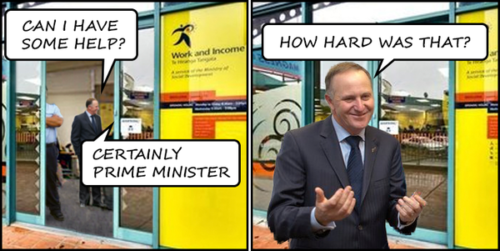
A lot of people complain about the way WINZ treats its clients, but their logic makes a certain sense. By verbally and psychologically abusing many of the people who come to them for help, WINZ staff sharply reduce demand for WINZ services and thereby save taxpayer money. This is called WINZ logic, and our mental health system runs by the same principles.

WINZ logic seems to appeal to the vast majority of New Zealanders. We like to consider ourselves a people who have “hardened up”, and who don’t need faggy things like welfare. Moreover, the high levels of diversity in our society mean that those at the top are unwilling to pay taxes for the greater good, because those taxes won’t be helping people like them. So we make sure that WINZ runs an extremely tight ship, where there is absolutely no wastage.

Somewhere along the way, someone working at WINZ realised that many of their clients could easily be discouraged from seeking WINZ services. Many people who need WINZ services are socially outcast or psychologically damaged, and so they are easily disheartened by abuse. If these people were spoken to like thieving, bludging, malingering scum, instead of being treated like fellow humans who need help, they were less likely to come back and ask for more money.

Ultimately, the essence of WINZ logic is this: the more unpleasant the experience of being a WINZ client can be made, the fewer resources WINZ clients will collectively consume.

With ever-tightening social welfare budgets under nine years of a National-led Government, treating the clients badly became the default way to distinguish between the deserving and the undeserving poor. If someone really needed a benefit, WINZ logic claimed, they’d keep coming back despite the mistreatment. So treating the clients badly achieves the twin goals of saving money while still helping the needy.

Unfortunately, our mental health system works on the same logic. In order to save money, patients are systematically verbally and emotionally abused by support workers. They don’t admit to this, and nowhere is it written that this is official policy, but it’s apparent from collating the experiences of many users of the mental health services that this is the case.

The logic appears to be that it’s better for a hundred schizophrenics to starve in the street than it is for one person to perhaps get a benefit that they didn’t 100% need. After all, a severely mentally ill young person who is unlikely to work again is liable to cost the country up to half a million dollars in benefit payments alone over the course of their lives. If people like this could be convinced to commit suicide instead, the potential savings could run into the hundreds of millions.

This might sound implausible to some, but it’s a natural consequence of neoliberal reasoning. Human life has a dollar value. If mentally ill people can’t contribute to the tax farm, and if we can’t just kill them directly, we have to encourage them to kill themselves. This reasoning was introduced to New Zealand by Ruth Richardson in the 1991 Budget and it’s now an indelible part of our culture. After all, we already have “by far the highest youth suicide rates in the developed world”.

If this wasn’t true, then the experience of being a user of the mental health services would be entirely different. One would be treated much like a person ill with a physical illness – as a fellow human being who had had something unfortunate happen to them and required care in order to recover to normal function. Doctors would answer your questions honestly. Consultations would work towards improving your mental health rather than merely assessing your work readiness.

Further evidence for this comes from the refusal to acknowledge cannabis medicine. Despite the fact that there was enough evidence for the medicinal value of cannabis for California to make it legal already in 1996, New Zealand politicians and doctors still have their heads up their arses. Now even Zimbabwe has legal medicinal cannabis.

What this approach to cannabis tells the mentally ill in New Zealand is that the mental health system isn’t really interested in helping them. It’s just: “Take these sedatives and get back to picking cotton.” It wouldn’t matter if 100,000 people all lined up to tell doctors that cannabis had helped them sleep or had helped with anxiety, depression or suicidal ideation. No-one’s listening, no-one cares.

Our mental health system shouldn’t run on the WINZ logic of withholding aid to as many people as possible. It should be recognised that an investment in a person’s mental health now will have excellent returns in both their future productivity and future unwillingness to use mental health services. The emphasis should be on treating them well so that they can get better and we can save money over their lifetime, not treating them like shit to save money this month.

*

If you enjoyed reading this essay, you can get a compilation of the Best VJMP Essays and Articles of 2017 from Amazon for Kindle or Amazon for CreateSpace (for international readers), or TradeMe (for Kiwis).