An Anarcho-Homicidalist Explains the Last 50 years of Workplace Relations

The social contract is held in place by a fine balance. Perhaps most famously expressed as the 13th-century ultimatum given by English barons to the despotic King John that led to the Magna Carta, it can summarised as: treat us well or we’ll chop your head off. This is to say that, the king has the right to be the king, but if he becomes tyrannical then the rest of us reserve the right to overthrow him.

This social contract is not unique to humans – it’s a natural feature of life for all social animals, perhaps most apparent in observing the political machinations of male chimpanzees. The alpha male chimpanzee might get his pick of the females, and he might even get to preoccupy more than one female at any one time, but if he gets too greedy, and tries to monopolise all of them, then the betas will band together from a solidarity borne of mutual frustration and tear him to pieces.

After all, no matter how strong the alpha is, it’s extremely difficult to beat two other healthy, fit males if those two males have sufficient solidarity to work together as a unit. Over the recent ten or so million years, our ancestors evolved to adapt to this brutal calculus. This instinct manifests as a rudimentary sense of justice, which provokes righteous anger if it is violated, such as by a greedy or tyrannical alpha that doesn’t share.

We have inherited similar sentiments from our common ancestor with the other apes, and they have expressed themselves as the multifarious political machinations that humans have contrived over the millennia. The ultimate intent behind all of this manoeuvering is the genetic imperative to get the maximum amount of pussy, which is essentially a question of getting the maximum amount of resources, this being primarily what attracts the females of sexually reproducing species.

Key to understanding anarcho-homicidalism is understanding the eternal truth of this equation.

The amount of pay that a worker gets in 2018 A.D. is the result of a negotiation. The negotiation reflects the amount of relative leverage that the worker has compared to the employer. For the most part, this is a question of the best alternative to a negotiated agreement. For thousands of years, it was understood that if the employer class offered the workers a deal that was so poor that they could not maintain their own basic dignity, as King John had done, this was effectively an attempt to enslave, and in such a case the workers would have the right to kill that enslaver.

This changed about 50 years ago, with the 1968 Revolution. Ever since that tumultuous year, which marked that the Great Pendulum had definitely swung back from the right that caused World War II to the left, Westerners have been conditioned to be nice. All of the problems of the Great Wars, we were told, stemmed from human nastiness. Now we have to be nice, nice, nice – all the time!

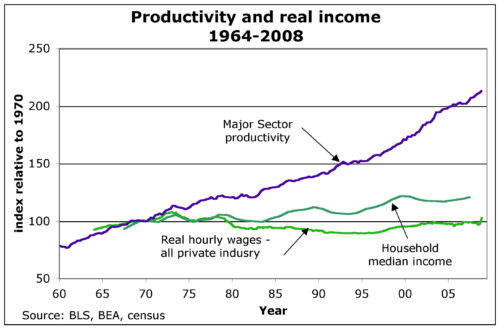
At the same time that the human masses were decoupled from their natural instincts to sometimes be nasty in defence of their basic interests, wages decoupled from productivity (as can be clearly seen from the graph at the top of this essay). Every member of the ruling class, in particular economists and politicians, will tell you that this is a coincidence. But the anarcho-homicidalist knows that it is no coincidence.

Basically, we’ve become so domesticated that not only have we lost the desire to kill our enslavers, which was the one thing holding our half of the bargain in place, but we’ve forgotten that it’s even a legitimate option. Because we’re no longer willing to kill, we’ve lost all of our negotiating leverage. In the age of nice, employers can simply play the working masses off against each other in a race to the bottom, knowing full well that there’s no tipping point at which they will feel too humiliated and revolt.

As a natural consequence, wages have plummeted.

Worst of all, we’re getting nicer and nicer, as most of us are now so powerfully conditioned against violence by a merciless school system that we resemble Alex from A Clockwork Orange after his exposure to the Ludovico technique. The very thought of rebellion is terrifying to a population no longer allowed to write ‘faggot’ on FaceBook, and where protesting the wrong religion will get you beaten to death in prison. One can therefore expect that our negotiating position will continue to weaken.

This is where the philosophy of anarcho-homicidalism becomes necessary: to restore the lost half of the negotiating equation. Those who consider themselves fit to rule need to learn, once again, to fear those who they presume to command. Because, no matter what your ruler says, it’s always, always, always permissible to kill someone trying to enslave you.

Anyone who is incapable of understanding this is already a slave!

*

This essay is an excerpt from The Anarcho-Homicidalist Manifesto, written by Viktor Hellman and due for release by VJM Publishing in the autumn of 2019.

Writing Generalised Anxiety Disorder

Everyone knows what it feels like to be anxious. The clammy hands, the tightness in the gut, the dizziness, the sudden need to urinate. Where anxiety becomes a psychiatric problem is when this anxiety gets out of control, causing suffering and an inability to get through everyday life. This article looks at how to write engaging and believable characters who suffer from Generalised Anxiety Disorder (GAD).

One cluster of problems that people with GAD tend to have relates to restlessness and irritability. They think too much about what might go wrong. A number of small problems can then have the tendency to build up and to provoke an outburst over something small. Often a person with GAD will hit their limit and explode, to the astonishment of others around them who didn’t appreciate the underlying anxiety.

Other characters might see the usual signs of anxiety, only writ large. They might notice the signs of despair in the face – tight lips or a pallid look. The character with GAD might tap their feet a lot, fidget or stammer. Other characters might be able to detect and increase in the tension level of the room when someone with GAD is present.

The author might prefer to be more subtle, however. A character with GAD might to prone to explosive anger or hysteria, but the other characters might not be able to perceive the anxiety that underlies the fractiousness. They might also be prone to mind blanks from the anxiety. The other characters might only perceive the surface expression of the GAD, leaving the reader to draw their own conclusion.

For instance, people with GAD tend to smoke a lot of tobacco. If the protagonist of your story has GAD, it might be that they’re reaching for the cigarette packet every time the telephone rings. If the protagonist of your story encounters someone with GAD, it may be that the constant presence of tobacco smoke or smell causes them them to realise that that character has an anxiety disorder.

Insomnia is another common sign. If the protagonist of your story is an insomniac because of GAD, this might be something close to a living hell; a nightly torment that they are forced to endure. Other characters will be able to pick it in their face as well – they will look tired, with puffy eyes and a downcast look. They will look every bit like someone for who life is difficult.

People with GAD, like many people with mental disorders, have a tendency to suffer low self-esteem. As with many other conditions, it’s not easy to tell where the border between the mental disorder and personal weakness is. A character with GAD might frequently be asking themselves if they’re a coward, or if they’re really cut out for the challenges of life. Naturally such an attitude will eat away at their self-confidence.

Intertwined with this is the reality that people with GAD will often not be treated too well by other people. For one thing, anxiety tends to be contagious. If another person is anxious it’s hard to properly relax around them because of the chance that they might blow their top any moment. For another thing, anxiety tends to make people selfish, because the focus is on the desires of the self and not the needs of others. This selfishness tends to be reciprocated.

GAD can cause some of the same thought-loops and obsessional thinking as other psychiatric conditions. With generalised anxiety it’s easy to become anxious about being anxious, especially once one has become conditioned by unpleasant physical side-effects of worry. A character with the condition might feel highly anxious every time they feel a slight gut disturbance or chest pain, fearing that death has finally come.

Although there’s a shared component of extreme anxiety, GAD is distinct from phobias. Phobias (as discussed at length here) are fears of specific things that are hard to escape. GAD is also distinct from social anxiety. People with social anxiety tend to only feel anxious in anticipation of the risk of social judgment, whereas people with GAD tend to be anxious all the time.

GAD is also distinct from Obsessive-Compulsive Disorder, but several patterns of thinking overlap between the two. In particular, people with GAD are prone to worrying about things like whether or not they left the stove on when they left the house. Because anxiety is always present in such people, and because the risk of burning down one’s house is (reasonably) something that many people are cautious of, people with GAD are frequently triggered into panic by such common concerns.

The best thing about GAD from an author’s point of view is that virtually all of the readership will be able to identify with it. Almost everyone knows what it’s like to feel unpleasantly high levels of anxiety, so GAD will also be reasonably easy to identify with. Probably they also are aware of how unpleasant it is to be around highly anxious people, so they can identify with that also.

*

This article is an excerpt from Writing With The DSM (Writing With Psychology Book 5), edited by Vince McLeod and due for release by VJM Publishing in the summer of 2018/19.

The Ways in Which White People Are Stupid

There is a lot of talk nowadays about how intelligent different races are. Some say that white people are smarter than the others, some say that this is impossible. In the vein of our previous essay about the complimentary dimensions of intelligence and stupidity, this essay – while happily conceding that white people are capable of feats of great intelligence – looks at the unique ways they are stupid.

There are basically two categories of ways that white people are stupid. The first category relates to their inherent nature, and the second relates to the environment they have created.

When children are born, they don’t naturally understand lying and cheating. The human infant is born in a highly immature state when compared to the infants of other mammals. As a consequence it comes into the world primed to rely on learning, not on instinct. It adapts to its environment primarily by mimicry.

This makes the human infant exceptionally trusting. In most cases, an infant that grows up around people who are honest and upstanding will come to learn that other people are like this. The heuristic becomes established that other people are trustworthy. They can naturally come to assume that everyone in the whole world must be like this, because if they are not exposed to the horrors of other people while young they might never get it.

This is the reasoning behind Sweden’s insane and suicidal decision to open their borders to mass Muslim immigration. The banks who control the media decided that they wanted cheap labour and upwards pressure on house and mortgage prices, and mass immigration from the Middle East and Africa appeared the best way to achieve those objectives.

So all the banks had to do was instruct their media pets to declare that mass immigration of cheap labour was good, and those opposing it were evil, and the white people of Sweden believed it all without question.

Another way that white people are stupid is a low social IQ, which relates to autism. White people are widely acknowledged at being good at abstract thought such as science, philosophy, computer programming and finance. Part of the reason for this is that the white brain has evolved to solve the problems of a cold climate, which means that evolution has selected for white people who can solve problems of physics, mathematics, logic and architecture.

But part of the problem with this evolution is that white people were not selected for solving social problems. There wasn’t a selective advantage for those who were skilled at this, owing to the low population density of Europe (and the population density gets lower, and the people more autistic, the further North you go). White people tend to assume that anyone smiling at them is their friend – which is why they are so readily suckered by democracy and television advertising. White people are more gullible than any other racial group, by far – and that’s a kind of stupidity.

The second category of ways that white people are stupid relate to the environment that they have created. This is not an inherent stupidity, but a secondary stupidity that arises as a consequence of the damage done by the inherent form.

White people, for all of their vaunted ability to see far into the future to overcome the cold winters of Europe, have utterly failed to anticipate and plan for the long-term environmental effects of the capitalist industrial system that they created. This capitalist machine rumbles ever on, free of any bonds, restraints or true oversight, consuming ever more of the natural world.

There is growing evidence that this capitalist-industrial system is unsustainable, such as disappearing Arctic ice, disappearing rainforest cover and disappearing insect populations. In fact, it’s already clear to most intelligent people that we’re headed for a mass collapse, like a train going over a broken bridge. Certainly a group of people who invented a system that caused the biosphere to collapse can justly be said to be stupid, because they will inevitably go down with it.

For whatever reason, white people are not intelligent enough to see this trainwreck about to happen, and so they continue to stoke the coals.

Perhaps worst of all, this insane and inhumane system causes an appalling amount of psychiatric disease in the people that it rules over. Western nations consume baffling amounts of anti-depressant, anti-anxiety and anti-psychotic medication, reasoning that the terrible side-effects are easier to deal with the effort of trying to live in a way that makes sense.

But the major reason why white people are stupid, over and above all the others, is that they have no spirituality. White people might have a low social IQ, but if there was such a thing as a spiritual intelligence quotient, white people would be to that what Australian Aborigines are to a standard intelligence test.

Instead of following a spiritual tradition that links white people to anything meaningful (i.e. either God or the natural world), most of them follow the dead traditions of a Middle Eastern tribe that almost none of them are descended from. They are even stupid enough to get tricked into persecuting their own, true spiritual traditions, in particular those based around meditation, cannabis and psychedelic drug use.

This lack of spirituality underlies all the other stupidities of white people, as well as their others. Because materialism is the widespread belief, most white people don’t believe that consciousness survives the death of the physical body. This makes them disinclined to consider the truly long-term effects of anything, whether it be financial, environmental or demographic.

*

If you enjoyed reading this essay, you can get a compilation of the Best VJMP Essays and Articles of 2017 from Amazon for Kindle or Amazon for CreateSpace (for international readers), or TradeMe (for Kiwis).