
Category: politics
How Do We Know They’re Not Lying Again?

In 2003, Britain teamed up with America to attack Saddam Hussein’s Iraq on false pretenses, an action that would eventually lead to over 1,000,000 preventable deaths – a war crime by any standard. 15 years later, Britain is again beating the war drums over a supposed Russian assassination of a former Russian intelligence agent on British soil. The question the rest of us have to ask is obvious: how do we know they’re not lying again?
The British Prime Minister in 2003, Tony Blair, solemnly presented to the world a “dossier of death” that supposedly detailed Hussein’s arsenal of chemical and biological weapons, ready to attack Britain within 45 minutes of the Iraqi strongman giving the orders. Even worse, the dossier claimed, Hussein had procured significant amounts of uranium from African sources, enough to build 200 nuclear bombs.
We were told all this, and then told that the international community “had no choice but to act”. It was a casus belli of such strength that it was apparent there would be no talking the Anglo-Americans out of their impending action. Iraq was, in Blair’s words, “a current and serious threat to the UK national interest”.
The trouble is, all of those claims were lies.
Hussein’s Government disintegrated at the first sight of the iron wave coming their way, and the victorious Anglo-American forces scoured every square metre of the country for the chemical and biological weapons that would have been triumphantly paraded before the world’s media. Had they been found. There were no chemical and biological weapons in Iraq.
Usually when someone lies to you, and you find out about it, you don’t trust them again until you are satisfied that they have learned the value in honesty. But no contrition has been shown, ever, by any of the leaders who worked to bring about the slaughter in Iraq. Neither George W Bush nor Tony Blair have ever shown genuine regret for the invasion, or even the barest awareness that the invasion was the wrong thing to do.
Both George W Bush and Tony Blair are free men, not wanted by any Western war crimes tribunal. No Western leader openly calls for their arrest or imprisonment, despite that they murdered as many people as Pol Pot. No-one in British politics appears to be willing to commit Blair to trial for war crimes, the minimum acknowledgement necessary that the lost Iraqi lives had some value.
So why should we trust the claims of the British Government this week that the Russian state killed someone on British soil? Nothing appears to have changed since the last time they lied.
Most worryingly for New Zealand, our current Prime Minister Jacinda Ardern volunteered to work for the unapologetic war criminal for two and a half years, and after the scale of the destruction wrought in Iraq was widely known, and even after the fact that the invasion was launched on false pretenses was known. This suggests that not even our Prime Minister has the moral fibre to understand that killing a million people with lies is a bad thing and that people who do it should not be supported.
The prospect for world peace is looking grimmer, but, as this newspaper has previously written about, there’s no need to worry until the television starts telling us that Russians are mistreating babies somewhere. Then it’s time to hit the bunkers.
*
If you enjoyed reading this essay, you can get a compilation of the Best VJMP Essays and Articles of 2017 from Amazon for Kindle or Amazon for CreateSpace (for international readers), or TradeMe (for Kiwis).
How Terrorism Works

Terrorism often seems senseless to modern, pampered Westerners. Killing for the sake of killing is a long way from our everyday lives of peace and bounty. But terrorism isn’t just killing for the sake of killing – there’s an established calculus behind it, and it works. This article looks at how.
The ultimate reason for committing any act of terror is to induce submission in an enemy population towards the collective that the individual terrorist is a representative of. The idea is that the terrorist does something so horrifically cruel and destructive that the observers of it become afraid of attracting the wrath of the terrorist or his allies, and so become submissive towards them.
The first king learned that submission could be induced by publicly smashing the skulls of his enemies in, and the natural logic of dominance and control that applied thousands of years ago also applies now. For instance, the vast majority of us are submissive towards government representatives because we have observed that governments will spare no cruelty when it comes to getting their will through.
This is no accident; all Western governments have purposefully committed acts of cruelty towards those they claim to be representing, for this is the simplest and most effective way to induce submission. Had they not done so, they would not exist.
The same is true of religions. All Abrahamic religions encourage and promote human rights abuses, whether those be infant genital mutilation, denial of rights to women or homosexuals, the murder of unbelievers or the incarceration of medicinal drug users. Neither is this accidental. All of these cruelties create an impression in the minds of the victims – an impression of the frightful consequences of resisting these people.
The purpose of terrorism, then, is to create an impression that it’s better to go along with the wishes of the collective you represent than to resist them. Therefore, submission means you can get your will through. Every woman burnt at the stake is another woman who doesn’t resist the will of the next priest to come through the village.
In the world of 2018, we can see that repeated acts of Islamic terror in Europe have led to incredible freedom and prosperity for that religion. British Police are so scared of being called Islamophobic that they happily turn a blind eye to thousands of young girls getting raped by Muslim grooming gangs – a phenomenon most recently uncovered in Telford – but they’re more than happy to arrest people for growing medicinal cannabis, knowing they can do so without risk to themselves.
This fear is a direct consequence of Islamic terrorism. In other words, the British Police have been successfully terrorised.
This is how fear and terrorism work, and it’s how the usual way that territories get conquered by foreign invaders, because the locals seldom acquiesce to such a thing without coercion. The British did similar things when they built the Empire, which is what makes it all the more surprising that they don’t resist when it’s being done to them.
Every Islamic terror attack in the West, especially if the attacker dies in the act, makes Westerners ever more impressed by the strong will and faith of Muslim people and ever more willing to bow down to those Muslims rather than stand up to them and risk being killed. The public response to terror attacks is usually horror and condemnation, but the unconscious individual response – especially among individuals who adhere to slave morality – is to be impressed by the bravery and conviction of the killers.
Terrorism bypasses the rational mind and makes its appeal directly to the unconscious. When laid out like this, it’s clear that terrorism is simply a form of iron magic like any other. All successful uses of iron magic induce submission in observers, and broadcasting those terror acts into every household during the evening news is a genius way of amplifying the magic.
All this is lost on the Pastafarians. There have been several cases where individuals have ostensibly had their religious rights denied to them on the grounds that Pastafarianism isn’t a “serious” religion. They all miss the point. A religion counts as a serious one when its followers are willing to slaughter anyone who mocks or disagrees with them. That’s the only way that the rest of us can be forced to take the kind of garbage written in Abrahamic holy scriptures seriously.
Every Westerner instinctively knows, whether they’re willing to admit it or not, that if they stand on a street corner wearing a Bomb Muhammad tshirt mocking the prophet of Islam, pretty soon a Muslim will come and stab or shoot them to death or run them over. So they don’t mock Islam, neither on the street corner nor anywhere else. From the terrorist’s point of view, that’s victory.
*
If you enjoyed reading this essay, you can get a compilation of the Best VJMP Essays and Articles of 2017 from Amazon for Kindle or Amazon for CreateSpace (for international readers), or TradeMe (for Kiwis).

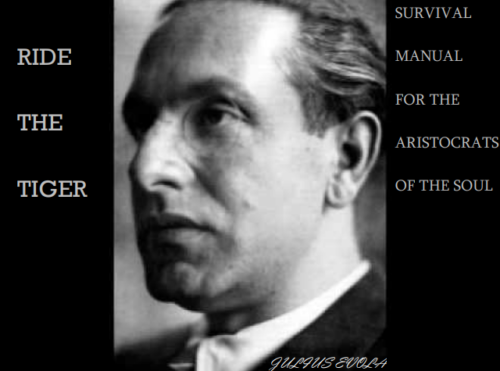
VJMP Reads: Julius Evola’s Ride the Tiger III

This reading continues on from here.
The sixth essay in Ride The Tiger is called “Active Nihilism – Nietzsche”, and continues to deal with the problem of the Death of God. Also continuing with the esoteric theme of this book, Evola appears to insist that the solution is alchemical. The negative is overwhelming and ascendant; it cannot be resisted. So the question becomes “how far the negative can be transformed into something positive.”
Here we are concerned with “the transition to the postnihilist stage.” Modern man is free, free from the strictures of Abrahamism – but free for what? We have striven against our enslavement for so long that we don’t know what to do with freedom. We invented God to assuage our existential anxiety, and, now that we are “free” from this God, that anxiety has rushed back with a vengeance. Evola cites Sartre here: “We are condemned to be free.”
Evola contends that Nietzsche’s conception of the Superman is not sufficient to avoid this nihilism. His reasoning is that the Superman theory is not sufficiently different from the other eschatologies, such as the Marxist one, and therefore cannot be more than a pseudosolution to the problem of nihilism.
As was true for Marxism, the Superman theory could potentially be used to justify all manner of horrors in the present by promising paradise in the future. However, Nietzsche’s theory of eternal recurrence strikes much closer to what might be described as a perennial philosophy.
The seventh essay is called “Being Oneself.” It seems as if that, once the pseudosolutions and outright false philosophies are abandoned, what one is left with is oneself. This something is beyond morality (indeed, morality is considered something to be liberated from), and internal, instead of imposed from without as if by God or King.
Nietzsche comes in for some criticism here. Evola considers his attitude to the human spirit “materialistic”, but concedes that Nietzsche must have seen beyond because he is capable of distinguishing the “Self” from the “I”. Other thinkers, such as Guyau, are considered, but dismissed for not offering anything truly new, merely “restrictions that more or less return to one οf the systems οf the old morality.”
Evola concludes that the answer, as ever, is to “Know Thyself”. However, there’s a caveat. In the past, it was easier to know thyself because one was defined by strictures of class, religion, nation, caste and many other things. Modern man is free, so he cannot fall back on these now-abandoned strictures.
Modern man is, in fact, so free that it is as if he has been shattered to pieces. His soul “contains multitudes”. This shattering, Evola contends, can be most easily observed in remorse, which is an emotion that mostly affects divided people and which is characteristic of our time.
The eighth essay is called “The Transcendent Dimension – ‘Life’ and ‘More Than Life'”. The man who gets it, Evola contends, is one who possesses a transcendental dimension, a spiritual dimension. Here he distances himself further from Nietzsche, who for Evola was more of a vessel that history acted through than a genuine actor in his own right. Nietzsche’s great error was “confusion of the sacred with the profane”.
Evola, through quoting Nietzsche, gives us a prescription for a man of gold, although without using alchemical terms: a many who has great passions (clay), but who holds them in check (iron), and who hold them in check with apparent ease (silver) and who, last of all, does not draw any particular egoic satisfaction from doing so (gold). Here, the highest sort of man is one who overcomes great dangers, for it is only in doing so that all these qualities can be expressed.
Evola mentions the common interest in Zen philosophy among the Beat Generation that was heavily influenced by the existentialists. Here, religious belief (of any kind) is rejected as a failure of the human spirit, of the sort of person who did not have the character to survive the tension of the Age of Nihilism, and who hence surrendered to easy answers.
*
If you enjoyed reading this essay, you can get a compilation of the Best VJMP Essays and Articles of 2017 from Amazon for Kindle or Amazon for CreateSpace (for international readers), or TradeMe (for Kiwis).