Where is Humanity on Maslow’s Hierarchy of Needs?

Abraham Maslow’s Hierarchy of Needs is a famous psychological theory based on the observation that people as a rule take care of their most pressing needs first, and only when those are satisfied do they develop an ambition to move to the next level.

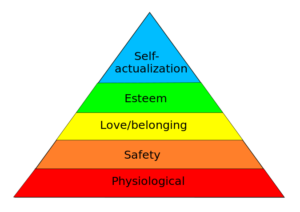
The most common way to represent this is as a coloured pyramid – one can see an example as the title image of this essay. The ‘lower’ desires represent the more fundamental ones. The need represented by each level must be satisfied before a person is motivated to move on to the next one.

The lowest level is physiological needs. This basically means air, water and food. When the need for these are met a person moves on to safety needs, such as physical and economic security. Meeting those needs will mean a person advances to the level of love and belonging, where they try and satisfy a need for friendship, intimacy and belonging.

Above these three levels are two that are arguably not so much ‘needs’ as ‘decencies’. The first is the need for self-esteem. This relates to the human desire to be accepted and appreciated by others and by oneself. Generally the lower one’s self-regard the greater one’s need for fame or respect.

The last level is self-actualisation. This involves fulfilling one’s greatest potential; becoming the best version of oneself that it is possible to be.

It’s common for individuals to look at where they are themselves on Maslow’s hierarchy. It certainly is an interesting theory for anyone curious about how they fit into the grand scheme of things.

Some people are further than others. What we generally consider wealthy, fortunate, or “doing good” correlates pretty strongly with where a person is on the hierarchy of needs. If we take a look at humanity, though, we can see that as a whole we have not come very far.

According to the World Food Programme, 842 million people go to bed hungry on any given night. This represents about one in every eight people, all of whom have fallen at the first hurdle when it comes to the hierarchy of needs.

If one thinks about what that means in practice, it is one in every eight people who have no realistic chance of ever making progress in any of the other needs. After all, someone who goes to bed hungry will hardly be concerned with their bank account, because if they had any money they would have bought food with it.

It’s worth thinking that one in every eight people are that desperate – possibly that means one in every eight people are desperate enough to have a strong incentive to do serious harm to another human being, should an opportunity for a robbery arise.

After all, the major incentive a person has for not robbing someone is their desire for physical security, in the form of not going to jail, and their desire for social esteem, in the form of not being thought to be a robber.

As both of those needs are less fundamental than the need for food, a hungry person is unlikely to care about them very much. The desire for food is even more fundamental than the desire for peace, and so one in every eight of us is too hungry to care at all about all the war in the world.

A global universal basic income would raise us up the hierarchy, as it would take care of most basic physiological needs. It is the inability to fulfill the need for these that causes the vast majority of human suffering in the world.

It does, however, raise the spectre of overpopulation, at least in the minds of those who believe that some of the tropical peoples are incapable of keeping their breeding in check. If a person believes this, then it is natural to also believe that a global basic income will lead to ecological collapse.

Maybe humankind is doomed to remain at a reasonably low level because of the belief that if we co-operate too closely, factions within humanity will take advantage of this peace to wage war against other factions, perhaps even without those factions knowing about it.

A Look at the Fashions This Political Season

With a General Election called for the 23rd of September this year, the political fashion season is now upon us. Kiwis everywhere are asking themselves “What political cause do I have to pretend to support this season in order to virtue signal my advanced and Christ-like moral sophistication?” This article has the inside goss.

The first thing that everyone needs to know is that gays are out, refugees are in. Gays have been fashionable for long enough – homosexual law reform has been fashionable since the 1970s – and have now become an entrenched part of the Establishment, fielding more than twice as many MPs as would be proportionate for their numbers in the population.

Cynics might point out that the sort of refugees that have the tens of thousands of dollars necessary to make it to New Zealand are probably middle class anyway, but the trendy thing to do is to blame it all on American bombing.

Now that America has a white man in the big chair once again, it will now once again be fashionable to talk about the drone strike campaign that killed hundreds of thousands of people during the reign of Barack Obama.

Talking about this was exceptionally fashionable during the last years of George W. Bush, because the indiscriminate nature of the killing naturally upset human rights fans. Drone strikes regularly claim dozens of ancillary fatalities that are written off as ‘collateral damage.’

It was highly unfashionable to speak about this during the reign of Obama because he was just so goddamn ball-achingly cool. But now that it’s trendy to compare Trump to Hitler it will also be trendy to talk about the drone strikes again, as one can have little doubt that drones are something Hitler would have gleefully used had he been able.

Women are also out, and this has made it even more fashionable to be pro-Islam this season.

The fact is that, despite the rhetoric about the gender gap (almost entirely produced by yuppie lesbians trying to smooth the path to a C-suite position), it is really hard to get away with paying a woman less for literally the same work in New Zealand.

The vast majority of the feminists who were fashionable at university are now middle-class and assuming positions of power themselves – and often at greater rates than the males of Generation X because the females tend to have higher educational standards.

And what’s less cool than a competent, educated middle-class person in a position of power?

Throwing women under the bus is probably the only way we political fashionistas can cope with the cognitive dissonance that would be brought about by simultaneously supporting them and an aggressively male supremacist religious tradition that considers women barely better than animals.

Do note that transsexuals are not the hot new thing this political fashion season. It seemed for a long time as if they would be, because of all the noise they had been making.

But New Zealand has long ago had an openly transsexual Member of Parliament – a Georgina Beyer, assigned male at birth, who completed two terms as an MP for the Labour Party from 1999.

On the clearly unfashionable side of things is the economy. Bill English said that the economy was the primary issue this political fashion season, and he’s the epitome of uncool.

So whatever you do this political fashion season, don’t point out the fact that refugees cost the country $100,000 per year each, and so taking even as many as a thousand per year costs more money than the Feed the Kids Bill would have done.

Hungry kids are out, unless they are foreigners. So mentioning the $100,000,000 per year expense of taking in 1,000 refugees might be this season’s biggest faux pas.

Cannabis users will have to continue their forty-year wait to become fashionable, because most of them are poor, mentally ill and Maori and all of those are associated with being grotty and poor and uncool.

Alcohol will still be fashionable, though, because the alcohol industry will continue to dump tens of millions into advertising until the plebs can’t talk or think about anything else.

So get ready to crack some chardonnay with your newly-made Syrian friends on the 23rd September this year.

If You Want Cannabis Law Reform in 2017, Pray Bill English Gets Cancer

National Party MPs are known for their kindness in the same way that Waffen-SS soldiers were known for theirs – not. Conservative politicians speak a language of fear to their constituents, who duly wet their pants and give all their power away in the hope that some mighty ruler will put it right, like their parents did back in the day.

What characterises the true right wing from the left is the degree of distance between the top and the bottom of the preferred hierarchy. Right-wing voters are generally more than happy to debase themselves before a ruler, and are thus far more likely to bow the head to one, but are at the same time far more likely to abuse or neglect someone they consider beneath them.

Essentially this is a primitive kind of social logic that has probably carried over into modern culture from brain circuits that evolved to meet the challenges of an era during which humans were much more like chimpanzees. Before the Stone Age began, your competition had to be kept down by whatever means necessary lest they kill you for your territory or women.

This suggests that, for conservative politicians, pain and misery is the only language they’ll ever understand.

The sort of person who becomes a National Party supporter is generally someone of a fairly limited degree of life experience. It’s rare that a New Zealander ever goes travelling and sees the world only to come back and vote for a conservative party, and it’s rare that one ever goes to university to mingle with a wide range of people from everywhere only to vote conservative.

The National Party psychology is a particularly unfeminine one; it prizes order above all other values. It’s as if they were taught while very young that empathy invites chaos, and is something only for the foolish.

Correspondingly, women vote National significantly less than men do, primarily because women tend to vote more in community interest and less in self-interest. Why would a woman vote for a party that cut funding to rape crisis centres? On the face of it, that seems very odd, like an unusually low degree of gender solidarity.

So if you look at National Party women like Paula Bennett, Jenny Shipley, Ruth Richardson, Michelle Boag and Judith Collins, they stand out as a particular breed. There’s clearly something missing from them, something that corresponds pretty closely to what a healthy person would consider empathy.

A normal woman is a person who one feels comfortable leaving in charge of a small child; a National Party woman is a person who feels more comfortable with a glass of bubbly in one hand and that small child on a spit roast being rotated by the other.

So when Nicky Kaye came out this week and said her diagnosis of breast cancer had changed her attitude to medicinal cannabis, the sudden change of heart demonstrates the degree of separation between the people making laws about medicinal cannabis and those needing it.

Kaye might not have encountered many cannabis users before. She might not have spent so much as one minute ever hanging out with a personal friend who had a need for medicinal cannabis. In fact, Kaye probably moved in circles that considered all cannabis users to be criminal scum, medicinal need be damned.

There’s always been that iron edge in the blue soul of the National Party, the one that believes that anyone weak deserves it, that any momentary failure or backwards step is an invite to be destroyed.

It’s why pleas to repeal cannabis prohibition on the basis of compassion will never succeed. It’s mostly the poor, Maori and mentally ill who suffer from cannabis prohibition, and none of the poor, Maori or mentally ill vote National.

Someone else’s suffering is not real suffering to the sort of person who is a National supporter. If anything, someone else’s suffering is considered by them a good thing because it keeps that someone else down and makes them much less likely to rock the boat.

So appeals to other people’s suffering, now matter how much of it there is, will not motivate a repeal of cannabis prohibition in New Zealand in 2017.

If New Zealanders want a change to our cannabis laws before the end of the year, there is only one way it will happen: if the Prime Minister Bill English himself gets cancer and comes to appreciate the value of medicinal cannabis in the same way that Nicky Kaye did.

Helen Kelly wasn’t enough. Paul Holmes wasn’t enough. Even Martin Crowe wasn’t enough. Nicky Kaye won’t be enough either. If New Zealanders want any reform to our barbaric cannabis laws in 2017 they have little option but to pray that Bill English gets cancer for the greater good of the Kiwi nation.

*

If you enjoyed reading this essay, you can get a compilation of the Best VJMP Essays and Articles of 2017 from Amazon for Kindle or Amazon for CreateSpace (for international readers), or TradeMe (for Kiwis).