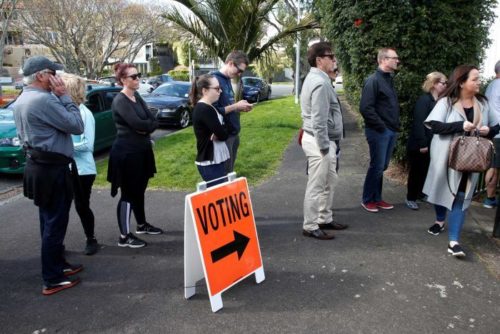
When Opening the Borders to Mass Immigration, The Effect on the Locals’ Quality of Life is Not Considered

The forces pushing for mass immigration in recent decades have been an alliance of both the left and the right, which is why the West has seen so much of it, despite that it often has clearly negative effects for the locals. Some people don’t seem to fully understand that, when agitating for mass immigration, the forces in favour of it have got no interest whatsoever in the effect of that immigration on the quality of life of the locals. This essay looks at why.

Western conservatives are not only terrified of being seen to oppose immigration lest they be confused with the racial conservatives who lost World War II, but they are more than happy to open the floodgates to mass immigration for economic reasons.

First among those economic reasons is that mass immigration destroys the existing bonds of solidarity among the native population, which works to divide and conquer them and make them ripe for wage exploitation. Western conservatives know that Westerners are too afraid to protest the importation of low-skilled workers from outside the country lest they be seen as racist, even when that same importation is undermining their labour power and thereby sharply lowering their quality of life.

It’s obviously much harder to start a union when much of the workforce doesn’t speak English, or if they’re here on temporary visas, or if they’re from a cultural tradition that has little idea of worker’s rights (which is most of them). So the wealthy know that by opening the floodgates to the whole world they can smash the sentiments that prevent workers from selling each other out as cheaply as possible.

Second among these economic reasons, but no less important, is that mass immigration drives up the value of investment property, which a large proportion of Western conservatives hold. In so far as the value of any given piece of land is a function of the amount of money willing to bid to own it, it’s mathematically obvious that opening the borders to all and sundry will remove previous restrictions on demand, thereby driving it up – alongside the price of the property.

After all, no-one is making more land, so the supply of land in New Zealand is a constant. By letting in a few extra million people, the wealthy can stimulate demand which pushes the price of that land up.

Which is great if you’re in the minority that already holds land, and terrible if you’re in the majority that doesn’t.

This reason, incidentally, is why the population will never be allowed to fall, and why it has not been allowed to fall in Western European countries where the birthrate has been below replacement level for a number of generations. Economic reasons mean that the rich will simply force their puppets in Parliament to maintain the price of their land holdings by opening the borders.

This is why the population of France has not decreased in several decades, despite that native French women have had a below replacement level birthrate for over a century now. The French elites would rather import foreigners to replace the missing locals than allow their property values to decline with a falling population – and the same is now true of Britain, Spain, Italy and Germany.

After all, if you’re in the top 1%, then it doesn’t matter if the average goes down as long as inequality rises by enough to compensate, because rising inequality will see the top 1% cream more and more of it. Selling your countrymen out for shekels might lower the standard of living of the nation, but it won’t lower yours (until enough other people do it of course, but the hope is that this point is never reached).

Western liberals, for their own reasons, are also more than happy to open the floodgates to mass immigration.

One reason is that these liberals do not generally live in the same neighbourhoods that are affected by mass immigration and the crime that comes with it. So the negative side of agitating for mass immigration is not considered to outweigh the positive side of virtue signalling one’s good will towards poor foreigners.

Another reason is that they are ideologically opposed to national bonds for the reasons that these are impediments to a global communist state. The sharper the lines are around who counts as a Kiwi and who doesn’t count as Kiwi, the more difficult it is to subsume New Zealand into the global communist consciousness.

None of this is to argue that immigration is a bad thing or that it should be stopped. But it’s clear that the National Party has lost control of the immigration system above and beyond the desire to keep wages low and house prices high. The wishes of the people who already live in New Zealand, and who have inherited a sense of guardianship over the land, is not respected and the effect of this immigration on their quality of life not considered.

Ultimately, the New Zealand immigration system needs to be run according to the philosophy that the New Zealand population as a whole are to be the beneficiaries of the fact that this is a nicer place to live than most of the rest of the world. Not right-wing special interests who want cheap labour for the sake of maximum profits or left-wing special interests who want the destruction of social coherency for the sake of maximum control.

VJMP Reads: Anders Breivik’s Manifesto XIII

This reading carries on from here.

In this section (pages 1068-1152), Breivik writes about a wide variety of topics, including a proposal for a merit system for the society of knights, how to counter state propaganda, an entreaty to European police forces and an argument for the reinstitution of patriarchy.

Again without apparent irony, Breivik writes that “[The media] deliberately portray us as the anti-thesis of the ideal person so that we achieve a minimum of impact when it comes to appealing to the average European.” This is a curious position if it is considered that the average European, being rather civilised, generally finds murderers unappealing.

It’s obvious from reading a document such as this one that a person with Breivik’s mind was clearly capable of carrying out the deeds he was accused of. But it’s hard to know what to make of someone who advises prospective mass killers to “Visit a male salon if possible and apply light makeup” before taking photos of themselves in order to look the best.

Here Breivik gives a very interesting explanation for the phenomenon of the mainstream media describing white mass shooters as “lone wolves” or “mentally unstable”: ultimately, the Establishment wants to avoid having to explain why there is an ideological opposition to the way they are running things, because having to explain this would give that opposition the perception of legitimacy.

This explains why ruling classes of all times and places are so quick to decry their opponents as “mad” – because it delegitimises them.

Yet again, Breivik decries Nazism: “We hate everything Nazi Germany stood for, in fact we view the current EUSSR/Multiculturalist regimes of Western Europe as totalitarian Nazi regimes.” It’s apparent that there will always be people who call him a neo-Nazi, but anyone who has bothered to read this document knows that this isn’t true.

The most difficult thing for most readers of this document to understand will be Breivik’s frequently declared opposition to “all hate-ideologies; communism, cultural Marxism/multiculturalism, Islam and national socialism.” Most people tend to assume that any mass shooter belongs to a hate ideology and will therefore have considerable difficulty putting Breivik in a box.

Also difficult to understand is Breivik’s frank acknowledgement of the success of Islam in honouring those who have martyred themselves for its cause. Perhaps this has occurred out of Breivik’s will to approach the question of nationalism from a military perspective.

When Breivik writes that “It is every Europeans duty to defend their people and country against the ideology of genocide, conquest and destruction known as Islam,” this raises a number of questions. Some of these questions are fair, but many will resist asking them for fear of granting legitimacy to violent nationalist sentiments.

The biggest is this: how do we know that Islam is not an ideology of conquest? Because the only thing stopping more people from following Breivik’s line of reasoning is the pervasive belief that Islam is not an ideology of conquest. If this belief does not accord with reality then it will eventually yield.

This is no trivial point. The fact remains that if a large number of fighting-age men come into your territory with an ideology of conquest then you are literally at war, no matter how much you might deny it or want it not be true. Who decided that these “refugees” came to Europe with a long-term will to peacefully integrate? Who is even qualified to decide such things, and, if no-one really is, how can it have happened?

Certainly if the millions of Muslims who are currently in Europe decide that they don’t want to peacefully integrate – and the experience from everywhere else is that they don’t – then letting them in in such numbers was a catastrophic strategic error from the perspective of European leaders tasked with maintaining the quality of life of their people. It might be a problem that takes a century or more to solve.

Perhaps it’s not unreasonable to declare these leaders traitors?

Interestingly, Breivik explicitly mentions in this section the fact that attitudes to Jews make it extremely difficult for European nationalist sentiments to unify around a common goal. On the one hand are neo-Nazis, who consider Jews the enemy; on the other hand are Christian conservatives, who consider the Jews a common ally against Islam.

At the end of this section, Breivik underlines the strength of his identification with Christianity, making the argument that only the Catholic Church can unite and speak for all Europeans and that conservative Christian governments ought to reflect this in their policy.

In all, it’s clear that the Establishment is, and must be, very uncertain about how to respond to someone like Breivik. They appear to have mostly decided to make the subject of him and his ideas taboo (which is, of course, a red rag to those of us at VJM Publishing), but this strategy is doomed to fail because of the increasing pressure brought about by the political trends mentioned in this document.

Peters Has More Leverage in a Labour-Greens Coalition than in a National One

Winston Peters aleady has a number of achievements in government, and the mana that comes with those. Labour and the Greens are more likely to recognise this than National are

The most important element in any negotiation is each side’s BATNA – Best Alternative To a Negotiated Agreement. In other words, how good or bad it would be for either side to walk away from the table. This article will argue that, ultimately, Winston Peters ought to go with Labour and the Greens, for the reason that he can wring a better deal for himself (and for the nationalists he represents) out of that side.

The deal that Peters ought to offer Jacinda Ardern and James Shaw is this: support Peters as Prime Minister for this next term at least, with Ardern in an apprentice role as Deputy. Let’s have a coalition Government that’s mostly Labour with certain New Zealand First mandarins in high places and James Shaw in Cabinet somewhere, maybe Julie Ann Genter as well.

Peters will be the Prime Minister, so if anything goes wrong he can take the blame for it when he retires. But if everything goes right, we get at least one, hopefully two terms of stable centre-left government, at which point Peters retires triumphant.

This should allow us to undo the game of hot potato that our immigration system has become and whack the minimum wage up to a point at which our working class have a standard of living similar to Australia and the rest of the West.

And if everything keeps going right, Ardern will step naturally into the role after those two terms when Winston rides off into the sunset.

This will achieve several purposes: it will allow for a change in Government from the hyper-neoliberal National Party; it will neutralise criticisms that Ardern is too young and inexperienced to take on the top role; it will help Winston Peters fulfill ultimate career objectives.

For Ardern that’s a pretty sweet deal. There’s no reason to think that this deal will be considered part of the electoral pendulum from Labour to National to Labour to National to Labour to National to Labour to National to Labour to National, which means that if Peters does step down after one or two terms of measured, calm, reasonable and dignified leadership, there won’t be a sense that it’s National’s “turn”.

This would mean that Ardern, at age 43, will be in prime intellectual condition to begin her own three-term reign of Prime Minister.

The BATNA for Labour and Ardern is that Peters throws his support in behind National and the country has to endure another three years of neoliberalism, except this time not under the shrewd cunning of John Key but under the blundering, hamfisted efforts of Bill English, with the baby-eating banshee of Paula Bennett shrieking in his ear all the while.

This is a pretty bad alternative, all things considered. It’s effectively a total loss.

Bill English simply couldn’t accept a deal that was this sweet to Peters. His backers expect nothing less than the Ninth Floor, and there would be howls of outrage from his own party if he gave up the Prime Minister’s Office to the leader of a party that won less than a sixth of the votes of National.

National also has a much better BATNA than Labour does. Even if Peters agrees to go with Labour and the Greens to form an African coalition, that coalition would still have to succeed and to provide stable government, for if it didn’t, the electorate would be only too happy to give National another chance under Bennett.

Some in National might be only too happy to let some kind of Labour-New Zealand First-Greens abomination tear itself to pieces for three years (or less) and then set up a three-term Sixth National Government under Bennett or Steven Joyce or some other half-witted order follower.

For this reason, Peters will understand that Labour will be more incentivised to maintain a stable Government than National will. The National Party social media machine proved itself exceptionally effective at raising an angry mob at the peak of the Metiria Turei affair, and if their working relationship with Winston Peters fell apart it could be predicted that the electorate would put the blame on Peters.

This all means that Peters has much more leverage to use against and with Labour and the Greens than he does with National.

Should People Lose The Right to Vote When They Get the Pension?

Ideally, the people who voted would be the same people who had something at stake

When our democracies were set up, there was one thing that was never anticipated: medical advances leading to a white-haired horde of pensioners that held the balance of power in almost every single election. We’re essentially living in a gerontocracy now, and there’s no giant ice floe to push them out onto. This article looks at a potential compromise for our society.

Life expectancy in New Zealand was about 71 years in 1960, which meant that the average person was only expected to live a handful of years once they went on the pension at age 65. When the pension was brought in, in 1898, it was obviously much less than even this.

Life expectancy was over 81 years in 2015, and it keeps climbing as medical advances and social changes like the decline in tobacco smoking prevent what had until recently been incurable diseases. This has led to a problem arising: New Zealand now spends over $12,000,000,000 per year on pension payments, as the average person now lives a dozen years or more extra past the pension age, which has not increased.

The reason why the age of 65 was usually chosen as the age of universal pension was that, by age 65, a person’s body is usually no longer capable of the physical labour necessary to earn a full wage. The wear and tear of life as a working man meant that a full effort was no longer possible from age 65 and, because the vast majority of jobs going around were working-class ones, it was a reliable rule of thumb that most people would be knackered by then.

But if we now live in a knowledge economy, as many politicians and economists are now insisting we do, then the original reason for setting the pension age at 65 is null and void. If we live in an economy where a person’s productivity is primarily a function of their intellectual capabilities then there’s no reason to have a pension age determined by the limitations of the physical body, because there is no need to treat mentally productive people as infirm.

It might be that a person’s intellectual capabilities are not enough to keep them in employment either. Perhaps that person traded on the strength of their body and, for whatever reason, their mind was not developed to the point where participation in a knowledge economy was possible. Such a person should still have the right to a pension.

But the unfairness arises when a person who is still more than capable of earning a living from their mind does so, at the same time as pocketing a $370 a week pension that was intended specifically for people incapable of working. Winston Peters has shown that even a career as intellectually demanding as top-level politics can be undertaken until one’s mid-70s, and yet if he retires in 2020 he will have claimed the pension for ten years while still working full time.

This is really a gigantic con game, in which the elderly have forced payment for their unsustainably lavish lifestyles on the young. Worse, the larger this 65+ age bracket grows, the ever more incentivised they are to vote against any reform to this Ponzi scheme.

Democracy was never intended to have this massive bulk of old voters gumming it up. Once a person is at this stage, they have relatively little stake left in the future running of the country. No major decisions need be taken by such people – they’re already sorted.

Perhaps our old people need to have a deal put to them?

If you reach 65 and feel that you are no longer intellectually capable of participating in the knowledge economy, that’s fine. Here’s a pension – but you are no longer considered intellectually capable of participating in representative democracy.

If you want to keep working on the grounds that you’re entirely capable of it still, you can – and you get to vote as well. But you don’t get to claim a pension on the grounds that you’re too infirm to participate and still get to wield power over others.

We can accept that, for some people, the fair price to pay for being looked after until death is to forfeit their right to further influence the political system in their favour. After all, if you have a political class that pays you $370 a week no questions asked, when you almost certainly own your own home already and don’t have to pay rent out of it, you’re already creaming it by any measure. Life is sweet and easy at that point.

It’s time to stop the Baby Boomers’ theft of the production of the following generations. Taking the right to vote away from pensioners will make it possible for a fairer balance of taxation and benefits to be struck.