Understanding New Zealand: Voting by Industry and Employment Status I

This article looks at what we can tell about the preferred industries of certain voting blocs based on their voting patterns. For the most part, the statistics in this area are fairly predictable, because industry types tend to be class defined and we already know which social classes vote for which parties.

There were few occupations that correlated with a significantly lower vote for the National Party in 2014, which is not surprising considering that National won the election. The most prominent was the transport, postal and warehousing industry, who had a correlation of -0.51 with voting National in 2014. As mentioned above, this can likely be best explained by the fact this is generally a working class industry.

It was a different story with rental, hiring and real estate services, which had a correlation of 0.49 with voting National. This is also not particularly surprising as it is an industry that essentially tries to generate money without performing any labour, i.e. by rent-seeking. Real estate agents and property managers are known for being the types that will do anything for a buck.

For the Labour Party these roles were, unsurprisingly, reversed – the transport, postal and warehousing industry had a correlation of 0.55 with voting for the Labour Party, probably reflecting the fact that if a Kiwi drives for a living they are very likely to be some kind of bogan and therefore a natural Labour voter.

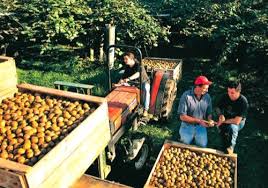
One statistic that will surprise many is the voting pattern of people in the agriculture, forestry and fishing industries. Many would expect people in these primary industries to vote Labour or Green, but it is not the case. These people are more likely than anyone to vote New Zealand First – there is a correlation of 0.40 between being in agriculture, forestry or fishing and voting New Zealand First, compared to -0.31 for Labour and -0.24 for the Greens.

This can be explained to some extent by the fact that people working in agriculture, forestry and fishing are more likely than average to be Maori (the correlation between the two is 0.22), and Maoris are significantly more like to vote New Zealand First.

The interesting thing about that is it shows the people who vote Green seldom actually have anything to do with the environment, because they usually live in wealthy neighbourhoods in big cities.

Green voters are more likely than any others to be students – being on the student allowance has a correlation of 0.55 with voting Green in 2014, compared to 0.34 for Labour, -0.18 for New Zealand First and -0.46 for National. They are also more likely than any other to work in hospitality – voting Green in 2014 had a correlation of 0.52 with working in accommodation.

Green voters are the ones most likely to be involved in the new technological occupations. Even though Green voters are older than Labour ones, voting for them correlates more strongly with high-tech occupations than voting for Labour does. Voting Green in 2014 has a correlation of 0.63 with working in professional, scientific and technical services, and a correlation of 0.70 with working in information media and telecommunications.

The Greens also overwhelmingly dominate the arts and recreational services industry. People working in this industry have a correlation of 0.69 with voting Green in 2014, compared to -0.17 for National voters, -0.13 for Labour voters and -0.18 for New Zealand First voters.

Oddly, there’s a pattern based on benefit type. Pensioners vote National (correlation: 0.50), unemployment beneficiaries vote Labour (0.62), students vote Green (0.55) and invalid’s beneficiaries vote for the Aotearoa Legalise Cannabis Party (0.76).

This latter correlation is both very strong and will be very surprising to many, until one considers that it is precisely invalid’s beneficiaries who suffer the worst from the Government’s refusal to reform our cannabis laws.

*

This article is an excerpt from Understanding New Zealand, by Dan McGlashan, published by VJM Publishing in the winter of 2017.

Understanding New Zealand: Voting Labour

The Labour Party formed in opposition to the sort of capitalist interests that would later form the National Party. Predictably, then, voting for Labour in 2014 has a very strong negative correlation with voting for National in 2014 (-0.85), and a moderately strong negative correlation with median personal income (-0.51).

With no other party apart from the Conservatives (-0.63) do supporters of Labour differ from near as intensely. Voting for Labour in 2014 was not significantly correlated with any of voting Green (-0.03), voting New Zealand First (0.11) or ACT (-0.19). The only parties that had a significant correlation with voting Labour in 2014 were the ALCP (0.38), Internet MANA (0.41) and the Maori Party (0.41).

This latter point is mostly a function of the powerful racial divide between the two major parties. The correlation between voting Labour in 2014 and being of European descent is a whopping -0.76. With being of Pacific Islander descent it is even higher, but in the other direction: 0.78. This latter statistic, coupled with the fact that voting Labour in 2014 has a correlation of 0.42 with being Maori, suggests that Labour is actually a Polynesian party to a considerable degree.

The statistic that Labour Party leaders will rue more than any other is the correlation between voting Labour in 2014 and turnout rate in 2014, which was -0.67. This tells us immediately that any given Labour supporter is significantly less likely to actually cast a vote for their party, which brings to mind the saying “Left-wingers fall in love; right-wingers fall in line.”

A statistic that might surprise many is that the correlation betwen voting Labour in 2014 and having no religion is -0.50. Although this can mostly be explained by the fact that being of Pacific Island descent has a correlation of 0.46 with being a Christian, it also brings up a surprising difference between New Zealand and the United States, where poor religious people have been driven apart from their natural economic classmates by wedge issues such as abortion, a phenomenon which is yet to be replicated in New Zealand, despite the best efforts of Brian Tamaki.

There was a correlation of 0.47 with voting Labour in 2014 and being a Hindu, which probably is a reflection of heavy Fijian Indian immigration over recent decades.

Although voting for Labour in 2014 had a significant correlation with having no qualifications, this was a barely significant 0.34. Some might be surprised that voting for Labour in 2014 had less of a correlation with not having a Master’s degree (-0.18) than voting Conservative did (-0.20). Considering that the average Labour voter is much younger, this suggests that the average Conservative is much more plebian.

The fact that the flag referendum was a National Party vehicle is demonstrated by the massive indifference of the working class to it. Voting for Labour in 2014 had a correlation of -0.84 with turnout rate in both the first and the second flag referendum, and a correlation of -0.80 with wanting to change the flag to the National Party design.

Perhaps the most interesting thing about the Labour Party vote is the size of the negative correlation with median age, which is -0.70. This is even lower than the Maori Party’s -0.66 and is far lower than the Green Party’s -0.17, which tells us that Labour is much more a party of the youth than the Greens (although this can be explained to a large extent by the fact that Polynesians are young and they seldom vote Green).

*

This article is an excerpt from Understanding New Zealand, by Dan McGlashan, published by VJM Publishing in the winter of 2017.

Metasanity

Being insane is one thing, and it is usually very difficult. Not seeing reality clearly comes with pain. Avoiding the difficulty that comes with insanity is primarily a question of avoiding the patterns of thought and behaviour that can lead to things getting out of control. This second-order sanity can be described as metasanity.

For example, you can be insane, but you can also be sane about being insane, which would be metasanity. Being metasane might involve taking advice about not smoking methamphetamine when someone points out that doing so has a deletorious effect on your mental health.

It might also involve, like the Carrie Fisher quote above, maintaining a realistic and objective view of one’s own condition.

A revealing thought experiment is to consider how a person reacts when being told that they have a mental illness. In this manner, two otherwise similar people can vary greatly, depending on their metasanity.

One person might accept that they have a mental illness and that this diagnosis accurately explains the difficulty they have experienced with their thoughts and behaviour.

For such people, high in metasanity, speaking to an intelligent clinician might bring with it a moment of clarity. Probably it will bring with it a sense of relief, as a clear explanation of why things become chaotic makes it more likely such chaos can be avoided.

Another person, lower in metasanity, might deny that they have a mental illness even when told so by a well-meaning doctor, or by family and friends. Such a person will be much less likely to take medications or to avoid situations and behaviours that lead to things getting out of control.

A person low in metasanity might accept that they have a mental illness, but behave in maladaptive ways like over-identifying with the illness, or becoming hyperdramatic about bad influences on their health (often, thereby, creating an anxiety that makes the illness worse).

A lot of a person’s ability to successfully recover from a mental illness – that is to say, from insanity – is really a function of their metasanity. It is metasanity that will tell a person if their current medication regime is actually working or not and so whether they should keep taking it or not, and getting to see a doctor in the first place is usually a matter of whether the patient has the metasanity to accept that they have a problem.

Conversely, metainsanity is, of course, an inability to think sanely about one’s mental health, despite being otherwise mentally healthy.

Part of the difficulty with sanity is that it correlates so strongly with metasanity. And so, a person who has trouble keeping things together may also have problems with keeping their awareness of the need to keep things together together.

Metasanity, as could be expected, correlates highly with narcissism. The obvious explanation is that the more narcissistic one is, the more likely one is to deny anything that might be seen as a weakness, such as a mental illness.

Sometimes metasanity can be a negative. Going insane and knowing that one is going insane is a unique torture that cannot be physically replicated.

However, even when this happens, the long-term prognosis is still better, because nothing is more likely to make an illness kill you than denying you are ill.

Autism and Psychosis Are Perfect Natural Complementaries

Some people contend that all autists and all psychotics are mentally diseased and have to be corrected by whatever means necessary. Others, especially the autists and psychotics themselves, contend that their conditions are not diseases but natural expressions of the human genotype.

A revolutionary article from 2008 pointed out that autism and psychosis are, in some physiological ways, opposite poles of a spectrum: “autism involves a general pattern of constrained overgrowth, whereas schizophrenia involves undergrowth.”

This can readily be confirmed by anyone who has spent much time observing autists and psychotics.

If autism is characterised by overgrowth, one might say that this reflected an excessive degree of order and therefore masculinity. Indeed, autism appears to correlate with masculinity in many ways – such as increased mathematical and logical reasoning and a decreased capacity for social intelligence. Also, autism is much more common in males.

If psychosis is characterised by undergrowth, one might say that this reflected an absence of order and therefore femininity. And, in opposition to autism, psychosis does appear to correlate with femininity in many ways – in particular, an increased capacity for social intelligence and a decreased capacity for mathematical and logical reasoning. Also, it is much more common in females.

On the dark side, the vast majority of serial killers have some kind of autism, because psychotics generally can’t keep it together well enough to kill many people and keep it a secret. However, the vast majority of suicides have some kind of psychosis, because psychosis is unusually terrible, and autists are better at keeping it together well enough to not fall into suicidal ideation.

On the bright side, both autists and psychotics have made immense contributions to the human survival project, not despite, but because of their lack of neurotypicality.

Autists can be programmed to last forever. They just keep going, and if they can find a subject interesting enough to them they never get bored. Many of our great engineers and surgeons were probably a bit autistic, as it was this that led them to obsess magnificently over their projects until they knew more about the subjects than anyone else ever had.

Psychotics are the exact opposite. Psychotics are not easy to program and they don’t stay programmed. Every time there is a ‘psychotic break’, more programming is shrugged off. This means that it is through psychotics, who have seen beyond Maya, that our spiritual and philosophical traditions arise.

In much the same way that, in order to get anything done, a person needs a mixture of autism and psychosis, so too does society need autistic and psychotic individuals in order to function healthily at the top level.

A society wouldn’t last without both autists and psychotics; without the former, no work would get done, without the latter, all work would still be picking berries and smashing open mammoth bones for the marrow within.

Oftentimes, it is necessary for a psychotic to show the way to a new field of knowledge but it is also necessary for autists, once shown the way, to do what is necessary to make practical applications out of that knowledge.

This is akin to how the Anglo-Saxons, whose culture has an unprecedented degree of tolerance for psychotics, tend to invent things and how the Germans, Japanese and Koreans, whose cultures have an unprecedented degree of tolerance for autists, tend to refine them into excellence.

In other words, society would go backwards without the autists and it would never go forwards without the psychotics. Autists, psychotics and people who are neither are therefore all necessary for an optimally healthy and functioning society.