Should We Lower Women’s Pensions to Bridge The “Gender Death Gap”?

The average Kiwi female enjoys 26% more life post-retirement than the average Kiwi male – this is dubbed the “gender death gap”

The national consciousness is currently in a state of hysteria over an Auckland electrician’s decision to offer a 12% discount to female customers on account of New Zealand’s “gender wage gap”. For those of you not in the matrix, the gender wage gap refers to the fact that the average weekly income of a woman is lower than the average weekly income of a man.

Although Dan McGlashan proved in Understanding New Zealand that the wage gap is entirely due to the fact that men work full-time jobs more often and the women work part-time jobs more often, and that there is no difference in wages for those men and women who are part of the professional class, the perception persists that women are deliberately ripped off in remuneration for their labour by some nefarious conspiracy of people with Y chromosomes.

Some, like the Auckland electrician mentioned above, seem to believe that this perception of a malevolent bias against women justifies giving women discounts when it comes to trade, in an effort to redress the imbalance in wages.

The real injustice when it comes to differential treatment of the genders is that women live much longer than men do. Females born today are expected to live 3.7 years longer than men do, an injustice many times more cruel than a piddling difference in wages.

The average female can expect to live 83.2 years from birth, whereas the average male can not even count on getting to 80. His average life expectancy is only 79.5.

Another way of looking at it is that the average female gets another 18.2 years of life after hitting retirement age at 65, compared to the paltry 14.5 years of the average male.

Measured in percentages, this means that the average female gets to enjoy 26% more life in their golden years than the average male. This is a disparity that weighs much heavier than that of mere money. Here we are talking about life itself.

We can call this disparity the “gender death gap”. Knowing about this gap in life expectancy, and knowing that there are tireless calls for restitution from working age men on account of the gender wage gap, one question immediately arises: should we call for restitution from pension age women?

It could be argued that, if tradesmen like the electrician mentioned earlier give discounts to working age women on account of the gender wage gap, they also should give discounts to pension age men. After all, the clock is ticking for those men in a way that does not compare to the experience of the female.

Perhaps the fairest solution would be to immediately cut female pensions by 26%, which would equalise the amount of post-retirement money that the different genders got out of the Government.


What Does Julie Anne Genter’s Medicinal Cannabis Bill Actually Say?

With Jacinda Ardern giving her enthusiastic support for medicinal cannabis, Julie Anne Genter’s Medicinal Cannabis Bill is very likely to pass into law given a Labour-led Government after the 23rd

With Julie Anne Genter’s Misuse of Drugs (Medicinal Cannabis and Other Matters) Amendment Bill in the Parliamentary Ballot, our ruling class is being forced to consider the question of cannabis law reform. The short of it is that the bill, if enacted, would finally legalise medicinal cannabis in New Zealand, some two decades behind California, Alaska, Oregon and Washington. This article looks at the precise details of the bill.

The striking thing about the bill, on first glance, is its brevity. There are only six sections.

Clause 5 of Genter’s bill means that cannabis will still be illegal – this bill provides for neither the decriminalisation or legalisation of cannabis (with the exception of CBD – see below). However, this clause inserts another clause, 9A, into the Misuse of Drugs Act 1975, which provides for cannabis to be legally grown for medicinal purposes, subject to a “qualifying health condition”.

Clause 4 tells us what a qualifying health condition is. There are four different groups of conditions. The first three are straightforward: any terminal illness, any severe chronic disorder of the immune or nervous system and chronic back or other pain.

The fourth group of conditions is vague, probably deliberately left so. It is “any other medical condition that a medical practitioner certifies may benefit from supplementary plant cannabinoids”. This has the potential to vastly open up the range of conditions that can be treated by medicinal cannabis – but the decision will be made by medical practitioners, not by politicians.

Clause 9A.2 of the amended Misuse of Drugs Act would allow for any patient with a qualifying health condition, or a nominated support person, to “cultivate, administer, supply, or possess medicinal cannabis” for the purpose of the patient’s lawful use. This is the crucial clause, because it essentially makes it fully legal for a sick person to grow their own cannabis at home – which is just about all the medicinal cannabis community ever wanted.

Of interest to many medicinal cannabis users is that Clause 4.1(c) of Genter’s bill will remove the controlled drug status from CBD preparations. This means that the penalties listed in the Misuse of Drugs Act for various schedules of drugs will no longer apply to CBD. Essentially, this ought to make CBD preparations little different to any over-the-counter pharmaceutical that one might buy from a chemist.

This is an entirely reasonable move because CBD has no psychoactive properties – it does not produce the “high” that wowsers and do-gooders are so terrified of. It also will bring New Zealand into line with similar cultures – CBD is a recognised medicine in Britain, for example.

All in all, this bill, if enacted, would represent a stunning victory for the forces of cannabis law reform in New Zealand. It would make it legal for sick people to grow their own medicine at home as long as they can find a doctor to agree that their use of the plant would be medicinal. This will not only greatly liberalise the cannabis laws but does not go so far that it ought to provoke a counter-reaction.

*

Vince McLeod is a former Membership Secretary of the Aotearoa Legalise Cannabis Party and author of the Cannabis Activist’s Handbook.

Te Reo With Mnemonics: Competition Words

Match – whakataetae

A boxer is about to engage in a boxing match. One of his eyes is wide open and the other squinting tight. He gets a punch in the squinting eye – his opponent whacked a tight eye.

win – toa

A reporter is interviewing a runner who has just won a race, with a gold medal around his neck. The runner says “I tore out of the starting blocks and then tore past my opponents and I won.”

lose – ngaro

Two men are rowing a boat in a race. One of them gives up and says “There’s no point – we’re going lose.” The other man yells “Nah! Row!”

draw – ōrite

The Black Knight from the film Monty Python and the Holy Grail, missing his arms and legs, says “Alrighty, we’ll call it a draw.”

Result – tukunga iho

A man is watching some Test Match Cricket. A friend comes in and says “Have we got a result yet?” The first man replies “The result is taking an eon.”

Strategy – rautaki

Two boys a playing a strategy game, like Risk or Chess. One of them thinks for a long time, then lays out on the game board a row of tacks.

The Maori word for ‘attack’ – huaki – sounds like the English word ‘hokey’ as in hokey-pokey icecream

Tactic – rauhanga

Two girls are playing tic-tac-toe on a sheet of paper. After the game is over, one of them takes the paper and hangs it up in a row of similar papers. She is the row hanger.

Violence – whakarekereke

There are two wrecked cars, and a man comes and whacks them with a stick. He is trying to whack a wreck wreck.

attack – huaki(-na)

A woman is carrying a container of hokey-pokey icecream. Suddenly the hokey-pokey grows arms and attacks her.

defend – wawao

A boxer is throwing punches at a sparring partner, who is defending them. Then the boxer pulls out a dagger, and the sparring partner says “Whoa, whoa!”

Competition – tauwhāinga

There is a throwing competition where competitors have to pick up a dwarf by the toe and fling him through the air. The competition is for toe flingers.

cooperate – mahi tahi

A swarm of servants is cooperating to dress a man in a business suit. They finish cooperating, but he does not have a necktie, so he asks “Where is my tie?”

*

The above is an excerpt from the upcoming Learn Maori Vocabulary With Mnemonics, by Jeff Ngatai, due to be published by VJM Publishing in the summer of 2017/18.

Why A Canterbury Government Is The Natural Successor To The Fifth National

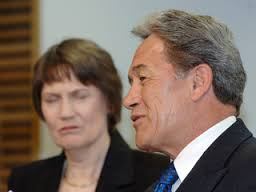
The Helen Clark-Winston Peters alliance of 2005-2008 was the last time the New Zealand Government didn’t suck

The National Party is clearly and evidently falling out of favour with the New Zealand electorate. An opinion poll publicised last night showed that the Labour Party now has more public support than National, for the first time since John Key became Prime Minister in 2008. The various coalition possibilities after September 23 are numerous, but this essay argues that a Canterbury Government would be the best for New Zealand.

This means Canterbury as in red and black, not the province. In other words, a coalition of Labour and New Zealand First would be the most likely to improve the standard of living of New Zealanders.

We can’t take it for granted that Labour will win just yet, but the signs are ominous for Bill English. Usually the incumbent Prime Minister dominates the Preferred Prime Minister poll against all comers. This has been the case ever since Jim Bolger was in charge. However, Jacinda Ardern is now ahead of English in the latest poll, despite being in opposition.

Moreover, the Labour Party has leaped almost 20% in the polls since Ardern became leader. This is partly because the electorate did not think highly of the stuffy Andrew Little, but mostly because of the growing perception that the National Party has completely lost control of immigration, of housing and of mental healthcare. The long-term effects of slashing funding to rape crisis centres and suicide hotlines for the sake of tax cuts are now starting to be felt, and the feeling is bitter.

The heartfelt desire in many quarters is for a Watermelon Government after the 23rd, namely Labour in coalition with the Greens. Indeed, this seemed like the most likely outcome for a long time – the Greens were, until recently, polling at close to 15%, and that meant that Labour only had to get up to 32-33% for the two parties to rule without any outside help.

Unfortunately for Meteria Turei and her Greens, the chaos of recent weeks has eaten away at that support. The party effectively committed seppuku in the wake of Turei’s confession about cheating WINZ and the electorate no longer seems to consider them to be a competent and reliable party.

This is where a Canterbury Government could be the most effective. The black of New Zealand First could help moderate the excesses of the reds in Labour, and prevent the lunatics in the Greens from having any excess influence.

Perhaps the most dangerous, if not outright suicidal, of the Greens’ policies relates to their desire to raise the “refugee” quota to several thousand. Letting in hordes of fighting age men who are possessed by criminal religious attitudes has been a catastrophe for Europe, yet the Greens, mad with ideology, would happily make the same error here.

As we have seen in Europe, the problem with letting in even a thousand “refugees” is that they soon become eligible to bring their families here, and then those family members become eligible to bring other family members here, and eventually the floodgates cannot be closed.

Peters and New Zealand First would provide a much-needed nationalist bulwark to this fashionable Marxist insanity. Peters is not afraid to have crowds of hysterical teenagers and twentysomethings shrieking “Racist!” at him – he’s endured much worse in his time in politics.

If he does become the kingmaker after the 23rd, he is therefore in a good position to reject the demands of the Greens to throw open the borders. This will make it possible for the Sixth Labour Government to focus on the issues that matter to all Kiwis, in particular housing, wages, mental health and drug law reform.

Considering that Peters has already shown himself entirely capable of working successfully with a younger, intellectual, female Prime Minister, as he did with Helen Clark between 2005 and 2008, there is good reason to think that a Canterbury Government is the best option for maintaining and raising the Kiwi standard of living for the next electoral cycle.