
Masculine and Feminine Expressions of Political Aggression

Aggression is a universal phenomenon within the human species. Both genders and all races are capable of it. Not only are we capable of aggression when it comes to sex, property and dominance but we are also capable of it when it comes to politics. This essay looks at the masculine and feminine expressions of political aggression.

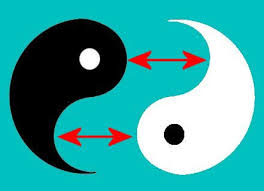
The nature of the masculine is to discriminate. This is represented metaphysically by the straight line, the angle and the number one, and is represented biologically by the sperm. A straight line is, after all, the shape of a sword, and the purpose of a sword is to separate and keep apart those things that the wielder believes should be separated and kept apart.

The nature of the feminine is to bring together. This is represented metaphysically by the circle, the curve and the number zero, and is represented biologically by the egg. The circle is the optimal way to achieve the largest possible surface area for the smallest possible perimeter, and is therefore the most inclusive shape that can be drawn.

The characteristic masculine political sensibility is disgust when confronted with disorder. This means that the masculine is that which desires to keep the peace and to keep things under control. This is partially achieved by means of the sword – to be more precise, the masculine keeps order by inspiring fear with its use of violence.

The ultimate feminine emotion is fear, and so the masculine right wing fights an eternal “War on Terror.” This it carries out by attacking places of excessive chaos. And so, it can be observed in the modern West that masculine aggression finds a political expression in conservatism, which seeks to impose order on as much of the world as possible.

The Republican Administration of George W. Bush is an excellent example of this. Under George W. Bush the masculine sentiments of Americans found a home in the War on Terror – which is essentially a war on the excess of feminine emotion. This led them to attack the Middle East in the belief that it was a chaotic place that produced terrorists, and which therefore needed order imposed upon it.

The characteristic feminine political sensibility is horror when confronted with oppression (this probably developed as a consequence of being confronted with the possibility of rape). This means that the feminine seeks to include as much as it can (in other words, to discriminate as little as possible).

This can be observed by looking at the nature of a circle, which is the appropriate shape for including as many people as possible on even terms. Inclusiveness, and a belief in the value of inclusiveness, was probably how prehistoric matriarchal societies prevented any frustrated reproductive instincts among its malefolk from spilling over into jealous violence.

The ultimate masculine emotion is hate, and so the feminine left wing fights an eternal “War on Hate.” This it carries out by attacking places of excessive order. And so, it can be observed in our societies that feminine aggression finds a political expression in liberalism.

There are any number of examples of this, perhaps the best one being the neo-Communist street gang Antifa, who are known for indiscriminate violence in the name of fighting discrimination.

Feminine political aggression is usually expressed as a will to tear down all borders, walls and hierarchies that separate people. Feminine political aggression thus occurs when the masses get together to get rid of a monarchy, for example, or through voting Marxist policies into law in democratic elections.

In many ways, these two sentiments work together. Most Westerners consider slavery, for example, to be both disorderly and oppressive, and consequently the vast majority of Westerners abhor the practice and it is illegal in all Western countries. Likewise, public health epidemics create both disorder in making people sick and oppression in making people suffer from the disease, and so society is capable of working together harmoniously to fight such things.

In other ways these sentiments work directly against each other. The most obvious example of this is immigration, especially immigration from refugees. The masculine sentiments are generally against refugees turning up because of a belief that they create disorder and disharmony, and many masculine thinkers are duly disgusted by politicians who argue in favour of this.

The feminine sentiments, on the other hand, are generally in favour of refugees because they do not want to exclude them from the perceived benefits of society. To exclude, after all, is to discriminate, and that is a masculine political expression.

Another common example is that of the drug war. Because using drugs causes original thoughts and original behaviours to arise, the natural masculine reaction is to punish their use in the belief that they cause chaos. The natural feminine reaction, on the other hand, is to reject punishment for taking drugs in the belief that this is oppression.

These two differing forms of aggression share what is common to all aggression, namely a will to remake the world in the image of the aggressor. They only differ in terms of what is targeted for destruction – chaos in the case of masculine aggression, and order in the case of feminine aggression.

Are We Living In The Kali Yuga?

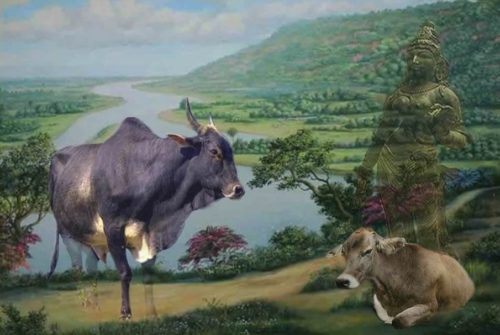
In the degenerate Kali Yuga, the bull of Dharma stands on only one leg, representing the loss of the other pillars of morality

In Hinduism, the Kali Yuga refers to a final age of strife and discord that the world falls into before righteous order is finally restored and humanity realigns itself with the will of God. According to the Sanskrit scriptures, humanity is doomed to repeatedly pass through cycles of time that end in this degenerate Kali Yuga. This essay asks – are we living in the Kali Yuga now?

The Hindu theory of the Yugas has an astonishing similarity with the theory of political decline described in Plato’s Republic. This is possibly because of a shared intellectual tradition that informed all of the civilised nations of antiquity.

The basic idea is that humanity starts off in a Golden Age, or Age of Truth. This is called the Satya Yuga in Hinduism, and corresponds to the rule of the Men of Gold in the Republic. In this stage, humanity is governed by the gods, and our actions allow morality to shine through and illuminate the world. Plato considered it to be an age where humans were ruled by philosopher-kings, who were able to guide humanity skillfully and steadfastly through their challenges.

Unfortunately, this golden age is too good to last and humanity eventually degenerates into the second age, called the Treta Yuga. In this age, people begin to lose touch with their spirituality and become more materialistic. As a consequence, morality starts to degenerate, and fear creeps in. This age corresponds roughly to the oligarchy described by Plato and references the rule of the Men of Silver.

This degeneration continues even further into the Dvapara Yuga, the third age. In this era, the divine intellect no longer manifests, and as a result people become pleasure-seeking and ignorant. Because of this, people no longer are truthful. They will tell lies about anything in order to gain advantage, and this leads to an age of disease and misery. This corresponds to the democracy in Plato’s Republic, in which people only care about short-term pleasure.

Eventually, all of this degeneration causes the entire system to fall apart, in the fourth age, the Kali Yuga. This is an age of war, discord, strife and misery.

The Hindu texts prophecise the rejection of spirituality that takes place during this age. This is perhaps the most definite sign that we are currently living in the age of Kali Yuga.

During this age, it is written, rulers will no longer consider it their duty to promote spirituality, Indeed, this is precisely what we are currently faced with. The rulers of the West make no effort at all to promote genuine spirituality – they are satisfied with merely paying lip service to some rotten Abrahamic tradition that has lost any connection it had to God millennia ago.

In fact, the rulers of our age have gone out of their way to attack spirituality at its source. Where Hindu religions drew spiritual inspiration from entheogenics such as cannabis and psilocybin mushrooms, our age is so grossly materialistic that we have made use of these sacraments illegal, and will go as far as putting each other in cages for using them.

Neither do we meditate. Where meditation was once seen as an essential practice for anyone who so much as hoped to distinguish reality from illusion, nowadays the practice is mocked as something that only brain-dead hippie space cadets would engage in.

It is also written that human relationships will degenerate during this period, and just by simple observation it’s possible to see that this has happened. Avarice and wrath are common, and people don’t see anything wrong with mindless lusts towards sex and murder. Essentially, we have strayed so far from spiritual truth that we have become something close to animals.

At the end of this age, it becomes impossible to even speak of God. It can be argued that we are already at this stage, because it can easily be observed that no-one does speak of God. Churches are full of empty rhetoric drumming up hate against non-believers, the newspapers and television only exist to sell advertising for material goods, and spiritual sacraments have been replaced with alcohol and methamphetamine.

It can be observed that people who do speak of God are roundly mocked, and if this does not deter them they are diagnosed with a mental illness and medicated.

Eventually, the Kali Yuga is supposed to end with a fiery cataclysm that heralds the dawn of a new Golden Age. With the aggressive nuclear program of North Korea attracting ever more aggression from Donald Trump’s America, the likelihood of this cataclysm draws ever nearer. Perhaps the Kali Yuga is soon to end, and perhaps the human race is about to return to God.

VJMP Reads: Anders Breivik’s Manifesto IX

This reading carries on from here.

In this section (c. pages 659-775), Breivik talks about strategies for strengthening the European right in the face of what he sees as the Islamo-Marxist enemy. Here the emphasis is on the cultural and propaganda wars.

Perhaps the biggest irony of this entire document, considering what happened afterwards and considering the public’s perception of Breivik, is when he correctly points out that if modern, mainstream conservatives are too cowardly to discuss the important issues “then extreme conservatives will, and we eventually risk ending up with another nasty/racist form of fascism”.

Again in this section, Breivik demolishes the hypothesis that he is a neo-Nazi with his repeated support for Israel. He also emphasises the point that an intelligent and strong European conservatism is necessary to make sure that European youths are not attracted to Nazi or white nationalist movements.

Indeed, he frequently uses the epithet “Nazi” as a derogative, such as when he suggests that the rhetoric about mass Muslim immigration being good for the economy is akin to the Nazi “Big Lie” tactic. And it’s simply impossible for any genuine Nazi to write that “Europe’s first line of defence starts in Jerusalem.”

In many ways, this document was prophetic, especially when it makes predictions about the nature of future Internet rhetoric. Breivik points out that, according to the mainstream media, “everyone who is not considered ‘politically correct’ must by default be racists or Nazis…” Indeed, some have called us at VJM Publishing neo-Nazis merely for daring to read this document.

Breivik points out one contradiction at the heart of Western Christians, in that they see Muslims as fellow followers of Abraham and therefore as comrades to a large extent. Despite this, he contends that Christianity is an essential part of European culture, although he feels that Christians need to realise that they have more in common with Jews, Hindus, Buddhists and Atheists.

Ultimately, however, the rhetoric of this document is that of war: “Christians need to understand that there can be no peace or understanding with the Islamic world. They want to subdue us, pure and simple.”

Breivik makes a very interesting argument towards the non-religious. It is that Christian and Jewish cultures produce societies that have a high standard of living, in sharp contrast to Muslim cultures. Therefore, non-religious Westerners might see themselves drawn to defending or even supporting Judeo-Christian culture for no other reason than the promotion of a strong society.

Many of Breivik’s criticisms about the nature of our modern culture and its direction are devastating. Attacking the consequences of Western egalitarianism, he writes that “The cost of equality is that we throw out all truthfulness in order to seem like nice people to each other.” This is a powerful critique because a culture that drifts from the truth, for whatever reason, is doomed, even if it drifts from the truth out of a desire to make the world a nicer place.

Perhaps the most devastating lies in the idea that the West has abandoned its foundational belief in the value of reason and replaced it with raw emotions. What matters now, he writes, on issues such as mass Muslim immigration is not whether the consequences of that immigration are good or bad but that the person supporting the mass immigration feels themself to be good and righteous.