Why the Religious Oppose Drug Use

The religious are closed-minded about a lot of things, and drug use is one of them

One oddity about the Western political landscape is taken for granted with no explanation given. It is that the religious, especially the fundamentally religious, oppose all drug law reform measures. Considering that drug prohibition does immense harm to drug users by subjecting them to a justice system built for murderers, rapists and thieves, it’s not clear why the religions would oppose this. This essay looks at why.

The religious prohibitions against drug use seem doubly strange if one considers that many of the world’s oldest religious traditions involve the use of cannabis. This is particularly true of the South Asian religions like Hinduism, which arose in the same general area in which cannabis was cultivated. Why would a tradition of behaviour intended to get one closer to God oppose the legalisation of an entheogen?

The truth is that religion, insofar as it’s practiced in our modern times, has degraded into the opposite of a spiritual practice. 21st century religion in the West no longer has anything to do with apotheosis or sharing any genuine insight into the nature of God that a person might have had.

21st century Western religion is just a sham, selling a communal sense of moral superiority, to people with low self esteem, for money. The people selling it don’t want their flock asking too many questions. They just want them regularly returning to be fleeced for a steady passive income.

In order for this ancient scam to be possible, people have to be separated from true spirituality. If a person is connected to true spirituality then they will instinctively understand that ridiculous stories like the need to mutilate the genitals of new-born babies, or that failure to worship God in the correct manner would doom someone to eternal punishment, or that a desert full of inbreds in Asia Minor was the holy land, are all ludicrous superstitions that serve only to distract people from genuine communion with God.

So religions need to deny people their spiritual birthright in order to make them confused enough to exploit them. Therefore, they need to deny them the entheogenic sacraments that the people have used since prehistory to connect themselves with God.

Entheogenic drug use leads to novel states of consciousness, which lead to original perspectives, which have a deconditioning effect on previous brainwashing, obsession or delusion. In this sense it is very similar to meditation, which also leads to novel states of consciousness that have a deconditioning effect (and it’s no coincidence that the religious have also tried to replace meditation with ineffective lizard-brain rituals such as prayer, chanting, contemplation etc.).

The religious oppose entheogenic drug use because it leads to genuine spirituality, because once this is achieved a person can no longer be scammed with fairy tales that are only convincing to the ignorant. It’s just a rehash of the many-thousands of years old story of wealth and power and the lies told to secure them.
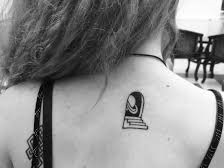
Te Reo With Mnemonics: Kitchen Words

Spoon – koko

An old woman spoons cocoa out of a tin and into a cup.

Cup – ipu

A creature shaped like the letter E takes a cup, puts it on the floor and does a poo in it. In the cup is an E poo.

Door – tatau

A man shows off a tattoo on his arm. It is of a door that looks as though it leads to extradimensional places.

Oven – umu

A man tries to wrestle an emu into an oven.

Fork – paoka

A man is eating a casserole with a fork. Another man asks him what he’s eating, and he answers “Pork.”

Knife – naihi

A woman takes a knife and cuts her own knee.

The Maori word for ‘Door’ – tatau – sounds like the English word ‘tattoo’

Kettle – tīkera

(loan) A woman boils a kettle to make a cup of tea that has a carrot in it. The kettle boils the water in which floats the tea carrot.

Frypan – parai

A frypan is stuck to stovetop, so a woman tries to pry it off with a crowbar.

Towel – tāora

A princess is wearing a tiara on her head and nothing but a beach towel around her body.

Plate – pereti

A plate says to a woman “You are very pretty.”

Saucepan – hōpane

Someone knocks the bottom out of a saucepan and affixes it to a basketball backboard, where it serves as the hooping.

Broom – puruma

A puma is cleaning its house with a broom.

*

The above is an excerpt from the upcoming Learn Maori Vocabulary With Mnemonics, by Jeff Ngatai, due to be published by VJM Publishing in the summer of 2017/18.

New Zealand in India 2017 ODI Series, Second ODI Preview

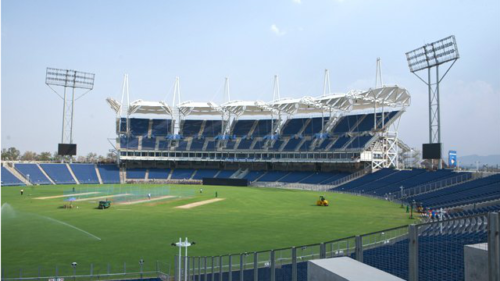
The previous ODI at this venue saw England post 350 batting first – and then lose

The Black Caps landed the first blow on their 2017 tour to India with a thumping six-wicket win in the first ODI in Mumbai, and a win in Pune tonight will see them inflict on India their first home series loss in two years. If the Black Caps can win both of the remaining matches (as unlikely as it might sound), they will go up to 3rd place in the official ODI team rankings – higher than Australia.

There is certainly a solid case that the Black Caps’ batting line-up is stronger than Australia’s, in Indian conditions at least. Martin Guptill does not have a high average in ODIs in Asia, and Colin Munro is so far unproven at the top in any conditions, but Kane Williamson, Ross Taylor and Tom Latham are all superb players of spin. Good enough so that India can’t simply rely on bamboozling them with drift and turn as for past Kiwi batting lineups.

In the previous ODI at this ground, earlier this year, England batted first and scored 350/7, and then India chased it down thanks to a Virat Kohli century and 120 off 76 balls from Kedar Yadhav. It’s not believed that the wickets in India will be as run-heavy this season, but in any case the Black Caps might be happier batting second.

Batting second confers a distinct advantage if the wicket turns out to be much more productive than initially believed. This is because of psychology. Generally speaking, a batsman will be reasonably satisfied with a big score batting first and might be more reluctant to accelerate if they feel they are already above par and don’t want to risk their lead by losing wickets.

This often leads to the team batting first not pushing hard enough for runs, and is why some massive totals have been chased down since the 2015 Cricket World Cup.

Apart from what to do in Pune if he wins the toss, Kane Williamson also has to think about which bowlers to take into the match. The batting lineup is settled and, apart from possibly Colin Munro as opener, the current top 5 will go all the way through to the 2019 Cricket World Cup, but there are two major questions about the bowlers.

The first is whether it might be a good idea to bring the legspin of Ish Sodhi into the equation to compliment the left arm orthodox of Mitchell Santner. India and Bangladesh have recently had plenty of success playing two spinners in subcontinent conditions, and Sodhi has improved majorly over the past 12 months, finally discovering the consistency he needed to be a genuine threat.

The second is whether or not they can keep leaving Matt Henry out of the starting lineup. Although Trent Boult’s place is assured it’s not at all clear that either Tim Southee or Adam Milne offer more threat than Henry with the ball. In fact, Henry averages 14 runs per wicket less than Milne in this stage of their careers, and Southee’s returns in recent years are not much better.

If Colin de Grandhomme cannot acclimatise to Indian conditions in time to reliably bowl 10 overs, the Black Caps might decide that the top six is strong enough that either Henry or Milne – who both average in the 20s in first class cricket – could be promoted to 7.

The Black Caps bowled well in the first ODI but the risk for the lineup they picked is that only Trent Boult and Mitchell Santner offer any realistic threat with the ball, considering the quality of the Indian batting. None of Southee, Milne or de Grandhomme were able to pose a consistent danger so perhaps the inclusion of Henry and Sodhi could make the bowling attack more dangerous at little extra risk of being bowled out.

VJMP Reads: Anders Breivik’s Manifesto XIV

This reading carries on from here.

In this section (pages 1153-1234), Breivik gives his thoughts on the Knights Templar and ethnocentricism. The ultimate goal appears to be the institution of a cultural conservative society akin to that of Japan or South Korea, or what Breivik believes Europe to have been like in the 1950s.

Again, an element of paranoia comes through in Breivik’s writings, evidenced through extremely cynical conclusions to otherwise intelligent paths of reasoning. He correctly notes that the Nazi loss in World War II made any nationalist or racial conservative sentiments start to look a bit dangerous, and that this gave the initiative in the culture wars to the Marxists, but it’s not necessarily true that what happened to the West was due to some nefarious master plan.

It’s more likely to be simple superstition – such a thing happens to the ideology of the losers of every war.

Despite the paranoia, Breivik’s cold Nordic honesty shines through as some points, such as when he concedes that the Marxists have up until now been better propagandists than the cultural conservatives.

Although Breivik decries Nazism as a hate ideology at many points in this document, this section, if read in isolation, could easily give the reader the impression he was a racial supremacist. He decries what he believes to be an attempt by the cultural Marxists to cause the extinction of the Nordic genotype on the grounds that this genotype is evil, and he justifies an ethnostate on the basis that one would preserve the indigenous rights of the European people in the face of high Muslim breeding rates.

At some points, Breivik’s argument shows a distinct lack of deeper coherence. At one point he correctly points out that women like Pamela Anderson, Gwyneth Paltrow, Scarlett Johansson and Taylor Swift attained fame due to their distinctively Nordic appearance, but the fact that this is true is evidence against a global media conspiracy to exterminate the Nordic genotype. Why would a media conspiracy put forward the Nordic genotype as a beauty standard when they could put forward an Asian or an African genotype and convince white men to ignore their women?

If the media puts the Nordic look forward as a beauty ideal this will simply shift the pressure of sexual selection to favour Nordic people, which means that the Nordic genotype would reproduce at a higher rate than it otherwise would have done.

The Nordic genotype is not really faced with extinction. People of Nordic genotypes control 30 million square kilometres of territory across Europe, North America and Australia and number close to 400 million (USA 180 million, Germany 75 million, Britain 55 million, Canada 20 million, Low Countries 25 million, Scandinavia 20 million, Australia and New Zealand 20 million). Their combined economic output is three times the closest competitor (either the Japanese or the Han Chinese).

Any idea that Breivik is a neo-Nazi can be decisively put to bed when he writes that “If there is one historical figure and past Germanic leader I hate it is Adolf Hitler.” However, he concedes that there is a 60% overlap between his ideal policy and that of the Nazis.

In a passage about sexual morality, Breivik writes “Approximately 50% of my female friends end up under the definition/category; promiscuous (female sluts) as they have engaged in sexual activity with more than 20 partners…” This sort of lifestyle was not for him, however, despite that “I could easily have chosen the same path if I wanted to, due to my looks, status, resourcefulness and charm.” This invites one to wonder how Breivik would have turned out if someone had given him some MDMA at age 18 or so.

Curiously, there is a passage where Breivik writes about the need to use “reprogenetics” to create a race of humans free from hereditary diseases in which he sounds very similar to the megalomaniacal Sigurd Mastersen in The Verity Key. Breivik wants to use women in third-world countries as surrogate mothers for embryos engineered to create a child of the Nordic genotype.

Further underlying Breivik’s inability to comprehend irony, he writes in one passage about the dangers of hip hop and how the lyrics can easily lead to a destructive and anti-authoritarian attitude. Well, it’s apparent that Breivik himself fulfills the criteria of having a destructive and anti-authoritarian attitude.

Notably, Breivik writes that “I never tried drugs myself as I never wanted to break that threshold.” Perhaps if he had been willing to try some drugs he would have broken out of the paranoid, obsessive, repetitive thought-loops of vengeance and justice that led him to kill over 70 people.