New Zealand Should Celebrate Halloween on ANZAC Day

Halloween is an autumn festival that recalls the spirits of the dead. There’s no sense in New Zealand celebrating it at the end of spring

All Hallow’s Eve, modernly known as Halloween, is a festival that marks a time of death and dying in the yearly cycle. In some rituals, the dead are invited to partake in the celebrations, either through being summoned by music or remembered in prayer. Commonly, stories are told about people who have passed. All of this makes sense on the Northern Hemisphere calendar, but not so much in New Zealand.

The purpose of the Halloween festival, befitting the harvest, is to remember the dead. This is fitting because it occurs at the end of October, which is near the end of autumn in the Northern Hemisphere, where the leaves have fallen dead from the trees and the nights are quickly becoming longer, colder and darker.

This is why it is associated with graveyards and skeletons and cobwebs and spiders and mummies, and any other symbol of death that one can think of. At the end of October in the Northern Hemisphere it’s closer to the midwinter to come than it is to the midsummer gone, and is only getting darker and colder, which naturally feels like death for those experiencing it.

What is understood by few, in New Zealand at least, is that the old festival schedule represents a deep natural understanding of the connections between the physical and the metaphysical world. Celebrating Halloween near the end of autumn when Nature is dying is the kind of tradition that deepens the connections of people to the natural world and gives their lives meaning.

This means that we in New Zealand shouldn’t celebrate Halloween on the 31st of October, when it’s light until almost 9p.m. and is sometimes as warm as summer (if the winds are blowing from the North or from Australia). Seven weeks before the summer solstice is a time when we should be conducting a fire festival to celebrate the return of light and warmth into the world at the apogee of the yearly solar cycle.

New Zealand already celebrates these natural traditions at the correct time in the yearly solar cycle in the form of ANZAC Day and Guy Fawkes’s Day.

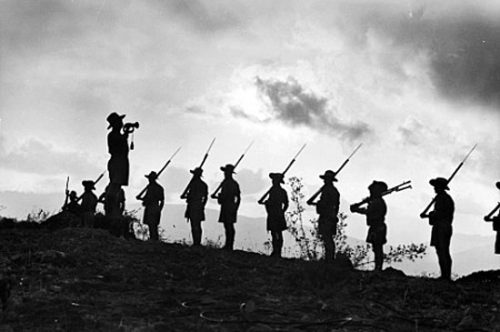
ANZAC Day has become a de facto national festival with an emphasis on the remembrance of the dead and a dawn ceremony – exactly as Halloween was practiced at the end of autumn in old times. On this day we listen to a bugle call that is the same as that our ancestors would have heard a century ago, and we stand in silence to make it as evocative as possible, which symbolically summons those ancestors to stand by our side once again.

Seeing the world as a Great Fractal, this is analogous to how people like us celebrate Halloween in the Northern Hemisphere. It’s also around this day – April 25th – that the trees are either bare or yellow and red as Nature falls into the peak yin part of the cycle.

Guy Fawkes, while not a national holiday, nevertheless involves a public display of fire in a very similar fashion to Beltane in the Northern Hemisphere, or the bonfires of Walborgafton in Uppsala and Walpurgisnacht in Northern Europe. The purpose of the fireworks and bonfires in either case is to celebrate how the Sun itself will soon be lighting up the night as it approaches the zenith of its yearly cycle.

In other words, ANZAC Day and Guy Fawkes’s Day have become the Southern Hemisphere equivalents of Samhain/Halloween and Beltane/Walpurgisnacht respectively. These festivals occur at almost exactly the same times of the seasonal cycle, and feature the same themes of death and fire respectively, but if a person in the Southern Hemisphere was primarily following the calendar they could easily fail to notice this.

Why Kiwis Hate the Police II

Many forget that the warrant of a New Zealand Police officer is not to enforce the law but to keep the peace

Consider this thought experiment. You’re driving down a state highway at 100km/h, with some cannabis in your car. Going around a bend, you see a Police car upside-down in a river with no person in sight. Obviously the driver failed to take the corner, and is almost certainly in dire need of immediate medical help. The question is: do you stop and help, or do you just drive on past?

Most Kiwis would argue that the correct answer is clearly to stop and help. After all, it’s a medical emergency, and the Police couldn’t possibly be so unreasonable as to charge a person with a cannabis offence if someone’s life was on the line. Surely discretion would be used in such an instance.

These Kiwis would have more faith in the Police than Caleb Smith, of Greymouth. His story, which hit the news yesterday, has appalled New Zealanders. Smith made a suicide attempt, and part of the Police response was to search his house, discover some cannabis plants, and charge him with a criminal offense. He now has three criminal convictions.

This incident is very enlightening when considered in the context of broader relations between the public and the Police. The reaction of most New Zealand citizens when reading about the conduct of the officers in the Caleb Smith story is horror, disgust and outrage, but that isn’t the worst thing.

The worst thing is the effect stories like this have on public perceptions of New Zealand Police officers.

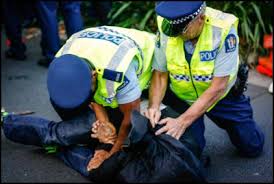
Stories like Caleb Smith’s tell the reader that the sort of person who becomes a New Zealand Police officer is the sort of person who is willing to go up to another Kiwi at their lowest point – in the midst of a suicide attempt – and kick him in the guts, making his life far more difficult for no benefit to the public good, and without the consent of the New Zealand people. It’s a person willing to be cruel simply for the sake of it, using their uniform as a shield to evade responsibility.

Like a dog, they just do what they’re told without consideration. At least, this is how the Police naturally start to appear in the eyes of the population they are supposed to be keeping safe when that population read about such incidents.

Cries of “They’re just doing their jobs!” don’t change the sentiments that stories like Smith’s make Kiwis start to have towards Police officers. In fact, mindlessly following orders is as contemptible as anything else – and people know this.

At the end of the day, every Police officer has the free will to refuse to enforce laws that are unjust, and if they choose not to exercise that free will they cannot complain of the consequences.

It is the duty of every sentient being to consider whether their actions cause suffering to leave the world, or whether their actions bring suffering into the world. That Police officers enforce a law on the Kiwi people that causes great suffering, and that they do so without the consent of those people – who do not approve of that law – is worthy of contempt.

If Police officers choose to enforce a law, even when doing so requires them to willfully add more suffering to the life of one of their fellows who is already suffering severely, then it’s only natural that the people come to hate them.

Not Kiwi Enough? If You Don’t Have Roots Here You’re Not a Kiwi At All

Very few New Zealanders would have the arrogance to move to another country and then lecture those people about who they are, and we shouldn’t accept it when it’s done to us

Three years as an immigrant in Europe taught me a lot about the concept of roots. This is a familiar concept to Maori people, who for a couple of centuries have had to tell the difference between Pakeha who were loyal to New Zealand and Pakeha who weren’t. The short of it is that one’s degree of belonging to a nation is a function of the roots that you have there.

In Sweden, like almost everywhere in the Old World, there is little question about who counts as a Swede. If you are Swedish then you have Swedish ancestors going back to the dawn of time, like all other Swedes. This is the common bond that gives rise to the Swedish nation.

If you do not have these roots you are not Swedish. This is a very simple and near-universally accepted belief. You can get a Swedish passport and become a ‘paper Swede’, and if you also speak Swedish this will entitle you to be treated with full dignity and as if your presence has as much value as anyone else – but you still won’t be Swedish.

Maoris in New Zealand have a similar concept. The depth of your roots tell you whether or not you can be trusted to stick around, or if you’re the sort of person who just wants to make a quick buck and then disappear (for obvious historical reasons, Maoris tend to be exceptionally wary of the latter sort of person).

The only real way to determine if a person is a Kiwi or not is whether or not they would stick by other Kiwis should a calamity befall the nation. This is a measure of the amount of solidarity that person has with other Kiwis. Would they stay to defend the country if it was attacked by foreign military forces? Or would they run away and leave Kiwis to their fate?

Fundamentally this is a question of solidarity. People with roots in New Zealand have cousins here, they have family friends in other cities, they have stories of how their great-great-grandparents or earlier descendants tamed the land, and this naturally leads to solidarity with other people who have similar roots and similar stories.

Golriz Ghahraman, who made the headlines today for lecturing Kiwis about our “internalised self-hate”, has no roots in New Zealand in any case, which is part of the explanation for the lack of solidarity she feels that she has received. Everything suggests that if the Kiwi people were ever truly in danger, she would rather move to another country than to stay and help out. If things got tough here, she would rather abandon us than face personal disadvantage by remaining here.

After all, she and her family have already done this once, so they have a track record of it.

She has no moral right to turn up in New Zealand as a migrant and then start lecturing us about what a Kiwi is or isn’t. The thought of a Kiwi moving to Iran and then presuming to tell the Iranians what’s what about who they are is ludicrous – so why do we accept the same in reverse? For someone with no roots in the country to act as if their verdict about our true nature has any weight represents an incredible arrogance and sense of entitlement.

Moreover, her implication that a refusal to allow New Zealand to become a dumping ground for the world’s human refuse is “race supremacy” is disgusting in light of the strong bonds of solidarity that exist between the descendants of British colonists and Maoris. These two groups get along as well as they do because they have shared roots in the country – it has nothing to do with race.

Obviously Ghahraman has spoken to very few Maoris in her lifetime, for if she had she would be aware that the strongest nationalist and anti-refugee sentiments in the country are harboured by them.

None of this is to argue that the National Front are correct or that they represent an appealing face of New Zealand. A New Zealand identity must not be based on a hatred of the other.

But for a Kiwi identity to exist, a certain degree of exclusivity is necessary. There is no other way of achieving this but to declare that people without roots in New Zealand are not Kiwis.

To make the argument that Kiwis with hundreds of years of roots in New Zealand are in the same category as people who just stepped off a plane and got a passport is preposterous. For one thing, it presumes to decide for those long-established New Zealanders who they are permitted to feel solidarity with. For another, it ignores the fact that almost every other culture in the world does the opposite.

Kiwis who are either Maoris or descended from colonists have a couple of centuries of family lore that relates to New Zealand that newcomers simply cannot have. They can tell you stories about how their great-grandmother cut her thumb off with an axe here, or how their grandmother broke her arm falling off a bicycle here, or how their grandfather used to go pig hunting here. Newcomers do not and cannot represent this culture.

At the end of the day, if people with deep roots in New Zealand want to exclude those who don’t, that’s their prerogative, and Iranian social justice warriors admonishing us to hate ourselves for it won’t make a mouseshit of difference.

Everything is a Matter of “Muh Feels”

It’s common for one side of an argument to demand from the other side a cold, logical, rational reason to justify their position, while at the same time decrying all appeals to emotion as fallacious. The problem with this line of reasoning is that there are no truly objective reasons to make moral judgments about anything. As this essay will investigate, all political motivations are based on emotion.

Usually the person dismissing an argument as emotional is the sort of person who is a bit autistic, perhaps themselves not really in touch with their own emotions. This sort of person has a tendency to dismiss the genuine outrage, horror or disgust of other people as illegitimate motivators. They also have a striking tendency to not realise how emotional their own arguments are.

For instance, on the question of taxation for the sake of paying for social services, many people on the left make the argument that the right are without emotion when it comes to child poverty, mental health services, rape crisis centres and the like. The usual rightist counter to this is to claim that them keeping the maximum amount of their own income is a moral imperative to oppose communism or the likes, and that left-wing “feels” about starving children etc. do not and cannot ever justify the government levying taxation upon people.

What these rightists usually miss when it comes to this line of reasoning are their own emotions that are tied up in the issue.

The government levying taxation upon people is not wrong by dint of some decree from God. It is usually only opposed by those who believe that their personal net return of government services received from this taxation is negative. For these people, a sense of anger arises from feelings of having one’s energy parasitised; a similar sort of anger arises in cases of property theft or gross disrespect.

It can thus be seen that the right wing opposes taxation for emotional reasons. In other words, “muh feels”.

Political questions, when it comes down to it, are all a matter of “muh feels”. Feelings of injustice motivate most of them, and for many people such feelings are unavoidable. After all, the feelings of the population about what is the optimum level of taxation fall along a bell curve with no taxation at one end and full communism at the other, but the actual overall level of taxation must fall on a point on that curve, meaning that many above it will be outraged that it isn’t higher and many below it will be outraged that it isn’t lower.

Even murder fulfills this criteria. After all, what’s wrong with murder other than that it makes us feel bad? If it wasn’t for the fact that a person likely feels terrified when they’re being murdered, or the fact that the people left behind feel bereaved when someone they love is murdered, or the fact that the people in the neighbourhood feel afraid by murders in case they are next, or the fact that other citizens feel disgusted by murder because they consider it a bestial act of brutality, then there would be no reason to even make murder illegal, much less anything else.

Indeed, it could even be argued that, without feels, none of us would be capable of feeling motivated to do anything, and we would simply lie about until we died of metabolic failure.

Although it’s often true that a person does not examine their own emotional impulses and makes political decisions by just lurching from one burst of neurotransmitters to the next, this does not by itself mean that emotional input into decision making is necessarily undesirable, or that a line of reasoning appealing to an emotion is necessarily fallacious.

It could even be that, for a social species, correct decisions cannot be made without some accounting for how people will emotionally react to them. If one drills deep enough, there may not be much more to life than “muh feels”.