

Henry Nicholls is Legitimately Good – Time to Accept It

Hammerin’ Hank Nicholls is inviting comparisons to Andrew Jones with his bulldog tenacity, scoring solid runs despite an ungainly style

Fewer Black Caps players in recent times have come in for more stick than Henry Nicholls. Frequently derided as a passenger, many commentators have been calling for Hesson to get rid of him for good. This article will argue that not only is Nicholls a legitimately good batsman already, but we ought to accept that he’ll be in the Black Caps for a very long time.

Black Caps supporters have been spoiled rotten in recent years. We have Kane Williamson averaging 51, Ross Taylor averaging 47, and a bunch of players like Tom Latham, Jeet Raval and BJ Watling averaging around 40. It’s probably our best ever batting lineup, even surpassing the Wright-Jones-Crowe one of the late 1980s and early 1990s.

It’s so good that we’ve failed to appreciate the quality record that’s slowly being established by our incumbent No. 5, Canterbury’s Henry Nicholls. After 17 Tests, Nicholls has 837 runs at 38.04 – not spectacular on the face of things, but if we look deeper there are some very encouraging trends in those numbers, not least an average of 49.25 over his last ten Tests.

The vast majority of quality international batsmen don’t hit the ground running, as it takes a while to adapt to the top level of the game. Let’s contrast Nicholls’s returns after 17 Tests to the great Kiwi batsmen: Kane Williamson, Ross Taylor, Martin Crowe et al. After 17 Tests, Williamson averaged a mere 29.80; Crowe 24.88. Taylor did not get thrown in the deep end as young as Williamson and Crowe, but after 17 Tests he was barely ahead of Nicholls, at 39.46.

Tom Latham’s average after 17 Tests was also 39. All this tells us that, even by way of comparison to New Zealand’s best, Nicholls stacks up pretty good. Some might criticise his style, but he’s scoring the runs. Leaving aside the overall numbers, Nicholls has succeeded in playing a number of excellent innings in tough conditions.

His first excellent innings may have been the 116 he scored in the Second Test of South Africa’s 2017 tour to New Zealand. Nicholls came in at 21/3 after the dismissal of Neil Broom and scored a counter-attacking 116. The Black Caps still lost, but Nicholls’s maiden Test century came against incredibly skilled bowling that had already done early damage.

Less heralded is Nicholls’s 76 in this Test against South Africa in South Africa. The Black Caps lost heavily – the reason why Nicholls’s effort is not feted – but it would have been a humiliating loss were it not for the 76 he scored in the Black Caps’ second innings, coming in at 7/4 after Williamson had edged a cut to slip. 76 runs might not be many, but coming in on a tricky wicket against superb bowling when his team’s top order had been obliterated, it was an innings of exquisite skill.

The crowning work was of course this week’s 145* against James Anderson and Stuart Broad, on a pitch where England had been dismissed for 58 and no other batsman had passed 33 aside from Kane Williamson. Anderson came into the match as the world’s No. 1 Test bowler and with conditions expected to suit him, but neither he nor Stuart Broad succeeded in dismissing the Black Caps No. 5.

If one considers these innings in tough conditions alongside Nicholls’s generally excellent shot selection, it seems like he has all the tools, including the most important one – the right mind for the game. His numbers might not be outstanding, and no-one’s claiming that he’s going to be another Williamson, but if he keeps improving at this rate he could fashion an excellent career.

It’s time for Black Caps fans to accept that Henry Nicholls belongs alongside Williamson, Taylor, Latham and BJ Watling as an established batsman in this Black Caps Test side.

*

If you enjoyed reading this essay, you can get a compilation of the Best VJMP Essays and Articles of 2017 from Amazon for Kindle or Amazon for CreateSpace (for international readers), or TradeMe (for Kiwis).


Verticalisation and Horizontalisation

Dividing the political spectrum into two poles depending on a person’s attitude to sociobiological dominance hierarchies can be more instructive than left and right

There are many competing theories of political spectrums. The best known is left-right, but libertarian-authoritarian and traditionalist-progressivist are two popular others. This essay contends that the most instructive way to look at the basic political division is to split it into what we call verticalists and horizontalists, based on crude biopolitical sentiments.

These terms refer not to a person’s ideal distribution of resources or land, or to the status quo or change, but to a person’s preferred form of social dominance hierarchy. In this sense, verticalists correspond to what has traditionally been called a “masculine” kind of politics while horizontalists correspond to what has traditionally been called “feminine”.

Verticalists also overlap heavily with what has hitherto been considered the right, and horizontalists with the left, but it isn’t as simple as this.

The basic belief of a horizontalist is that the dominance hierarchy ought to be flattened, or at least that the ideal dominance hierarchy is a relatively egalitarian one. This entails that no-one can exalt themselves too far above the others or above the average. The basic belief of a verticalist is that it is morally permissible for an individual to acquire many, many times more wealth or power than the average person.

Horizontalists are therefore much like mainstream leftists when they contend that CEOs should not be allowed to earn 500 times more than the most lowly-paid workers at their company, or when they express a dislike of feudal monarchy. Their core sentiment seems to be a belief that people should not be allowed to wield power over others, and that to do so is obscene.

Verticalists don’t feel the same sense of injustice that horizontalists do at the thought of a dominance hierarchy in which some positions carry much, much more power or prestige than others. They are much more comfortable with the thought of a person having exclusive control over an area, such as a fascist dictatorship.

There are essentially two types of verticalists.

The first are those who think that they themselves are the natural inheritors of the top of the dominance hierarchy. These people are the natural alphas. Usually they are distinguished from the others by being exceptionally vigorous, strong or intelligent. Sometimes their distinction is a matter of will.

The second are those who want to serve the first group, in the hope that some of the spoils of war fall to them. These are the natural betas. If one observes the natural dominance hierarchies that occur in chimpanzee troops, it is clear that this alpha-beta vertical distinction is a naturally occurring phenomenon in social creatures.

Horizontalism draws its power out of a discontentment with this primitive way of things. Some people naturally have a moral objection to others wielding great amounts of power. Horizontalists tend to think that such a thing is obscene, and that “the people” (i.e. the betas) need to work together to avoid being exploited out of their fair share of the proceeds of their labour.

Horizontalisation probably came about when some early primate realised that the alpha male of their tribe was preventing them from accessing reproductive opportunities by means of extreme jealousy and possessive violence over the tribe’s females, and that if our early primate teamed up with a like-minded they could collectively eliminate the alpha male and thus gain access to those females.

Over time, this created a selection pressure in favour of those males who reacted angrily to other males asserting dominance and control over large amounts of resources. In other words, there was a selective pressure in favour of those who believed in horizontalism.

There are also two types of horizontalists. The first are those who do not themselves think they are the natural inheritors of the top of the dominance hierarchy. These people are similar to the beta males who become verticalists, only they have chosen another strategy. Instead of trying to work with and for the alphas, they aim to supplant them and become the new alphas themselves.

The second are those who promote horizontalisation for idealistic reasons, despite being in the upper half of the dominance hierarchy themselves. These people are often very intelligent and have taken a particularly long-term view, because a long-term view will naturally suggest that one should focus on co-operation rather than competition. These people are the natural nation-builders and philosopher-kings, and are extremely rare.

A verticalist generally has no problem stating that one thing is more valuable than another. For example, they might be comfortable saying that Person A is a great man and that Person B is a piece of shit. A horizontalist, on the other hand, is disinclined to show great respect to Person A and is also disinclined to show great disrespect to Person B. In this sense the verticalists are more masculine and the horizontalists more feminine.

Verticalism differs from the popular conception of right wing in several ways. A verticalist has no problem with a person smoking cannabis, for example, because that doesn’t impact the individual verticalist’s ability to get ahead. Whether or not cannabis is legal doesn’t make it harder or easier for a verticalist to get ahead from their own effort, so they won’t support it for the sake of mere tradition like a conservative, or for the sake of destroying poor and non-white people like a right-winger.

Also, verticalists don’t tend to be either racist or misogynistic. A verticalist doesn’t have a problem with respecting a black man or a woman as long as those people are capable of distinguishing themselves from the plebs by their own merit. In this manner, there is an overlap between verticalism and Luciferianism.

Conversely, horizontalism differs from the popular conception of left wing in that it doesn’t need to posit a new ruling class in the form of any kind of global authority. A horizontalist feels absolutely no need to crate a global hierarchy in which an entity like the United Nations wielded great power over the peoples of the Earth. Horizontalists are fairly anarchistic in that sense.

Furthermore, a horizontalist would likely oppose mass immigration from poorer countries, for the reason that this tends to form an underclass of people who aren’t really a part of the nation, and an overclass of wealthy landowners who benefit handsomely from the cheap labour and increased demand for housing. Horizontalists might therefore have more in common with national socialists than with regular socialists or Marxists.

Alchemically, all of these positions relate to the four masculine elements. The basic verticalist dichotomy can be said to reflect the basic feminine-masculine distinction between clay and iron, between the passive, receptive yin and the active, outgoing yang. The horizontalists are themselves split into the false egalitarians of the silver and the true philosopher-kings of gold who intend to lead humanity out of the brutality of biological dominance hierarchies.

*

If you enjoyed reading this essay, you can get a compilation of the Best VJMP Essays and Articles of 2017 from Amazon for Kindle or Amazon for CreateSpace (for international readers), or TradeMe (for Kiwis).
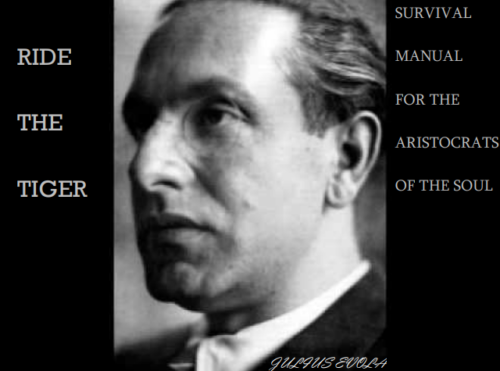
VJMP Reads: Julius Evola’s Ride the Tiger IV

This reading continues on from here.

The tenth essay in Ride The Tiger is called ‘Invulnerability – Apollo and Dionysus’. Here Evola further describes his conception of an aristocrat of the soul as someone who feels very deeply and who is very moved by things. The modern man (the man of clay, essentially), only feels very shallow emotions, and quickly moves from one such shallow impression to the next.

In this essay, Evola touches on the truly aristocratic topic of deliberately exposing oneself to great trials and tribulations, for the sake of learning one’s true nature. Alchemists will recognise this mentality as the one necessary to burn away everything but the gold so as to learn to distinguish Spirit from Nature. The purifying fire is that which burns away body and mind and leaves one with one’s true nature – it is necessary because it burns away everything shallow, leaving only actions which arise from the depths.

A person who has done this may find themselves gifted with a “transcendent confidence” that is characteristic of the aristocrat of the soul. This is important because in purifying oneself down to the gold one also strips away all of the conditioned belief in life’s meaning. To proceed past this stage, the alchemist must find within themselves the will to assert a meaning to life independent of any outside source. Then one is invulnerable.

To open oneself without falling apart is not easy in an age of dissolution. Here Evola takes care to point out that it’s very easy to fall at the second hurdle. Just because mainstream religion is bullshit doesn’t mean that we should abandon it for wild paganism and barbarianism. There is more.

The eleventh essay is called ‘Acting Without Desire – The Causal Law’. Once a person discovers their true nature, they should also learn the ability to act without desire. This entails taking the correct action at any given time instead of becoming distracted by profit or loss, or by what other people might think of you. Doing what needs to be done.

This needs to be qualified, however. There are naturalistic desires, that arise from the biology of the human animal. These are generally to be avoided. There are also, however, heroic desires, that arise from something greater than the merely physical, from something transcendent. These may be acted upon.

An aristocratic person, then, thinks not in terms of sin but in terms of error. The concept of sin is impossible because God has long been repudiated; all that remains is adherence to standards that one sets from within as an expression of one’s true nature.

One ought to act with a mind to what is effectively a law of karma, in that actions have consequences, regardless of whether those actions conform to any conception of good or evil. Those consequences are real and should be regarded as such. This is fine because the real man of gold doesn’t just live, but rather manifests himself and his true nature in the world.

This is the end of the second part of the book. The next part is called ‘The Dead End of Existentialism’, and the first essay here is the book’s twelfth: ‘Being and Inauthentic Existence’. This deals with the two types of existentialism (as Evola sees it): the philosophical, academic tradition and the practical tradition exemplified by Jean-Paul Sartre.

Evola dismisses existentialism almost entirely, for the reason that the existentialist philosophers are too much a product of their times, and because they are not themselves interested in the world beyond. The existentialists are very materialistic and this disqualifies existentialism from being a philosophy that an aristocrat might be concerned with.

Despite this, existentialism can be credited with some things. For one, the idea that “existence precedes essence” serves to keep the existentialist in touch with the metaphysical and transcendent. It also helps to highlight the dual nature of the aristocratic soul, which, as described earlier, is much deeper than that of the pleb.

*

If you enjoyed reading this essay, you can get a compilation of the Best VJMP Essays and Articles of 2017 from Amazon for Kindle or Amazon for CreateSpace (for international readers), or TradeMe (for Kiwis).