

Who Owns The New Zealand Media?

In more sophisticated countries, informed citizens go to considerable lengths to detect any biases among the people reporting the news. This is necessary to make sure that one develops a balanced, nuanced and independent opinion. Kiwis don’t generally bother with such things, preferring instead to believe everything we’re told like the good little lambs we are – except for this article.

It’s often remarked upon, by foreign visitors, that New Zealanders blindly believe everything they hear in the news. Conditioned into obedience by a brutal state education system that encourages bullying, social and emotional abuse, Kiwis are too afraid to question anything even vaguely resembling an authority, such as a television.

Given that we don’t question what the media is trying to tell us, it’s worthwhile figuring out who owns our media, because these same people effectively own our beliefs and opinions. In other words, let’s find out who own our minds.

We can find a ranked list of the major players in New Zealand cyberspace from Alexa. The two major internet portals in New Zealand are the New Zealand Herald and Stuff. You could confidently argue that the New Zealand online mediascape was an effective duopoly, with NZH and Stuff the only real players.

New Zealand Media and Entertainment (NZME) controls the New Zealand Herald brand, ranked by Alexa as the 9th biggest website in New Zealand. NZME is a large media conglomerate (by NZ standards, anyway), as can be seen from the list of newspapers they own at the bottom of their company page.

Finding out who owns NZME is not straightforward, because they are a publicly traded company on both the New Zealand and Australian stock exchanges. Helpfully, their own investor relations page lists their top 20 shareholders, but this doesn’t lead very far. All of the major shareholders are banks or holding companies for banks.

Number one on the list is Citicorp Nominees Pty Ltd, which is based in Sydney. According to Bloomberg, this company is a subsidiary of Citicorp Pty Ltd, which has been incorporated since 1954 and “provides a range of banking and financial products and services to retail, small business, corporate, and institutional clients primarily in Australia.”

One would think that this would surely be the end of the trail, but no. Citicorp Pty Ltd is itself a subsidiary, this time of Citigroup Holding (Singapore) Private Limited. This too, is a subsidiary: of Citigroup Asia Pacific Holding LLC, itself a subsidiary of Citi International Investments Bahamas Limited, itself a subsidiary of Citi Overseas Holdings Bahamas Limited, a child entity of Citigroup Inc.

Citigroup is a gigantic American bank, one large enough to be considered “too big to fail”, with its origins in the City Bank of New York, chartered in 1812. The closest Citigroup has to an owner, at 7.06% of the shareholding, is Vanguard Inc., “One of the world’s largest investment management companies” (as per their company page). In second place, at 4.76% of the shareholding, is State Street Corporation, another investment management bank. Third, with 4.51%, is BlackRock Inc., yet another global investment management corporation.

So that line of investigation doesn’t lead to any specific names, but neither is it any easier trying to figure out who is behind any of the other of New Zealand Media and Entertainment’s major shareholders.

J P Morgan Nominees Australia Ltd is at third place on the NZME shareholder’s list, with 12.69%. Finding out out who owns JP Morgan Nominees Australia Ltd is no easy task, as the article linked here demonstrates. One passage from the linked article reads “Unfortunately, it is practically impossible to track down the identities of those underlying shareholders through the various financial structures that hold shares for each other and on behalf of each other.”

If it’s practically impossible to find out who owns NZME, what about finding out who owns Stuff, the 3rd largest website in New Zealand?

Investigating this is just a shorter path to the same place. The Stuff brand is owned by Fairfax New Zealand Limited, a subsidiary of Fairfax Media Ltd., which is also publicly traded on the ASX. As it turns out, the second-largest shareholder of Fairfax Media Ltd. is none other than Vanguard Inc.

They only own 2.26% of the shares, however, so can only give us a clue as to the ownership of Fairfax Media Ltd. Looking down the list of funds and institutions that own shares in Fairfax, there’s little more than a pile of asset management companies, wealth funds and banks. As with Vanguard, BlackRock also appears on the list of major owners of both Citigroup and Fairfax Media Ltd.

The story with television media is little different to the story just described with print and online media. The New Zealand television market is, like the print and online media markets, an effective duopoly between Television New Zealand (TVNZ) and MediaWorks New Zealand.

TVNZ is Government-owned, but is almost entirely funded by commercials and is therefore little different to any other commercial broadcaster. MediaWorks New Zealand, for its part, is entirely owned by Oaktree Capital Management, which is (you guessed it) another global investment and wealth management fund.

In summary, no-one has any fucking idea who owns the New Zealand media, apart from the small niche carved out by TVNZ and the independents. Trying to pin it down to any one person is like trying to catch shadows in a jar. The best one can say is that the New Zealand media is ultimately controlled by global wealth management funds and corporations and their nominated representatives.

Being owned by such institutions tells us that the New Zealand media is run for profit and probably has little agenda other than commercial. In other words, there is little in the way of direct political propaganda or slanted editorial content, but one can expect the quality of the journalism to degrade to that which appeals to the lowest common denominator in society. Indeed, it has.

The astute reader will have drawn a connection between all of this bank ownership and the never-ending series of “I became a homeowner at age 21”-style stories. The reason for this is the banks benefit directly from a shallow, consumerist, disposable culture in which it’s considered normal for people move away from their parents and get a massive mortgage so that they can pay hundreds of thousands of dollars of interest to a gigantic, parasitic investment corporation.

In other words, the owners of the New Zealand media directly make money from consumerist culture, in particular from people taking out loans to buy shit that they don’t need. This is why all manner of wasteful, extravagant and unnecessary consumer purchases are advertised, and normalised, by the New Zealand media.

*

If you enjoyed reading this essay, you can get a compilation of the Best VJMP Essays and Articles of 2017 from Amazon for Kindle or Amazon for CreateSpace (for international readers), or TradeMe (for Kiwis).
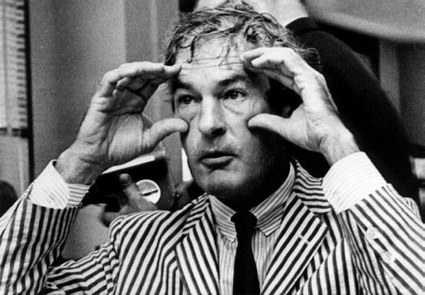

Jordan B Peterson is the Timothy Leary of Our Generation

Helping the next generation to see beyond – or corrupting the youth?

Jordan B Peterson has struck a dull and ossified mediascape like a meteor. Where there used to be only talking heads reading from teleprompters and a variety of family-rated corporate whores, the Canadian professor has burst onto the scene spraying the truth like machinegun rounds. Being so used to lies as we are, this has astonished us, and as of right now Peterson is the man of the moment. The reaction he has generated is an echo of another psychologist who clashed with the Establishment of his time – Timothy Leary.

Once described by U.S. President Richard Nixon as “the most dangerous man in America,” Leary was a pioneer of psychedelic therapy. Also like Peterson, Leary was once a psychology lecturer at Harvard University. Leary devoted his life to understanding the human mind and behaviour and communicating this knowledge to other people, and in doing so helped set them free.

And in setting people free, he became the enemy of the Establishment.

Peterson and Leary are hated by the Establishment because they deprogrammed the young people of their time from the brainwashing that the elites had forced onto them. In Leary’s time, during the early 60s, the young had been brainwashed to be right-wing: they had been programmed to be judgmental, harsh, even hateful. Leary’s task was to teach them to love, and he found that psychedelics were useful for accelerating this deconditioning process.

The only difference with Peterson in this regard is that the young people being deprogrammed by Peterson have been brainwashed with left-wing logic. Instead of being programmed to be discriminating and hard, they have been programmed to be unquestioning, passive, yielding and soft. In other words, where Leary was confronted with a youth that was too masculine as a response to World War II, Peterson has been confronted with a youth that is too feminine as a response to the great decades of peace.

Timothy Leary showed in the Concord Prison Experiment that violent felons could be induced to repudiate their criminal ways if given a guided psychedelic therapy session under the supervision of a qualified therapist. Recidivist criminals learned some empathy for the victims of their aggression and swore off it. In other words, he showed that an excess of masculinity can be countered by the restorative effects of psychedelics.

Those restorative effects can also counter an excess of feminity. They can help a Western world that has lost itself in materialist sensations. We are so obsessed with our own bodies and with sensory pleasures that we have lost touch with the spiritual and with the transcendental. Peterson correctly understands that psychedelics can help here but he is also canny enough not to fall into the Leary trap of propounding something that the populace isn’t mentally ready to handle.

Both men also had a message of “turn on, tune in, drop out”, only they are different. Leary’s message was to drop out of society entirely. His belief was that people who turn on to their true nature will realise that it isn’t served by the way society is structured, and that if they completely rejected it they could form a new society that suffered from none of those problems. A new society could be built by a switched-on movement of hippies, and it would prevail.

Peterson has a similar message, only without the anarchism. For both Peterson and Leary, turning on and tuning in involved learning to know one’s own mind, one’s one thoughts and consciousness. Where Peterson is different is that his emphasis is on restoring order within oneself before attempting to impose order upon the external world. His catchphrase is “Clean your room before you worry about fixing the world,” echoing Gandhi’s “Be the change you want to see.”

Where both men are exactly the same is in that they teach people to look within for answers, instead of without. Teaching young people to rely on their own judgment and their own experiences instead of taking direction from aggressively self-imposed moral authorities absolutely terrifies the Establishment – because the Establishment consists of nothing more but self-imposed moral authorities.

The Government, the Church and the media all gain their power from the attention that they are given by those who look to them for guidance. Power flows where attention goes. When Peterson exhorts young people to impose order upon their own inner lives so that they can more easily impose order upon the outer world, these Establishment elites correctly see this as a massive risk to their own influence and control – and that’s why the Establishment and its lackeys are attacking him more and more.

The true counterculture is neither left-wing nor right-wing, but simply a reaction to the excesses of the previous culture. In the same way that Leary was the voice of the left-wing counterculture of the 60s that opposed right-wing thought control, Peterson is the voice of the right-wing counterculture of this decade that opposes left-wing thought control. In this way, he is another iteration of the philosopher-king archetype who gets attacked by the liars in the Establishment – a pattern going back at least to Socrates.

*

If you enjoyed reading this essay, you can get a compilation of the Best VJMP Essays and Articles of 2017 from Amazon for Kindle or Amazon for CreateSpace (for international readers), or TradeMe (for Kiwis).

Writing Phobias

Most people are familiar with the idea of phobias – the term refers to intense and persistent fears of things, to the point that a person with a phobia will take extraordinary measures to avoid triggering it. Although most people have mild, subclinical phobias of some things and manage okay, for others a phobia can cause immense disruption to everyday life. This article looks at how to believably write characters who suffer from phobias.

The degree of fear caused by a phobia is enough to cause chaos in a person’s life. Instead of merely feeling alarm, a person presented with the object of their fear (or even the threat of it), will often break out in sweats, heart palpitations, dizziness and shaking. They will go to great lengths to avoid being exposed to the triggering stimulus, even if doing so has a heavy impact on their day-to-day social functioning.

Generally speaking, there are three major kinds of phobia.

The first kind of phobia is called a specific phobia – it’s a phobia of something specific, such as spiders, heights or dogs. This sort of phobia is usually a reaction to situations that occurred frequently in the biological past. For this reason, there’s nothing really unnatural about them – it’s just that the fear has been exaggerated to a point where it causes more harm through disrupting a person’s life than it helps avoid harm from danger.

Many phobias begin with an incident in which the object of the phobia caused intense fear in a person. For instance, a person walking through a field and being stopped in their path by an angry dog might develop a phobia of dogs. A phobia of spiders might develop from a childhood in an unclean house that was full of spiderwebs.

Readers who have never experienced living with a phobia could well be interested in reading about the sort of thoughts that go through the head of a character with one, or how they behave (or feel themselves forced to behave) on account of having the phobia. Few who have never had a phobia can imagine how intrusive the fear can be, and how greatly it can impact the ability of a person to live a normal life.

Social phobia is different to a specific phobia in the sense that the phobia reflects a general fear that follows the person with it. Social phobia relates to an intense fear of being judged. In particular, it tends to revolve around a fear of being humiliated in public by means of some judgment being levelled. People with it tend to feel very uncomfortable around authority figures, and would never raise their hand in class to answer a question from the professor.

Most people have a degree of self-consciousness that modifies their actions, but for a person with social phobia this will be exaggerated well beyond mere shyness. For instance, someone with social phobia may be unable to get a driver’s licence on account of being unwilling to sit with the traffic control officer and risk being judged as unfit to drive a motor vehicle.

A character with social phobia might be more interesting if their phobia was ultimately grounded in narcissism. It might be that they were only afraid of being judged on account of having an enormous ego that could not handle even the faintest criticism. This might lead them to becoming vicious in defence of that ego, or to adopting an exaggerated ‘cool’ affectation intended to mask their extreme fragility in the face of judgment.

The third major kind of phobia is agoraphobia. This relates particularly to a fear of finding oneself in an environment that offers no easy means for escape. These environments are common ones such as trains, elevators or open spaces, which naturally leads to a significant impact on ordinary life function. Being caught in such a space with no easy avenue of escape can easily cause a panic attack in an agoraphobic.

Much like social phobia, a character that has agoraphobia might live a particularly lonely and unhappy life. Having agoraphobia makes it much harder for a person to get out of their house, because their house becomes a kind of safe zone from the horrors of society. Stressful and traumatic events can trigger agoraphobia, and central to it is the fear of loss of control. Going outside comes to feel like stepping into the maelstrom.

Generally speaking, it’s easy to include a character with a phobia in your story because almost all of your readers will understand fear, and so they will be able to relate to that character. Having a character with a phobia might be an easy way to create a strong sense of fear and dread in your reader, especially if the phobia is a common one.

Phobias are not generally believed to arise as a result of a moral failing or of any personal weakness. It will therefore be easy to write a character with a phobia who comes across sympathetically to the reader. Portraying a character who struggles valiantly to live a normal life despite a crippling phobia might read as heroic, but if emphasis is put in the wrong places the character might come across as a milksop.

*

This article is an excerpt from Writing With The DSM (Writing With Psychology Book 5), edited by Vince McLeod and due for release by VJM Publishing in the summer of 2018/19.